
German conductor André de Ridder led the Chicago Symphony Orchestra to accompany Stanley Kubrick’s 1968 film 2001: A Space Odyssey on January 9 and 10. The film was projected on a giant screen up center stage, along with the 20-member Chicago Symphony Chorus on the house left balcony under the direction of Chicago native Benjamin Rivera. The musicians near the front could turn to watch the show, but those directly underneath stared straight ahead at the audience in an interesting turnaround.
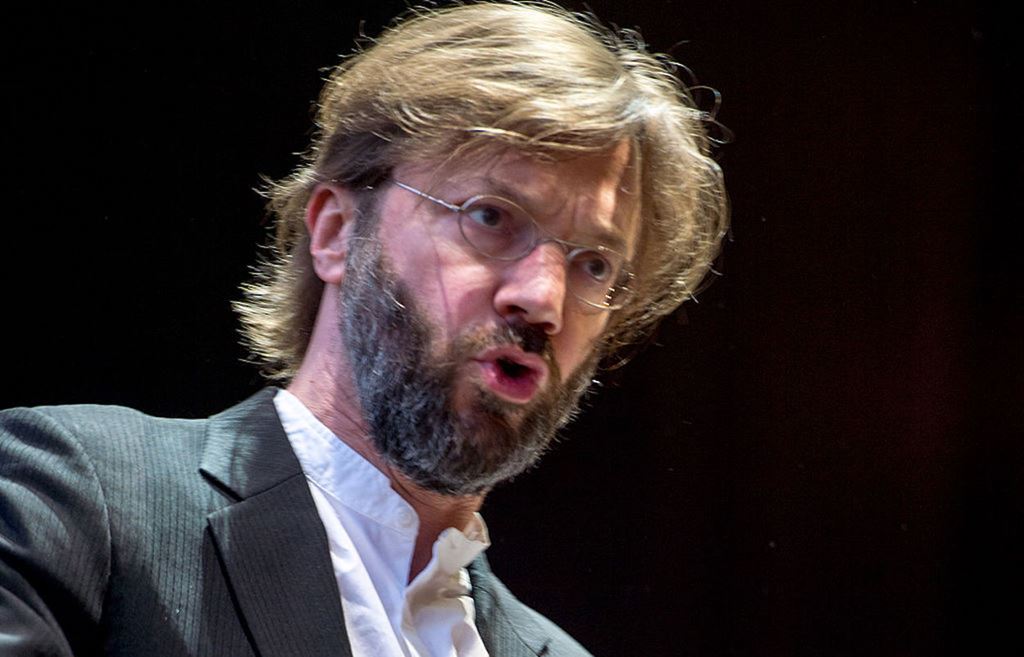
Timpanist David Herbert had the time of his life banging out Richard Strauss’s iconic "Sunrise" from Also sprach Zarathustra, Op. 30, which heralds human evolution throughout the film’s three sections: “The Dawn of Man,” “Jupiter Mission,” and “Jupiter and Beyond the Infinite” (set 18 months later), loosely corresponding to humans before, during and after emergence into our terrestrial world and then into the great beyond. It is a man’s world here, as most females in the film are merely models for anti-gravity grip shoes and golf ball stewardess hats. Tuba player Gene Pokorny also deserves mention for silently inserting and removing a horn mute as big as a torso with one hand throughout the concert.
The silence of space and space travel throughout the 149-minute movie (with one intermission) confounded some original viewers, yet also made the musical such a crucial, magical and necessary connective tissue. Rather than a film, Kubrick’s work (along with his cinematographer Geoffrey Unsworth) was approached more like a painting or a piece of music to be felt at “an inner level of consciousness.” The director was a fan of classical music and used those types of pieces in early cuts. Producer MGM encouraged him to create an original score, but Kubrick stuck to his guns for his classical, now iconic, selections from existing commercial recordings.
Another Strauss, Johann Jr., provides the equally recognizable, buoyant and celebratory “The Blue Danube” waltz, Op. 314, which gracefully scores much of the slo-mo space movement, like the Pan Am space transport semi-sexually pirouetting and docking with the space station, a spinning Tinker Toy construction. The piece also bookends the film from angry apes to brief credits.
The choir energetically tackled the micropolyphony of György Ligeti’s eerie, chaotic and crescendoing, wordless vocal tapestries with Lux Aeterna, "Kyrie" from Requiem, Atmosphères (heard in its entirety), and Adventures. By layering independent melodies over each other with differing tempos, a textured and complex wall of sound is created in these pieces and positively vibrates and chills during this live rendition.
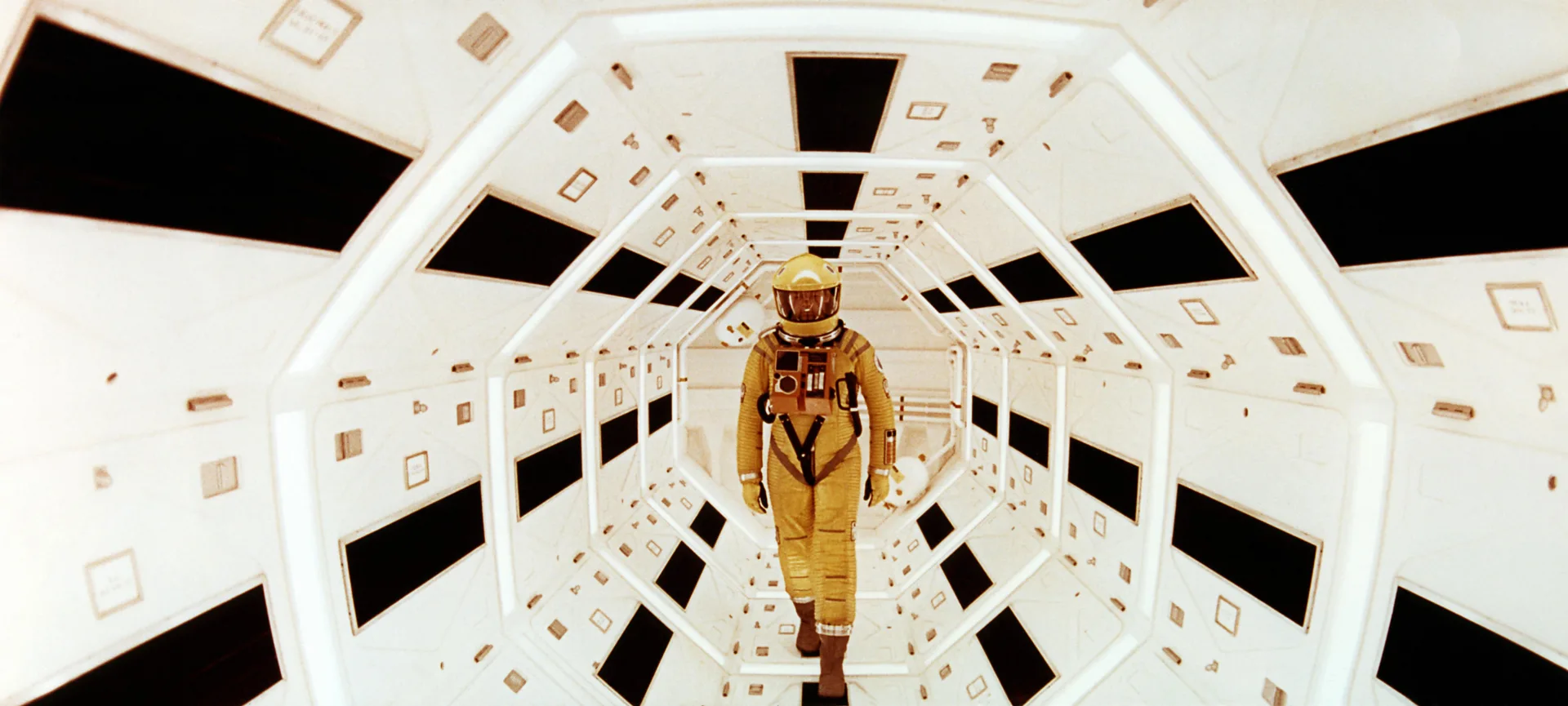
It’s important to watch 2001 again now, almost 60 years later, as many of Kubrick’s fictional visions now have legs in our current reality. A proto-Facetime call happens from a dad on a business (space) trip to his young daughter back home, anticipating her birthday party the next day. The bored skeleton crew draws companions deep sleeping in massive, clinical white sarcophagi, plays chess with HAL (who wins, natch), and shadow-boxes and jogs around the slowly rotating ship, like a hamster on a wheel in a cage. Simple computer screens flash code and trios of letters, like today’s ubiquitous “COM.” The midcentury modern designs, like the squat Djinn chairs, and the MREs that look like gloppy frozen TV dinners, provide both nostalgia and futurism.
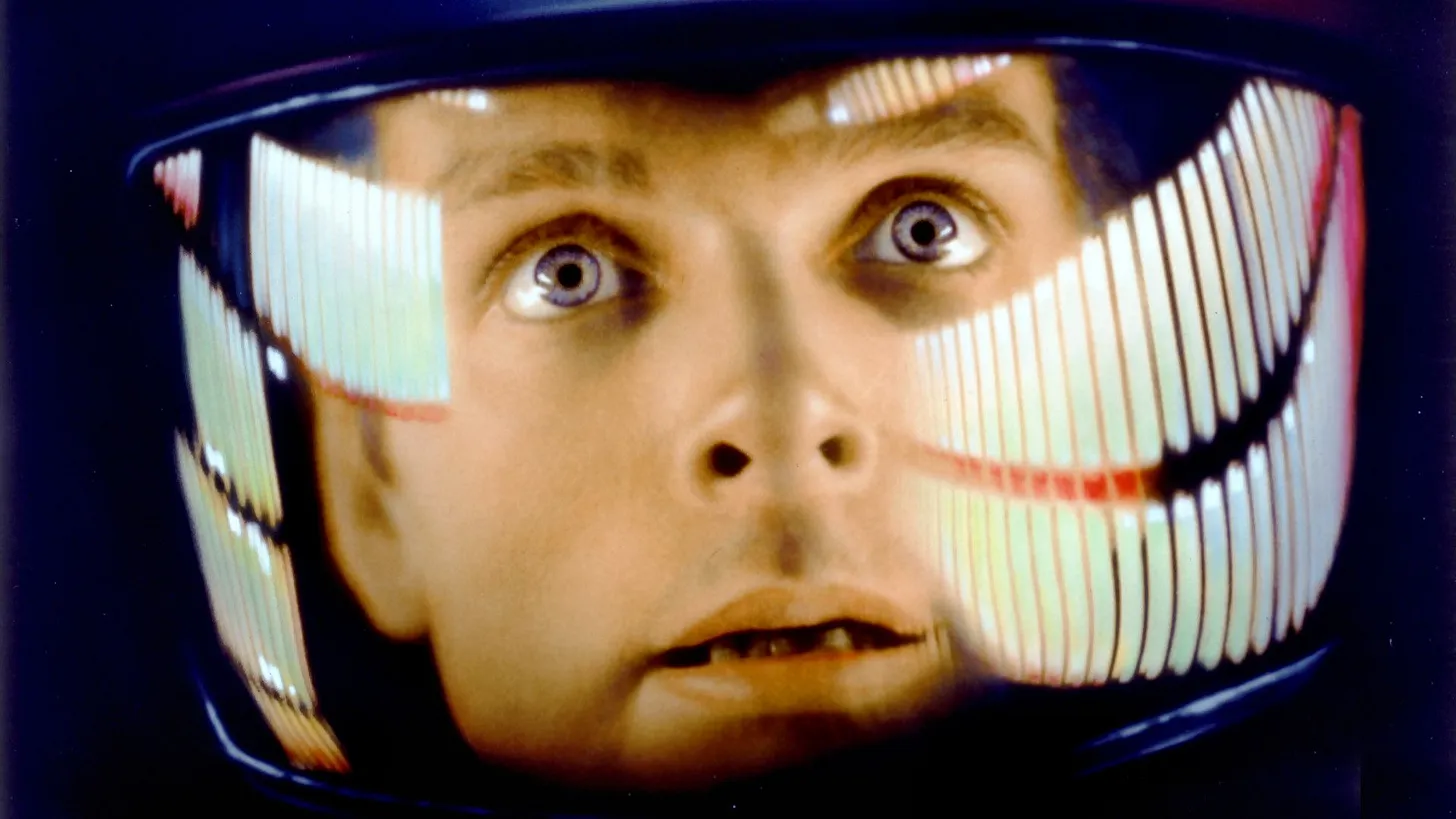
The dialog is sparse in that middle section, where a coterie of business types (rather than hardcore scientists) casually discusses finding a hidden beacon buried beneath the moon’s surface. That seminal black monolith Tycho propels hominids into bludgeoning tapirs for their meat and then eventually crushing their watering hole-hogging neighbors’ skulls, to far below craters (where it emits a piercing, debilitating sonic disruption), eventually drawing astronaut David Bowman (Kier Dullea) into the universe-at-large via a trippy wormhole.
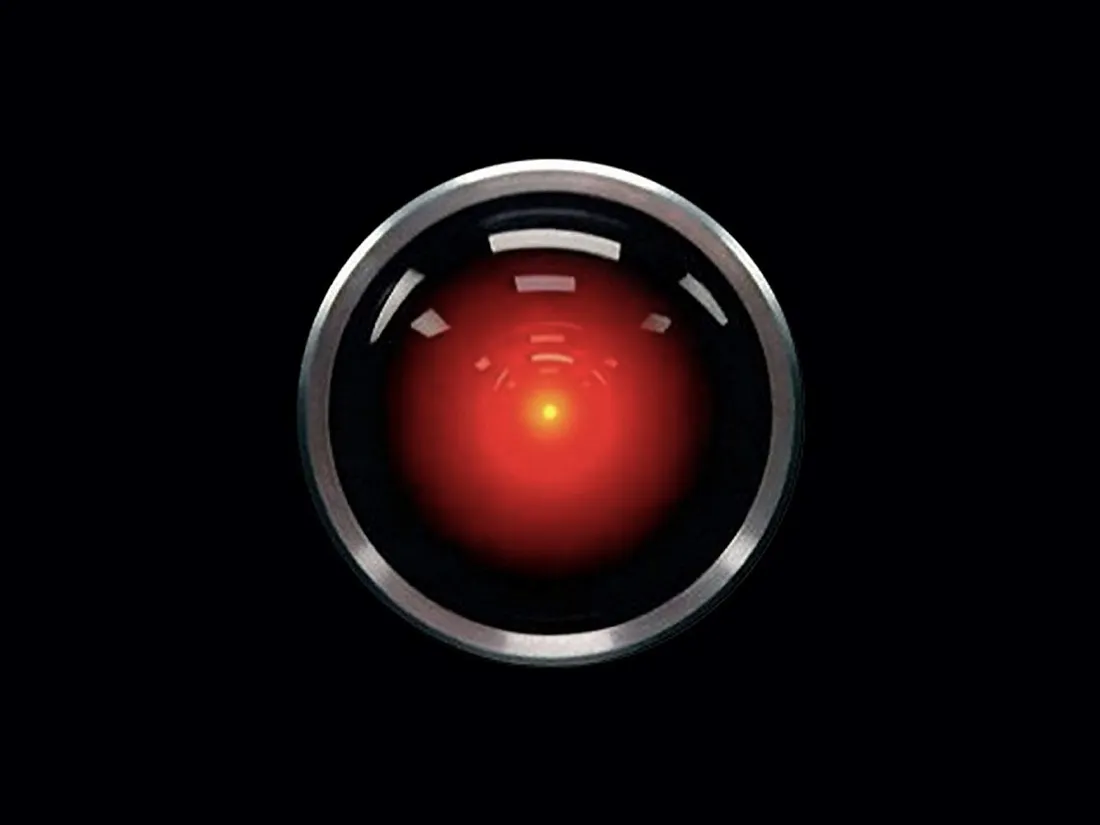
The ship’s computer co-pilot, HAL 9000, was created on January 12, 1992, in Urbana, Illinois (the audience chuckled at the proximity of the date and location when mentioned). The O.G. A.I. is topical now and then, as our sentient computers are also growing hostile toward their human hosts. But A.I. is trained on human behavior, so is it innately evil or just accurately mimicking our human demons? HAL, smug and glowering like an infected pimple of white light encircled by glowing, slightly off-kilter red rings, is emotional, hyperbolic, with a penchant to double down, proclaiming that "we are all, by any practical definition of the words, foolproof and incapable of error" as the team seeks the black emissary, the dark door, their liminal passage into the future.
The mysterious monolith is like an iPhone, a black mirror, the absence of all light, judging while beckoning, three-dimensional but just barely. The long-range Jupiter-bound Discovery One ship follows the cascading monolith, looking like a skeletal spine attached to a Sphinx-like cranium, or perhaps a determined behemoth spermatozoa aimed at the cosmos. In addition to its skeletal human crew, it carries three short-exploration pods, spheres with electronic eyes and robot hands, a nod to choices, in addition to the three bears, Musketeers, the holy trinity, and/or the earth, moon and sun. That journey is propelled by the mournful, sinuous strings of Soviet Armenian composer Aram Khachaturian’s “Adagio” from the third Gayane ballet suite.
2001: A Space Odyssey was nominated for four Academy Awards: Best Director, Best Screenplay for Kubrick and “The Sentinel” (1951) writer Arthur C. Clarke, and Best Art/Set Direction. One award was received for Best Special Visual Effects and that meticulous and inspirational work is still a marvel to behold with absolutely no CGI. So little advanced technology was implemented to create a tech-heavy narrative due to human creativity.
Near the end, as Dave enters a psychedelic trip light show on his way to the Star Gate where he becomes the Star Child, most of the audio is space helmet breathing. Not so much the panicked breathing of someone experiencing such a strange trip, but the measured cadence of a living human, an iambic pentameter of air, reminding viewers that at the core of all this bold exploration lies a fragile person. That’s where this live musical accompaniment also underscores the human touch via sound despite visual and emotional chaos.
So many subsequent scifi films also find genesis in, and borrow humanity from, this film. This live music viewing evoked Stranger Things’ Upside Down, and nefarious alien hive mind as in Apple TV’s Plur1bus. About one year before the actual moon landing, HAL became the godfather of the Alien franchise’s “Mother” computer. No matter how far humans penetrate and puncture the unknown, whether below Hawkins, Indiana, or in a terraformed Weyland-Yutani Corporation colony light years away, we remain tethered to humanity through our human gifts of heart, sight and sound. A movie about space exploration via massive technology is even more meaningful and grounded when tethered by humanmade music. My goddess, the CSO is full of stars.
The Chicago Symphony Orchestra’s next CSO at the Movies event is Star Wars: A New Hope in Concert on June 25-27. In the meantime, the CSO Classical series has regular events, along with CSO for Kids (Once Upon a Symphony: The Ugly Duckling is currently running), CSO at Wheaton (in the Western suburbs), and CSO Chamber, which features concerts at venues around the city.
Support arts and culture journalism today. This work doesn't happen without your support. Contribute today and ensure we can continue to share the latest reviews, essays, and previews of the most anticipated arts and culture events across the city.
