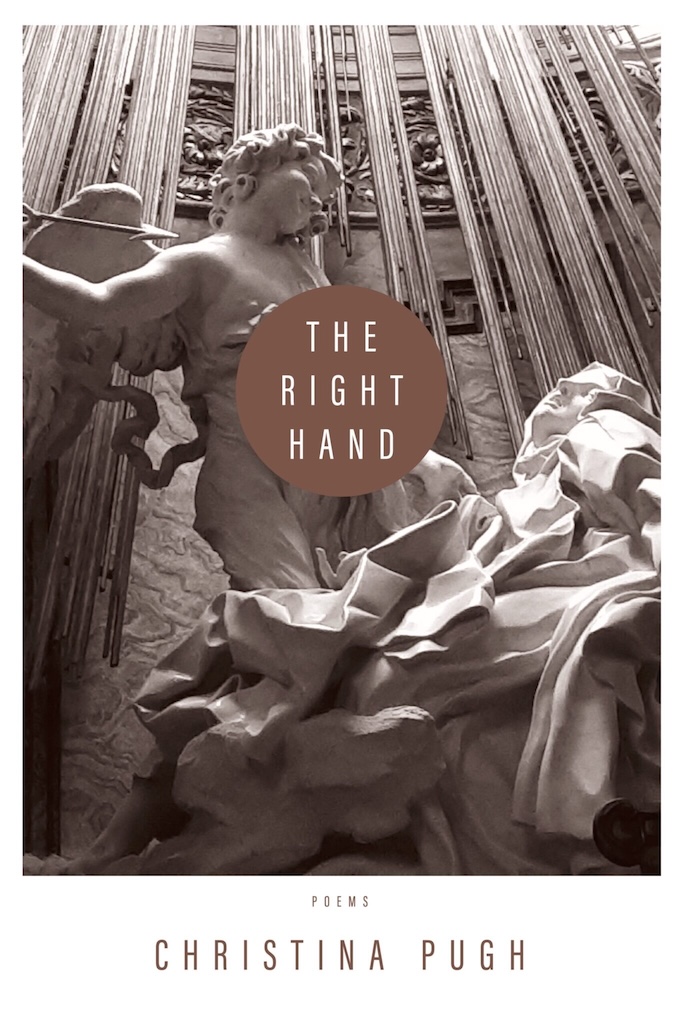
The Right Hand, the latest poetry collection by Christina Pugh, possesses abstraction dancing with tradition, faith with the mystical, form that examines line and white space with the material body. Bravery exists within these pages sensing an indefinable quality amid an intense clarity in discussing pain within the body. The collection possesses deep truths with an oracle-like energy commingled with mystical meditations. The cover of the book echoes these truths and sentiments as the Bernini sculpture Ecstasy of St. Teresa leads the reader inward. The ecstasy and the Christian mysticism St. Teresa of Avila wrote about in multiple autobiographies is present (even omnipresent) within the two poems that make up this collection.
The first poem, “Into the Skin,” examines this mysticism while moving toward a thoughtful search of the body. The white space in the poem points to the psychical energy of St. Teresa within an ecstasy in the Bernini work. As a sculptor frees the sculpture from a block of marble, Pugh frees words from the page. An angel hovers over the swooning body of St. Teresa, the story told in the kinetic elements of faces, hands, postures, and the fabrics that dance with the figures point to the ecstasy Bernini conveys. Partway into the poem, Teresa’s ecstasy and Bernini’s deftness in expressing that ecstasy are meditated upon by the speaker:
Anything sexual: it’s why we close our eyes
We’re always closing our eyes against beauty
This is what you find in a Bernini sculpture
Filling your vision as you circle around it
The ankle will swirl and the hair serpentine
I’m trying to recover a pathway to the body
My eye is filling for the love of doubling back
Everything escapes into a tree, unto metaphor
Consent is a power.
To yield is a power.
I might even say: to yearn is a power (pp. 22–23).
The line breaks guide us through the speaker’s musings as Bernini’s oneness with the marble guides us through the narrative before us. Throughout “Into the Skin,” the use of punctuation is minimal and when it is employed, it asks the reader to pause, sending the reader into the meditation regarding the body, the mind, and the mystical soul.

As the poem begins to saunter toward its end and the narrative continues to be freed from the page and white space, parentheses, and italics assist that reveal. This part of the poem continues with a heightened self-awareness by the speaker as they address the reader, asking us to “(think of ink written on the skin before surgery” as the speaker zeroes in on their moment with skin and ink—much like the poem’s self-awareness of the page / skin and of the words / ink as the speaker notices their surgical ink as blue lightning above the hip, “its blueprint” (pp. 36–37).
The second and final poem in the collection, “L’Incontro: The Meeting” has epigraphs to ground us before the poem begins. One is from St. Teresa of Avila’s Life of Teresa and one from art historian Howard Hibbard’s book, Bernini. Both epigraphs signal more meditation on the material body as well as the spiritual. This poem moves outward with observations of the surroundings, the ecstasies happening to those around the speaker. The poem begins with the observation of the speaker and those in the church with them “we all landed / at Teresa and the angel” even though the “church had other beauties” (46) again signaling a bit of a shift in awareness in the poem, a moving outward while still being acutely aware of the inward.
The use of white space Pugh employs continues in this poem ending without punctuation:
But it was an incontro in Bernini’s Italian
a woman’s skin to be pierced by an angel
a saint exhaling between two cuts in marble
and coupling far into the twenty-first century (49)
The poem continues an ekphrastic path with the sculpture, but even with the onlookers, those who surround the speakers who view the Bernini. “On a cloudy day in Santa Maria / people wander in pairs or one by one / the gentled ripple of light a relief / slight smiles a dreamier air within the scene” (58) speaks to this sort of outward ekphrasis at work inside and outside the speaker.
As the poem moves to close the collection, the speaker muses on their last moments with St. Teresa and although it is said a bit earlier in the poem that “yearning is an ancient thing” (80), the yearning is also present in that moment oriented in the 21st century. “On what I knew would be my last day with Teresa / someone had left a panda pillow just outside / the church door No one was sitting there / The person had departed” (91) orients us within a very current moment for the speaker and their yearning, their realization of an ending. “I know there is no new knowledge or sensation / But everything escapes into a tree unto metaphor / Stamped unto my eye / their two-leafed body / alive now living far from me // a petal then two within / an iris opening / its ruffled courier / lifting slightly the light / so far from me” (92-93) is how this poem ends, how the collection ends.
This collection is a full awareness of meditation and yearning. The Right Hand adds the hand of a Bernini depicting a saint in the throes of a mystical awakening. Pugh’s enrapture is clear in these poems and in reading this collection the reader is invited into that joy and the delights within that joy even if getting there may involve some musing on bodily pain and yearning.
The Right Hand is available at bookstores and through the Tupelo Press website.
If you enjoyed this post, please consider supporting Third Coast Review’s arts and culture coverage by making a donation. Choose the amount that works best for you, and know how much we appreciate your support!
