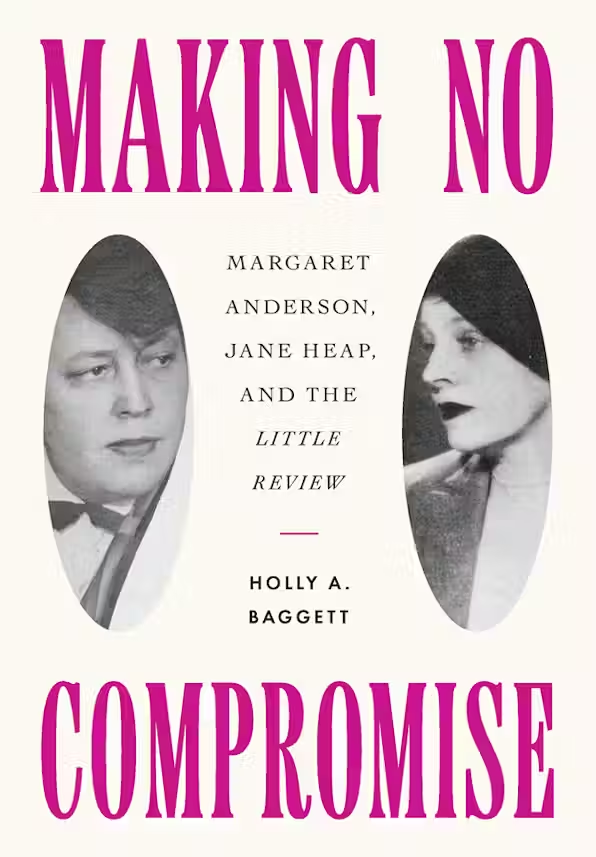

Early in Making No Compromise, Holly A. Baggett asks how it was that two young Midwestern women from the late 19th-century American Midwest—uncloseted lesbians and lovers, at that—became the international arbiters of 20th-century modernism. And then she tells their story.
It’s a fascinating tale centered on the Little Review, the avant-garde literary magazine edited by Margaret Anderson and Jane Heap, initially from an office in Chicago’s Fine Arts Building at 410 South Michigan Avenue. From 1914 to 1929, the journal offered readers cutting-edge poetry, essays and other literary work as well as experimental art.
Nineteenth-century-born midwestern mavericks, grew up to be iconoclastic rebels, flaunting their lesbianism, advocating causes ranging from anarchy and antiwar activism to feminism and free love, their lives and work shattered cultural, social, and sexual norms...They managed to transform themselves and their little journal into a major force for shifting—and not always welcome—perspectives on modern literature and art.
Baggett’s book is published by Northern Illinois University Press, an imprint of Cornell University Press. As its subtitle—Margaret Anderson, Jane Heap, and the ‘Little Review’—suggests, the book is a triple biography, telling the life stories of each of the editors as well as the magazine. Yet, these tales are also deeply intertwined.
Publishing Ulysses
During its 16 years, the Little Review published a panoply of major American writers, including Amy Lowell, Ford Madox Ford, H.D. (Hilda Doolittle), Hart Crane, Sherwood Anderson, William Carlos Williams, Vachel Lindsay, Edgar Lee Masters, Marianne Moore, Ben Hecht and Ernest Hemingway.
However, after they moved to New York, Anderson and Heap’s magazine became an important international publication in 1917 when they named Ezra Pound as the magazine’s foreign editor. During his two years in that role, Pound sent his own work to the magazine as well as the writings of T.S. Eliot, William Butler Yeats and James Joyce.
“Like Joyce,” Baggett writes, “Anderson and Heap were asking the most basic questions—the nature of the universe, the meaning of life, the truth about human beings. Like Stephen Daedalus, they were intellectual dissenters on a sacred mission.”
In 1918, the Little Review began to serialize Joyce’s masterpiece Ulysses until 1920 when copies of the latest issue were seized by the Post Office and the two editors were charged with obscenity. At a trial, Anderson and Heap were found guilty and fined $100 (the equivalent of about $1,700 today). But they and their magazine had become famous—and infamous—worldwide literary figures.
“Like Joyce,” Baggett writes, “Anderson and Heap were asking the most basic questions—the nature of the universe, the meaning of life, the truth about human beings. Like Stephen Daedalus, they were intellectual dissenters on a sacred mission.”
Also, like Joyce, they enjoyed stirring the pot and getting controversy bubbling. As Heap wrote:
“We have printed more isms than any other ten journals and have never caught one. Our pages are open to isms, ists, ites…we have been after the work, not the name…our drooling critics, in true American fashion, became sea-sick over a name…we are enjoying ourselves.”
One of their critics—in private—was John Quinn, an early funder of the Little Review and the defense attorney for Anderson and Heap during their obscenity trial.
Quinn was apparently strongly attracted to Anderson when he met her long before the trial. In a letter to his friend Pound, he called her “a woman of taste and refinement and good looking,” and, in a later letter, he gushed that she was a “damn attractive young woman, one of the handsomest I have ever seen, very high-spirited, very courageous and very fine.”
That, however, was before it became clear in preparing for the trial that the two women were lesbians. Then, Quinn was no longer gushing, writing instead:
“I have no interest at all in defending people who are stupidly and brazenly and Sapphoistically and pederastically and urinally, and menstrually violate the law, and think they are courageous…THEY ARE BORES. They are too damn fresh. They stand for no principle. They are cheap self-advertisers. All pederasts want to go into court. Bringing libel suits is one of the stigmata of buggery. The bugger and the Lesbian constantly think in terms of suits and defenses.”
Quinn, remember, was the attorney for the two women. His antipathy toward them is an example of the enmity that, in the early 20th century, Anderson and Heap faced as women unashamed of their same-sex relationship.
“The Buzz and the Sting”
The two women were very different. Anderson, Baggett writes, was “a supremely lively young woman whose rebelliousness flouted convention,” while Heap was “a stellar conversationalist who was also a pessimistic, most likely clinically depressive artist.”
Anderson and Heap were “iconoclastic, sexually liberated, and flirting with madness as artistic expression.”
One embodied an optimistic flurry of activity; the other was an introvert whose scornful wit rarely missed its mark…While Heap tolerated Anderson’s flights of fancy, Anderson reveled in Heap’s brilliant repartee. The two of them were, in Heap’s words, “the Buzz and the Sting.”
Indeed, Anderson wrote that the two women were so radical in their way that, when they moved to New York, they didn’t fit in with the literati.
“We cleaned, scrubbed, dusted, cooked, washed dishes. We made our own fires, cleaned our hearths…did our own shopping—chose our own meats and vegetables—and as Jane had an intelligent old-fashioned prejudice against canned foods, hulled our own peas. We washed and ironed our own clothes. We cut our own hair—very well too.”
Keeping house as rebellion—just one of the many ways the two women and the Little Review overturned the status quo.
In summarizing the spirit of the Little Review—and of the women who edited it—Baggett writes that they were “iconoclastic, sexually liberated, and flirting with madness as artistic expression.”
And, as Heap wrote, they were enjoying themselves.
Making No Compromise is available at bookstores and through the Cornell University Press website.
Support arts and culture journalism today. This work doesn't happen without your support. Contribute today and ensure we can continue to share the latest reviews, essays, and previews of the most anticipated arts and culture events across the city.
