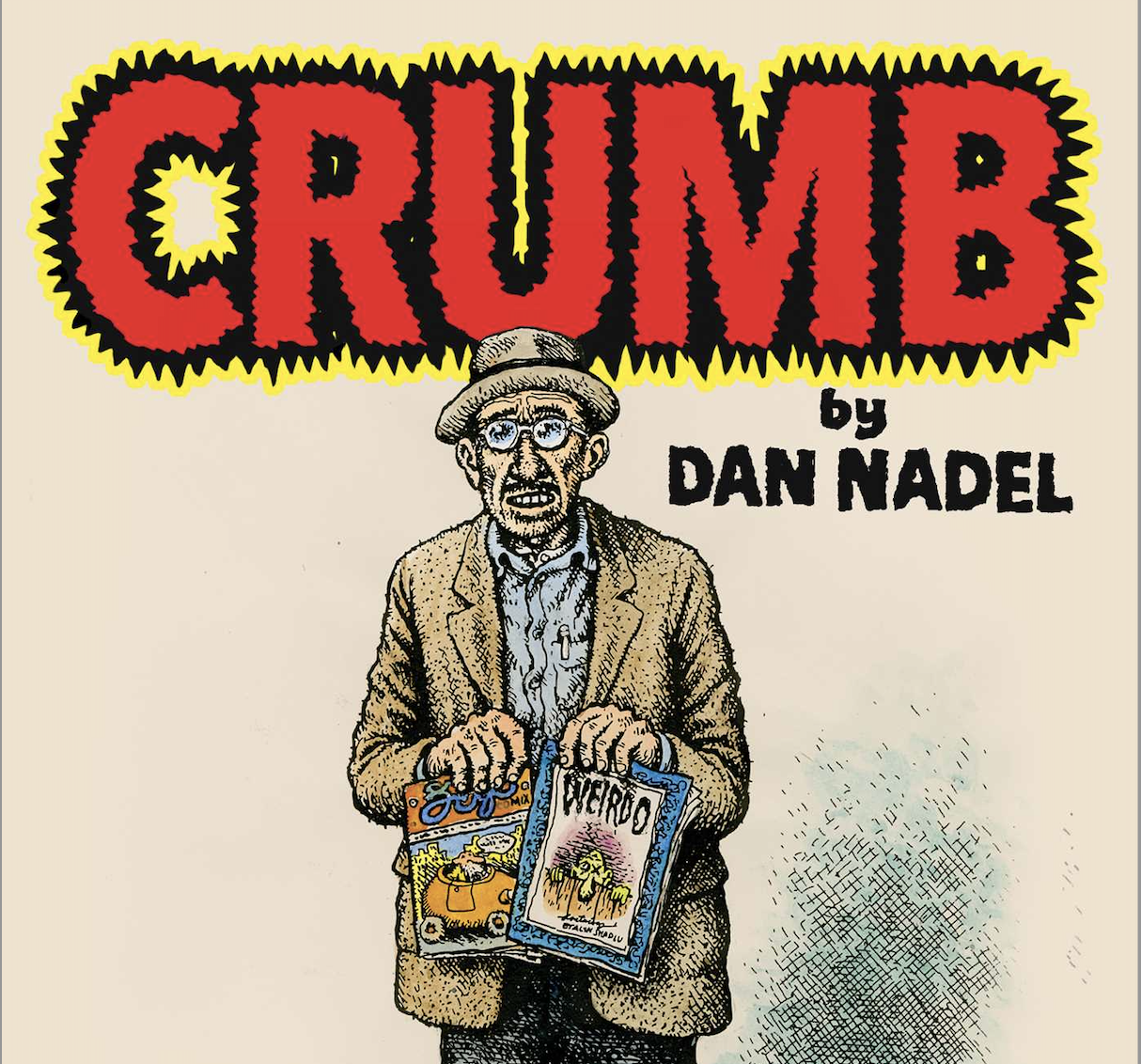
Cartoonist Robert Crumb is, inarguably, a master of his craft. For 60 years he’s created a distinctive style and memorable characters, while inspiring generations of artists. He’s also a polarizing figure, illustrating several controversial comics (to be genteel about it) as well as his sexual escapades and fantasies. Crumb’s life and family were well-plumbed in director Terry Zwigoff’s 1994 documentary Crumb, but thus far the artist lacked a full-length biographical and critical assessment. Now we have Dan Nadel’s Crumb: A Cartoonist’s Life offering anecdotes and insights aplenty on the man and his work. Unfortunately, while thorough, the book tends to adulate—a work of fan nonfiction, in a way.

In reviewing biographies, a critic risks assessing the subject’s life too. Crumb’s work—often autobiographical and opinionated—makes it difficult not to do so. Through his comics, he has addressed subjects as diverse as the Bible, early recorded music, obsession, the collector’s impulse, recreational drugs, the 1960s, mysticism, sexuality, and more. But Crumb’s foremost subject is Crumb. To read his work is to, presumably, get to know him. After 60 years one wonders what’s left to spelunk.
As it turns out, there is more. Crumb pulled back the curtain for Nadel, allowing access to his person and personal files. This, alongside several years of research, talks with family and friends, and interviews with Crumb himself helped Nadel produce a compact and fairly thorough record of an American artist. But Crumb: A Cartoonist’s Life leans toward the hagiographic. The constant reference to Robert rather than Crumb signals the book’s admiring and circumspect treatment of his subject—something Crumb rarely engages in with his own work.
Crumb is Nadel’s biggest biographical competition. If you’re familiar with his comics, you’ll find few surprises here. Crumb repeats many stories told by the cartoonist elsewhere. Not that Nadel has been slacking. A few revelations turn up that don’t appear in Zwigoff’s documentary and which Crumb, to my recollection, hasn’t shared: a disturbing bit of family history; inside baseball about underground comics publishing; and so forth. But while Nadel is fine at delivering the facts, he's less successful generating compelling imagery or delving as deeply into his subject...as his subject.
For instance, Crumb briefly lived in Chicago during the 1960s. Nadel’s descriptions of the time and city are sparse. Referring to a walk Crumb took with his long-time friend Marty Pahls down “West Madison Street” in ”North Chicago” (not the Lake County town, but rather the Loop), Crumb recalls purchasing funny-animal comics at a used magazine shop and seeing “a wisp of a man with a leashed chicken on his head playing an accordion.” Crumb likely witnessed local performer Anderson “Chicken Charley” Punch, a habitué of Maxwell Street rather than Madison, where junk stores reigned, records were sold, and old-time southern blues were played by musicians from the 78 rpm era. Just speculation, of course, but even after making allowances for 60-year-old LSD-laced memories, it's hard to believe young Crumb would miss the opportunity.

As a comics historian, Nadel covers a wide swath of Crumb’s work—no small feat. Crumb’s output is voluminous, and often critics hone in on his more famous and/or problematic comics. Nadel explores the many beautiful, informative, and ambitious comics Crumb created in his lifetime about the blues, Franz Kafka, Philip K. Dick, Jelly Roll Morton, and other subjects. Nadel honors Crumb’s more recent output too: illustrating the Book of Genesis, a history of Crumb’s Weirdo magazine, his Art & Beauty series, and other comics, not dwelling overlong on the triumvirate of Fritz the Cat, the Cheap Thrills album cover, and “Keep on Truckin’.” That said, Nadel’s descriptions and assessments of individual comics aren’t especially illuminating. Like many before him, he blandly explains the incestuous orgy in “Joe Blow” as satire, its “explicit message” being “that the American nuclear family was not well”—a flat observation even back in the day. Interestingly, while Nadel discusses how “Joe Blow” led to obscenity charges against booksellers carrying Zap Comix, he doesn’t touch on that family history mentioned earlier.
If Crumb: A Cartoonist’s Life does one thing well, it illustrates a consistent trait in his supporters. No matter how weird, cranky, or freaky Crumb gets, we’re told that’s just Robert being Robert. In a recent New York Times Book Review interview with Crumb and Nadel, the writer reports Crumb’s “penetrating eye,” “charmingly rude ’tude and…steel-trap mind,” presumably after he declared modern pants “stingily designed” and decried people for wearing “untucked t-shirts with some stupid logo on it…” Thus spake Crumb, whose website sells 23 different t-shirts emblazoned with his characters. For those who love hearing how modern society and culture suck and everyone is awful, it’s an intoxicating viewpoint, especially coming from a prodigious talent.
With this in mind, Nadel spends too much of the book exploring Crumb’s quirks, neuroses, and borderline to outright offensive works with a courtier's eye. Crumb is a warts and all biography, though it appears Crumb's warts are special.
Starting small: Some folks never learn to drive a car due to a lack of money, fear, or concern for the environment. We’re informed Crumb’s inability stems from his dyslexia (understandable) and his preference for the “existential state of being the ‘eternal passenger’” (what?). Despite moving to a small French village 30 years ago—a fact dreamily brought up in every puff piece—it was “difficult for him to learn French” because of his dyslexia (again, understandable) and his “general disinterest” in learning French (Quoi?). Crumb is entitled to his opinions—at least the informed ones—but Nadel seems too ready to hand wave his more peculiar notions and uncomfortable behavior. One might argue he's just presenting the facts (warts, all, etc.), but they become trickier to rationalize.
For example, in discussing Crumb one inevitably addresses his sexual history and troubles with women (his words and the title of a collection of his comics on the subject). Impressively, he's managed the rare capitalistic achievement of monetizing his masturbation fantasies. It’s less amusing as Nadel shares the younger Crumb’s philandering, hopping on and piggy-backing women, and rougher practices. Crumb appears to have avoided any “me too” moments, all his dalliances apparently consensual. Yet, Nadel performs uncomfortable contortions when describing the Crumb comic “Memories Are Made of This!” where the artist takes advantage of an inebriated woman. In another interview, Nadel reports the woman involved told him it wasn’t that way at all. In the book he expounds that Crumb was “insistent on indicating both his own and the male urge to dominate, that he was willing to plausibly portray himself as a quasi-rapist.” Which isn’t really damage control.
And we’ve barely scratched the surface of Crumb’s more disturbing work—tinged or brimming with misogyny and racism—which hasn't aged well. Reportedly reflecting American society rather than Crumb's id or personal philosophy, they still make it hard to appreciate the good stuff, especially when the satire is barely there. More grimly, Nadel reveals Crumb’s anti-vaccination stance and other conspiratorial beliefs with passivity. In the current climate, it’s not a good look. "Just Robert being Robert” is harder to justify.
Question: why did Nadel and Crumb feel the need for a biography? Crumb has more than adequately, almost excruciatingly, shared his life. His willingness to confess his failings through elegantly earthy drawings has always been…well, admirable’s not the word. Perhaps fascinating, in a grimy, visceral way. For the sake of his art, he’s willing to look bad, going where few artists have gone before. But Nadel never really answers the question, "Why do that?" As Crumb often says, "No one understands… but of course, how could they?" A plea for sympathy, or a cop-out?
Throughout Crumb: A Cartoonist's Life, Nadel is clearly thrilled to be there, playing Boswell to Crumb’s Johnson, perhaps in preparation for Crumb’s, um, late period. As mentioned, one thing the book does very well is reveal the devotion Crumb inspires. We witness the decades-long support system allowing him to spend 82 years drawing, collecting records, playing music, copulating, and doing whatever he wilt. In Crumb Nadel comments on his lifelong network of enablers:
“…he’s still getting enmeshed in other people’s schemes and million-dollar ideas—but the lengths to which people will go to preserve his well-being is extraordinary. Even more extraordinary is that each person, whether a record collector, art dealer, agent, lover, publisher, or friend, usually thinks they, and they alone, are responsible for the entire Crumb superstructure.”
Always room for one more.
Crumb: A Cartoonist's Life is available at most book stores and through the Simon and Schuster website.
If you enjoyed this post, please consider supporting Third Coast Review’s arts and culture coverage by making a donation. Choose the amount that works best for you, and know it goes directly to support our writers and contributors.
