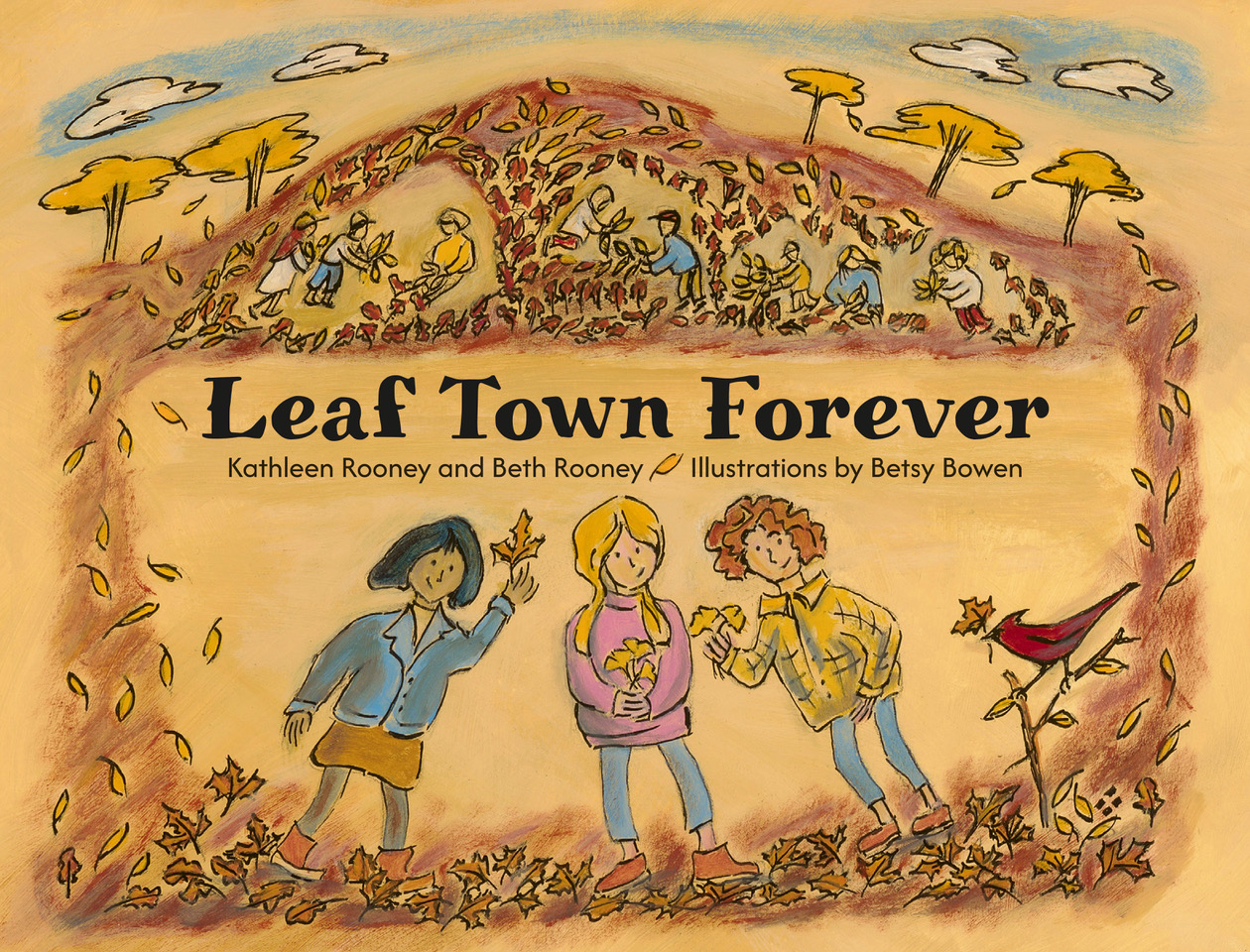
The 8-year-old inside me perked up early in my reading of Leaf Town Forever when two friends are hired by Lucinda at the Treasure Shop to search for treasures, such as walnuts, pottery, feathers, and gymnastics medals.
Suddenly, I was back to a time when one of the subtle delights of living was to find something like a treasure in the dirt or the grass. It might be a worn Roosevelt dime or a funny-looking bottle cap or the top half of a painted tin soldier or an oddly angled tiny twig. I knew that such a treasure wasn’t worth anything, but I felt that, in some pretend part of my existence, it was a rich relic, richly evocative of the mystery of life, as if it provided a key if I could only find the door.

A silver skeleton key actually shows up a few pages later in Leaf Town Forever, found by one of the friends “in the muck near the muddy creek.” It is, she announced, “The heart of Leaf Town.”
In their text, sisters Kathleen Rooney and Beth Rooney mention lost rings among the treasures, and Betsy Bowen includes many others in her plush and inviting illustrations: marbles, bead bracelets, pencils, small toy trucks, LEGO pieces, even a small section of a bicycle chain.
Leaf Town Forever is described by its publisher, University of Minnesota Press, as a children’s picture book for ages 3 to 8. However, if my own experience is any indication, adults and even teens who find themselves reading the book to, say, a granddaughter or a little brother are likely to resonate with the story.
Building an Imaginary Place

Some, like me, will be touched by memories of treasures. More, I suspect, will enjoy the recollection of getting up close and personal with nature—the brittle leaves fallen from neighborhood trees, acorns, sticks, pine needles.
And, of course, this book will spark recollections of building imaginary places. My wife has a deeply resonant memory of creating a “fort” with two friends in the shadows under a couple of overgrown bushes on her quiet home street. It was more a hide-out than a fort since they weren’t fighting anyone. I recall taking all of the drawers out of two dressers to create a “train” through the bedroom as my toddler sister watched from her crib.
For children 3 to 8 who read Leaf Town Forever or have it read to them, the book is not only a description of how imagination, individually and collectively, can create a vivid and vibrant place, but also an invitation to them to imagine.
One of the many beautiful aspects of Leaf Town Forever is the way it evokes a child's imagination to create the town. In several scenes, Bowen depicts the friends envisioning the buildings of the town they are creating. The buildings look nothing like those structures, however. Instead, they are shown as vague spaces within which the children are arranging leaves and treasures. What an outsider sees is a vague space, but, inside the mind and wonder of the child, the building is substantial and organized and beautiful.
For children three to eight who read Leaf Town Forever or have it read to them, the book is not only a description of how imagination, individually and collectively, can create a vivid and vibrant place, but also an invitation to them to imagine.
Empty Time to Daydream
Kids are good at imagining, but, to do so, they need empty time in which to daydream. Today, that means time away from screens and scheduled activities.
A version of Leaf Town actually existed near West Suburban Montessori School in Oak Park, back during the pandemic. The authors explain that the playgrounds were closed, so the kids in the neighborhood came up with the idea of building their own imaginary community. “We are happy,” they write, “to present this poetic commemoration of that attentiveness to nature and cooperation—and the idea that dreams are worth working together to preserve and protect.”
Their text was written using the three-line Japanese poetic form of haiku—five syllables, seven syllables and five syllables. This is a calm and delicate form that fits well with a book for children. My guess is that many adults who read the book won’t even notice that it’s poetry.
Kathleen Rooney, who lives in Chicago, teaches poetry at DePaul University, is a founding editor of Rose Metal Press and is the author of five novels and four poetry collections. Beth Rooney, an Oak Park resident, is a photographer and journalist. Betsy Bowen, who lives near Grand Marais, Minnesota, has illustrated many children’s books.
Together, they have created a book that will inspire children to dream. And adults too.
Leaf Town Forever is available at bookstores and through the University of Minnesota Press website.
