The American Writers Museum (AWM)’s exhibit American Prophets: Writers, Religion, and Culture will look “through the pages of American history to explore the influence of religion and spirituality on writers and readers.” The exhibit, which opens Friday, November 21, will feature “interactive displays incorporating 100 different creative works and writers spanning genres and mediums from literature to film, music, comedy and more.” Additionally, the exhibit will highlight “unique objects of religious significance to writers that can be tied to their works.”
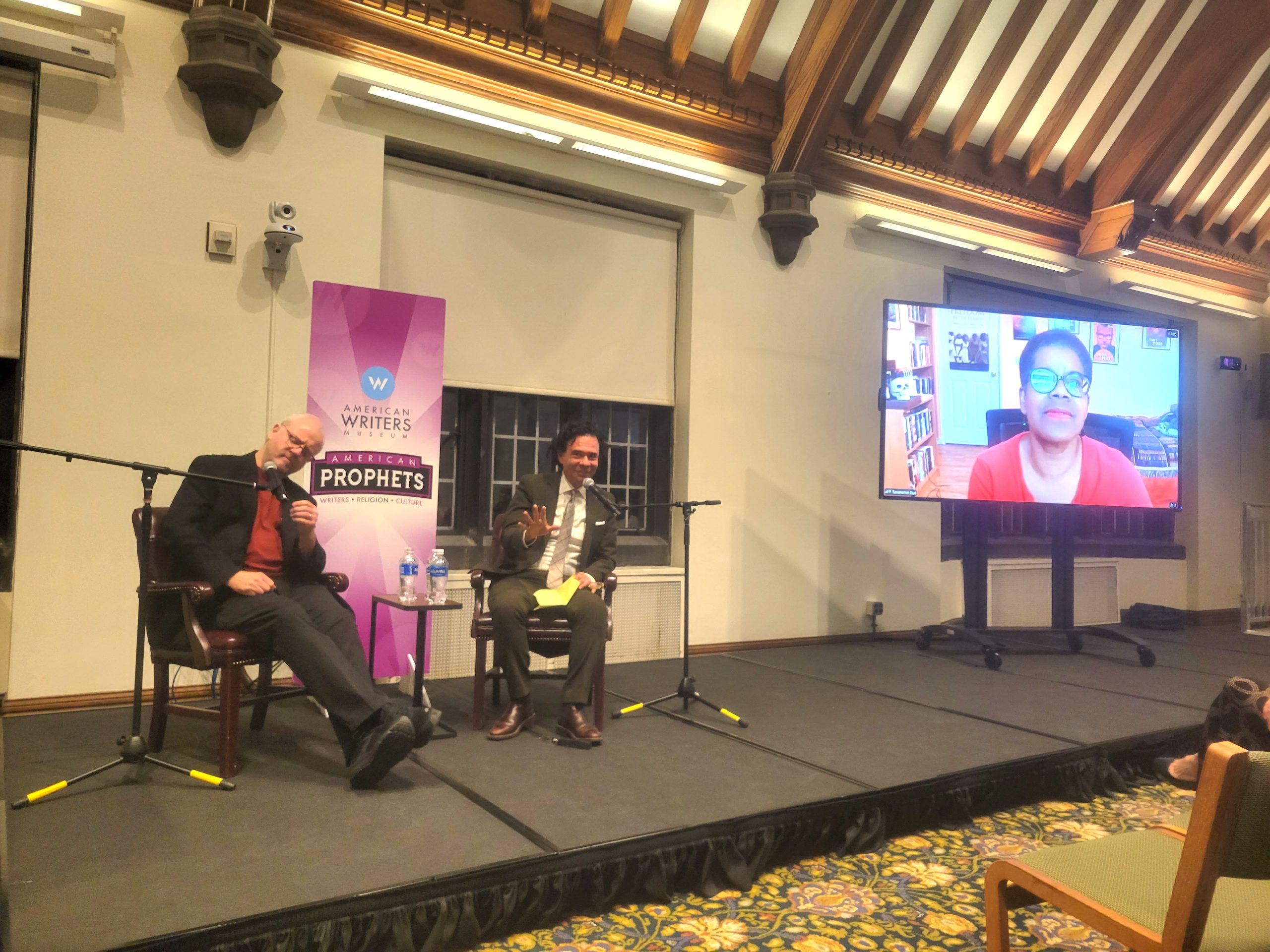
To celebrate this upcoming exhibit, the AWM is hosting several events tying different genres of writing to religion. I was lucky enough to attend the event related to horror writing at the museum.
The Writers
The AWM brought together three authors for a discussion about horror writing and religion: Tannarive Due and Matt Ruff, with Juan Martinez who acted as moderator. Due teaches Black Horror and Afrofuturism at UCLA. She has earned an American Book Award, an NAACP Image Award, a British Fantasy Award, a Los Angeles Times Book Prize, a Chautauqua Prize, a Bram Stoker Award, a Shirley Jackson Award, and a World Fantasy Award. She has written numerous books with her most recent novel being The Reformatory (2023), which was directly inspired by a relative’s experience at a reformatory school for boys. Ruff is also an award-winning author. While he’s written eight novels, his most famous one is probably Lovecraft Country (2016), which was adapted into an HBO series. His most recent novel is The Destroyer of Worlds: A Return to Lovecraft Country (2023), a sequel.
Martinez is an author, associate professor of English at Northwestern University, and editor of Jackleg Press. His works include the recent horror novel Extended Stay (2023).
The Discussion
Martinez kicked off the evening by asking Due and Ruff how it feels to have the historical events that often inspired their writing to return in a (sometimes) new form. Due was quick to jump in and say it didn’t feel good, “This march backward is horrifying.” Ruff was a bit more reserved.
As the talk went on, both Ruff and Due found themselves discussing how their backgrounds influenced their writing and religious beliefs. Ruff said that his dad was a Lutheran minister and his mother emigrated to the US from Brazil, but had grown up in Argentina during the Perón years. Additionally, a fraction of Ruff’s family converted to Mormonism, which caused tension. “I grew up in this multicultural, multi-theological debate society,” Ruff mused, “I like writing about culture clashes. I like writing about weird, complicated families. My version of religion is trying to understand other folks. One way I do that is by trying to write honestly .” Later, Ruff reflected on how he grew up a very conservative Christian, which meant he was taught very specific beliefs that made him "saved." Later, this made him draw a parallel between the Holocaust—an obvious atrocity—and Hell for people with beliefs different from his own. “I probably stopped believing in Hell before I stopped believing in God,” Ruff said while noting that “Even in a universe where God doesn’t exist, can sometimes act like one that does You can still have hope.”
Due said that her grandparents grew up in the African Methodist Episcopal Church (AME) whereas her parents had veered away from AME and instead embraced Unitarianism. “I think from a very young age, religious faith was sort of a journey I had to absorb on my own. And as a family, our religion was Civil Rights and politics,” explained Due, whose parents were civil rights activist Patricia Stephens Due and civil rights attorney John D. Due Jr. Martinez brought up how both Ruff and Due had utilized ghosts in their writing. Martinez asked them for—spoiler free—favorite ghostly moments in their works. “The ghosts were really my salvation,” reflected Due. She went on to say how she used ghosts as a means of avoiding writing page after page of horrific abuses. She also described that one of her favorite ghostly elements to her book The Reformatory was that calling out a ghost’s full name was how you summoned them. This was inspired by her family’s avoidance of talking about her uncle who died at a reformatory school and by the contemporary Say-Their-Names movement. Ruff explained that, in one of his pieces, there is a house in a white neighborhood a Black woman purchases at a suspiciously good price. It turns out, the house is haunted by a white ghost. Over a chess game, the character convinces the ghost to go against the hateful neighbors who want her out.
Martinez moved on to ask Due and Ruff about their works’ connections to Chicago. Due sees The Reformatory as, in some small part, a story of the Great Migration. “Chicago is this mythic land of freedom. It really did represent a kind of hope for change.” Ruff had a very different take. Ruff expounded on the false notion that racism is a southern problem while sundown towns were almost exclusively found in the north and western United States. The dread of being Black and stopped by a white cop close to sundown on the edge of an unknown town, was “Lovecraftian,” said Ruff.
When it came time for audience questions, a participant asked what drew each author to horror as a genre to explore complex issues. “My late mother loved horror. I used to think of it as just sort of a quirk,” said Due before explaining that she later realized it allowed her mother—a civil rights activist—to put a face on the monsters as opposed to a faceless system, and to sometimes win. Due further added that horror also often demonstrates how to survive.
The final takeaway was Due’s response to a question regarding the difference between a supernatural story and a horror story. Nested in a longer reaction, Due responded that “The great thing about horror as a genre is that it’s just an emotion.”
Holly Smith is a communications specialist with a history in publishing and the bookstore world. Now she tackles book and literary event reviews one at a time. You can read more of her book reviews at Holly Reviews, Bookman!.
