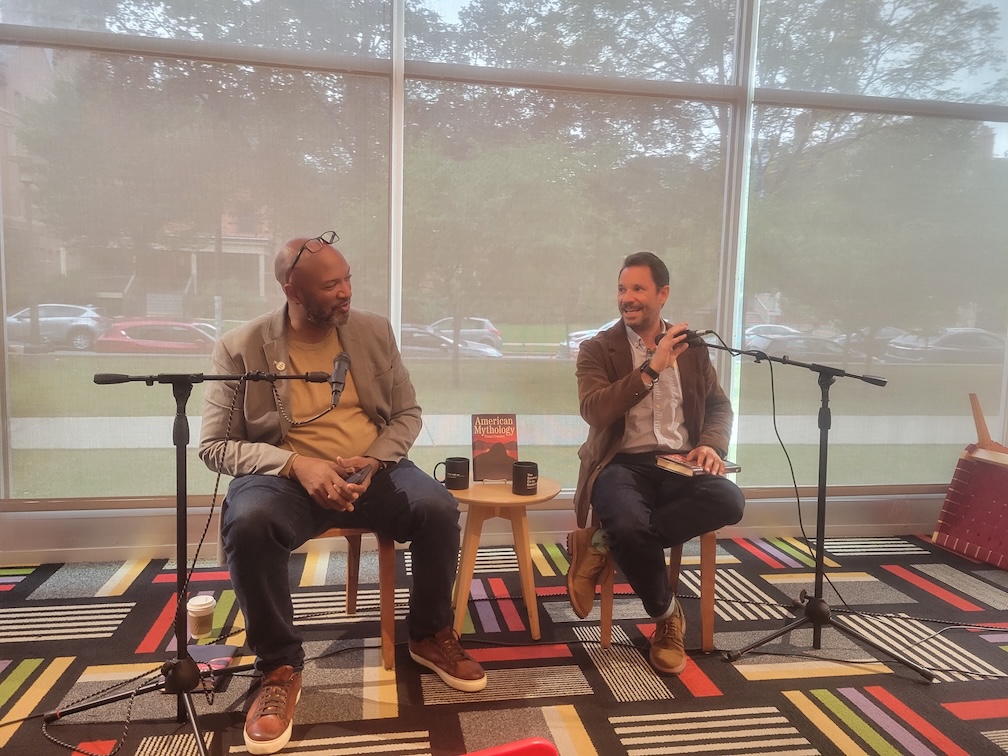
While author Giano Cromley currently lives on the Southside of Chicago and teaches as an English professor at Kennedy-King College, he was born in Montana and is a certified wildlife tracker. He was joined by his friend, Dr. Duane B. Davis—who runs Raising Expectations LLC, a consulting firm that works with schools, nonprofits and businesses around the country—for a conversation about Cromley's new novel, American Mythology, the two were quick to joke around.
Davis pointed out that, in Cromley’s pitch to why audience members should become members of the Seminary Co-Op Bookstores Inc., Cromley had pointed in the wrong direction to indicate where the Seminary Co-Op’s sister store, 57th Street Books, was located. Cromley joked that he was a tracker, but had a terrible sense of direction.
When Davis asked, Cromley shared that he became a tracker because his wife had gotten him an intensive course hosted at Yellowstone National Park by famous tracker Jim Halfpenny. Cromley was quick to add that, allegedly, Halfpenny had helped track Bigfoot.
Thoughts on Writing and Folklore
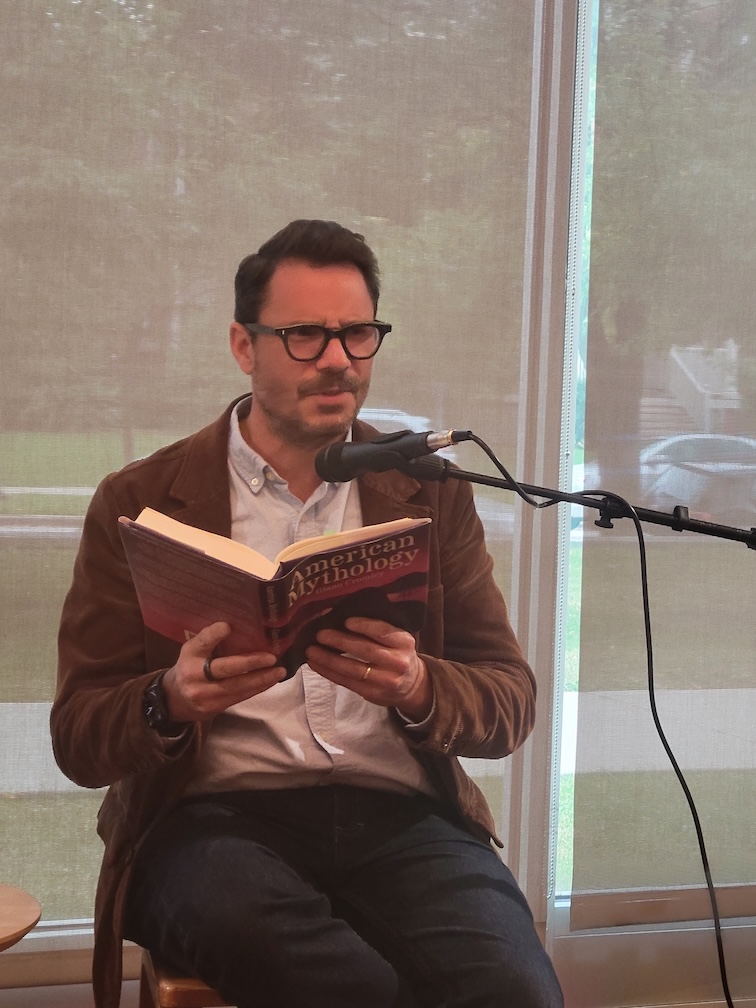
The discussion explored Cromley’s novel, which heavily features Bigfoot and Bigfoot believers. Davis praised Cromley’s nature writing. “You can become a better writer by reading good writing,” explained Cromley. In order to prepare for writing American Mythology, most of which takes place in the natural world, he read a lot of nature writing and tried to emulate his favorite authors.
Additionally, Cromley read a great deal of mythology, folklore and religious works. One thing Cromley learned was that mountains are often seen as a connector between earth and heaven and many of the world’s sacred sites are asteroid impact sites. This helped inspire Cromley to set some of the novel in a crater lake, just beyond a mountain. Personally, Cromley reflected on how crater lakes are unbelievably clear and inspire awe.
In regards to mythology, Cromley said that, to him, “Bigfoot represents one of the quintessential American myths.” He pointed out that the belief in Bigfoot goes back thousands of years and into the beliefs of Indigenous peoples.
However, Cromley saw mythology appear in other ways in his book. He described the mythology of a dying mining town that believes the industry will return and save them. He discussed how his novel portrays a family mythology wherein a great grandfather discovered a mysterious lake left off of maps.
Davis asked if Cromley could explain the difference between mythology, folklore and religion. Cromley said he could only explain the difference between them in regard to what they mean to him. Cromley said that folklore is mythology with a much of the detail removed. It's an older version of urban legends in that it was “a friend of a friend’s cousin” who originally encountered the folkloric being. Whereas mythology has more details, especially the names of the beings and those who encounter them. Religion, Cromley explained, is best summed up as “when someone else says it, it's myth, when I say it, it's religion.”
Later, Cromley quoted C.S. Lewis: “Myth is truth without facts.”
Bigfoot—Aper or Woo?
It is important to emphasize that American Mythology is heavily centered on characters who go on a quest to find Bigfoot. So, naturally, ideas about Bigfoot became part of the conversation between Cromley and Davis.
When asked what Bigfoot believers believe, Cromley explained there are two main camps in regards to Bigfoot: Apers and Woo. Apers believe that Bigfoot is a human ancestor or cousin that has survived in isolated pockets. Woo followers think Bigfoot is a spiritual creature—this, Cromley added, includes a lot of Indigenous beliefs. Although, he noted that certain Indigenous cultures belief Bigfoot is a “stick Indian”—meaning a person who decided to split off and live a wilder way. Cromley shared that he subscribes more to the Woo theory.
Overall, Cromley sees Bigfoot believers as optimists. “There has to be eternal optimism to go out and do something for which you've had no success,” he explained when describing those who go searching for Bigfoot.
The Power of Stories and Friendship
Davis asked Cromley what the “why” of American Mythology was. Meaning, when you boiled American Mythology down and removed any window dressing, what was it about?
Cromley shared that he saw the why as “the power of stories to bring us together and save us.” Davis joked that he saw it as the story of a powerful friendship—which Cromley acknowledged was also true.
American Mythology is available at bookstores and through the publisher's website.
Holly Smith is a communications specialist with a history in publishing and the bookstore world. Now she tackles book and literary event reviews one at a time. You can read more of her book reviews at Holly Reviews, Bookman!.
