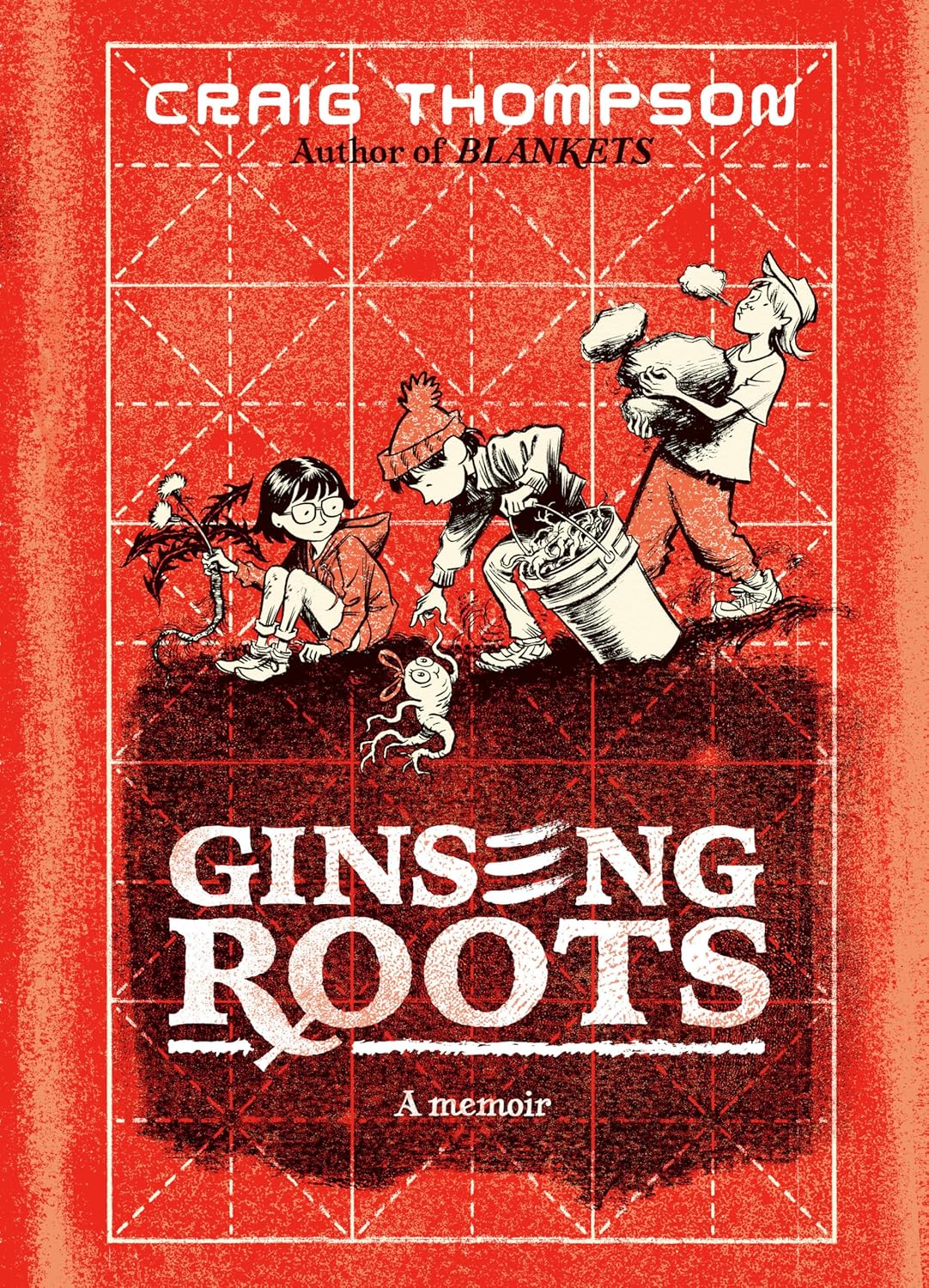
Most Americans likely think of ginseng as an exotic ingredient, showing up on occasion in candy, tea, and energy drinks. But ginseng has (literal) roots in the United States as well. While China cultivates and harvests most of the world’s ginseng, most American ginseng grows in our neighbor to the north, Wisconsin. In Ginseng Roots: A Memoir, cartoonist Craig Thompson recalls a childhood spent working on ginseng farms, while exploring the plant’s influence as an adult. But while Ginseng Roots is a visually impressive work, Thompson’s storytelling grows as twisty as the tendrils of the ginseng root itself.
Thompson’s previous books include Blankets, which charts his youth and young adulthood in the Badger state. Raised by fundamentalist Christian parents, Thompson and his siblings spent their summers working alongside their mother on farms: pulling weeds, removing stones from the ground, and other forms of, well, child labor. Those memories, and more recent family history, are intermingled with Thompson’s travels and extensive research on ginseng’s historical, economical, and cultural impact. And he seems driven to share it all.

Known for monumental works—Blankets is 592 pages, while his previous graphic novel, Habibi, clocks in at 672—Thompson fills Ginseng Roots’ compact-by-comparison 442 pages with skilled and meticulous renderings that draw the viewer in and along. While favoring monochromatic illustrations, Thompson has introduced a third color—red in different shades—to the mix. An allusion to Asian package design perhaps and the Chinese view of red as a symbol of happiness, luck, and fortune. It’s an interesting choice of leitmotif. Red is ever-present, through threads, lines, and jagged shadows, guiding the reader through the narrative.
Trouble is, there’s more than one narrative. Ginseng Roots drifts into a dozen different tangents, sometimes in the course of a few pages. Thompson explores ginseng’s history, uses, and cultural importance with sensitivity and scholarship, but the reader should prepare to hear his thoughts and findings on agriculture, corporate versus family farming, pesticides, the Hmong people, his struggle with fibromatosis, “alternative” medicine, class divides, religion, labor, cartooning, familial relationships, and himself as well (and just for starters). A devotee of the precise and complex school of cartooning, no stone is left unturned, no corner unexplored, and no stray thought left unaddressed. Ginseng Roots was originally presented in serial form, in 30 or so page installments. Bound together in the current volume it is a formidable and rigorous read.
Ginseng Roots’ subtitle is A Memoir, so it’s to be expected the author would share his life and musings in earnest. Ginseng Roots is about ginseng, but it’s mostly about Thompson thinking about ginseng...and Thompson. He is a thoughtful man. Perhaps overly so. Every notion—ginseng-related or not—that crosses his mind is pursued for several densely illustrated pages and tied in with something from his past, his health, his habits, or his personal virtues. Blankets described Thompson losing his religion, so to speak, but it’s clear in Ginseng Roots he’s not free of feeling guilty for, well, everything. He swims in self-recriminations. On a single page he rebukes himself in rapid succession for hanging out in a Taiwanese Starbucks, using the WIFI, enjoying air conditioning, and having ample space to work. It feels a little performative, for the reader and himself.

Later, he hangs out with his parents—who didn’t come off well in Blankets, but are shown in their mellow golden years here. His mother, after a lifetime of Christian toil, tells Thompson and his siblings she has no memories of them growing up, to which Thompson thinks, regarding his previous accounts of working the fields and being abused, “Have I marred these moments by drawing them?” Clearly, he wants to repair his relationship with his folks, but it often feels like he’s rationalizing for peace of mind. After indicating his father’s climate change denialism (“liberal propaganda to limit industry,” says the old man) he nonetheless admires his parents’ lifestyle—living in rural Wisconsin, working, thrifting, and growing their own food—as having less environmental impact than his own. An odd way of looking at things because Thompson’s parents frequently cite Hebrews 13:14, “For this world is not our home; we are looking forward to our everlasting home in heaven,” a passage often invoked to claim environmentalism is pointless since it’s all gonna end and the righteous will go to Heaven. Even the little cartoon ginseng mascot that accompanies him throughout the book chastises him, “Your city slicker life has distanced your connection to the earth” (Note: Thompson lives in the teeming seedy metropolis hellscape of Portland, Oregon.) Yet, no indication is given that Thompson will stop cartooning, move back to Wisconsin, and go full Tolstoy—but he likes to allude to it. Seeking redemption perhaps, he visits a ginseng farm and performs his best proletarian impression as he works the earth for a few hours, declaring through a thought bubble, “Ah! Honest, hard-working LABOR!” Progressives with backyard composters and back-to-the-land fantasies as a temporary absolution for their urban lifestyles will love it.
Ginseng Roots is a monumental work—physically and academically—revealing a keen and steady hand in its research and rendering. If Thompson had stepped off-stage and made it a straightforward account of the root and less of a meditation on how it all reflects back on him, however, it might have worked better. But such is the condition of the modern documentarian, I suppose.
Ginseng Roots is available at bookstores and through the publisher’s website.
