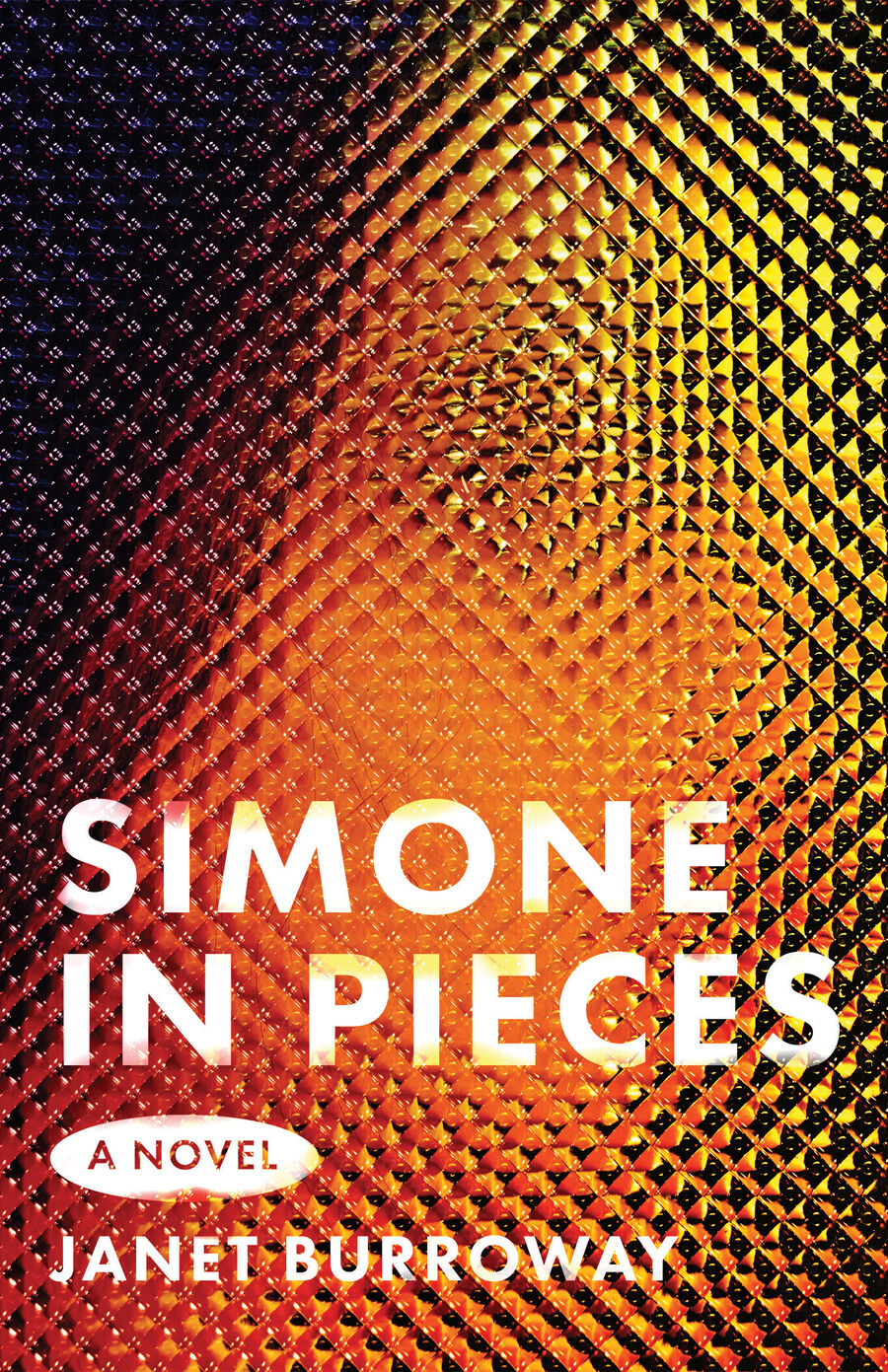
Simone Lerrante is 70 years old. It is the year 2000, and she is ruminating as she looks at the panes of a large Florida window near the bed of a dying man.
Saint Augustine said that Christ was conceived of Mary as “sunlight falls through glass.” Simone wonders if they still make glass by melting sand. The beach, cremated into windows, is made of the transparent bodies of sea-creatures? And is that cremation then the worldly equivalent of purity?

It's not that Simone is religious nor overly concerned about purity. But, across her decades, she has never not been thinking, struggling to understand the fracturedness of human life and of her own life—more fractured perhaps than many others, but maybe not.
Nearly six decades earlier, in 1940, out of the deep blackness of the shore of German-occupied Belgium, Simone walked, a gawky 10-year-old, into the arms of a woman from a small British trawler. There on that dark night to rescue refugees. Many years later, the woman recalled for a television crew:
“Skinny as a rail she was, and her coat too small, though it was posh—velvet collar and that. I wrapped her up, and she says, po-faced, ‘My father arrives not. I arrive alone.’ She says, ‘My fah-zer.” I knew better than to ask.
In that harrowing experience, Simone left behind all she had known—people, home, a way of life—and she left behind as well most of her memories. Throughout her teenage years and in her young adulthood and into middle age, her life before escaping Belgium alone were for her only a few scraps of images, a mystery.
And she, too, was a mystery to herself, not knowing, not able to remember, who she had been before she got into the rowboat to the trawler. So, there was a tentativeness to her life and actions, a detachment. Without childhood roots, she was floating, weightless.
And she, too, was a mystery to herself, not knowing, not able to remember, who she had been before she got into the rowboat to the trawler....Without childhood roots, she was floating, weightless.
Chronological Shards
Janet Burroway’s new novel Simone in Pieces tells Simone’s story from that moment on the shore where she arrived alone, from age 10 to 70. She tells the story chronologically but not as a single narrative.
Burroway’s novel is comprised of shards of biography—25 fragments of her character’s life, many, especially in her younger years, told from the perspective or in the voice of others. Eleven of these fragments—only a few pages each—have to do with transitions, a particular movement from here to there, what Burroway calls “Transits.” The other 14 fragments are more substantial chapters of 10 to 30 pages.
It is an ambitious and complex storytelling approach that serves Burroway’s novel well.
It enables her to flesh out and bring alive many characters whose paths cross Simone’s. At the same time, the fracturedness of the technique mirrors the fracturedness of Simone’s life. Indeed, so splintered is Simone’s life that, as an amateur photographer, she tends to focus on a piece, a segment, rather than the whole, such as during her visits to a small local zoo.
She always had a Polaroid camera hung around her neck, with which she took close-ups of a leaf or a puddle with oil-rainbows on it. If she aimed it at an animal it was likely to be at a single hoof, a nostril.
In her later years, she gains recognition for her photomontages, such as the two-part “Piece Work.”
One is of women sewing, so contrived that they seem to be themselves stitching the photo segments together. The other shows a trio of women cooking slabs of meat over a blazing forest.
Coincidence
The storytelling in Simone in Pieces is a testament as well to the creativity and chutzpah of Burroway, who has been publishing works in a wide variety of forms since the 1950s and turned 89 in September. It is a novel rich in character, deeply felt, resonant with the messiness of existence, and universal in its embrace of mystery and fact and their intertwinement.
It is a novel rich in character, deeply felt, resonant with the messiness of existence, and universal in its embrace of mystery and fact and their intertwinement.
In addition to eight earlier novels, including The Buzzards which was nominated for the 1970 Pulitzer Prize, Burroway has published memoirs, short stories, poems, plays, children’s books and other works. Her most financially successful book has been Writing Fiction: A Guide to Narrative Craft, first published in 1982 and now in its 10th edition, a textbook in writing programs throughout the United States.
From 1972 through 2002, she taught English Literature at Florida State University in Tallahassee. She and her husband Peter Ruppert, a scholar on the idea of Utopia, now split their time between Chicago and Lake Geneva, Wisconsin.
With Simone, Burroway has created a character who is present and absent simultaneously throughout the novel, both to the reader and to herself. It is only through a random moment—a coincidence—at a feminist academic lecture in 1975 that Simone, in her mid-forties, begins to find herself, to start to discover and piece together all the shards, many of which she had not even known existed.
Just before the lecture, Simone and her friend Hettie, both professors at a small Missouri liberal arts college, are talking about fluke parallels, and Hettie asks, in the manner of academic chit chat, “Is a coincidence a coincidence if nobody knows about it?” Simone responds, “Things like that happen all the time. They just don’t mean anything.”
Moments later, they are in the lecture hall to hear the feminist historian Olivia A. Purdy speak about her latest book Why Britannia Is a Woman.
Unknown to Simone, Purdy is the orphaned daughter of Lt. Johnny A. Purdy, a 19-year-old married soldier from Missouri, who, more than thirty years earlier, had been a frequent visitor to the English family that had taken Simone in. A short time after his visits, he was part of a suicide mission to deliver supplies to snow-stranded soldiers in Greenland, and, throughout Burroway’s novel, references in news reports and elsewhere rise up at the edges of Simone’s consciousness about the doomed flight without her making the connection.
In the shard of Simone in Pieces that is told from Johnny’s point of view, Simone is 14, and practices her English with him: “Do you know this one, Johnny Purdy: opsimath? It is from Latin, for a person who begins learning late in life.”
“That Girl”
It is, as Simone and the reader will learn, a prescient word, and, as the lecture begins, Simone is about to start on her late-in-life learning. Purdy shows a short 1960s, BBC documentary Women of World War Two, and one of the women interviewed is the matronly Mrs. Winona Farnsworth who “took part in one of the most daring joint ventures with the Belgian Resistance.”
Hettie is distracted by thoughts of her newly departed lover, but she keeps getting distracted from her distractions by Simone and her body language, “A funny thing—she’d become aware of Simone again; something muscular. A tensing where their arms touched.” And now Farnsworth is saying:
“…there’s this girl, maybe ten or twelve, gawky little tyke, slogging straight into the water up to her coat hem.”
And Simone is clutching her skirt, having trouble catching her breath. “Her mouth grabbed at the air the way her fist grabbed at the cloth—no, that hand was still now, with a death-grip on the thigh.”
Hettie is afraid Simone is having a heart attack, and, finally, after the lecture is over and the crowd has gone away, she asks what happened. And Simone disjointedly talks about the woman and her story.
“But you mean—that girl she was talking about, that was you?”
“It was. I do.”
And, with that, the rest of Simone’s life begins—and her discovery of everything that had gone before as well.
Simone in Pieces is available at bookstores and through the University of Wisconsin Press website.
