Reviewed by Tori Rego
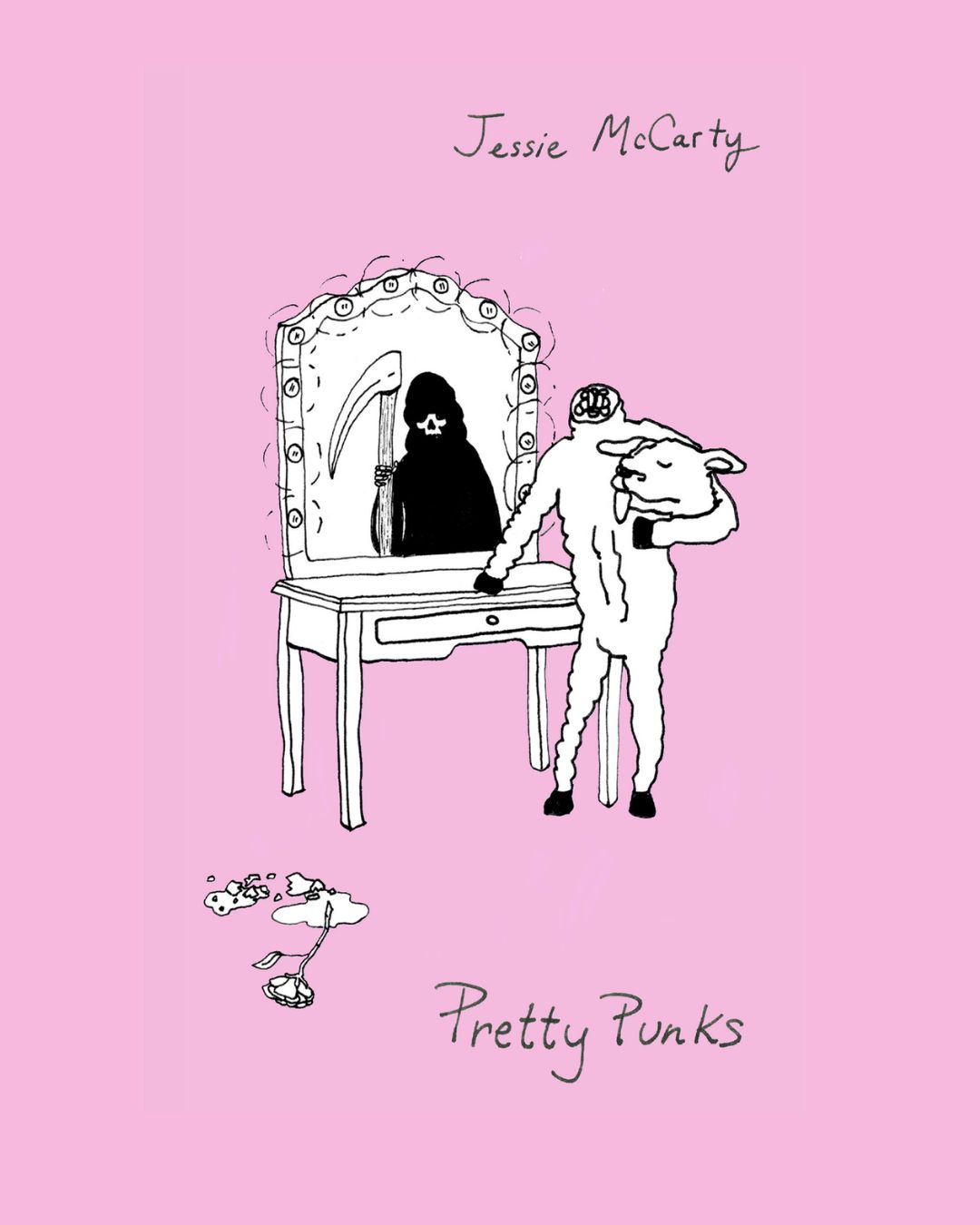
To talk about Pretty Punks by Jessie McCarty, it is necessary to talk about W.B. Yeats. Like many, I’d venture to guess, I had not experienced Yeats’ work since first reading him on an English course curriculum. I remembered him from the haze of memory as profound, romantic, and entirely foreign to my world view. As a young southern American girl living in suburbia, what was I meant to connect with in Yeats’ work? I recognized it as beautiful, but it had nothing to do with me.

Born in Dublin in 1865, Yeats’ life spanned the turn of the century and most of two world wars. Yeats, as much as anyone, lived in a time of change. It is fitting, in considering Jessie McCarty’s new collection, to emphasize this point. Pretty Punks principally drew me towards a new recognition of the continued relevancy of Yeats’ artistic preoccupations. The first poem of the collection “Come Swish Around,” pays homage to Yeats’ “A Drunken Man’s Praise of Sobriety.” McCarty’s poem pulls its title and opening directly from Yeats. McCarty’s poem begins: “come swish around / my pretty punk and keep me dancing still / while war rages through the sill / of bedfire”.
More than homage even, McCarty’s poem feels like a continuation of Yeats’. If there were a second stanza to Yeats’ poem, this could very well be it. McCarty’s poems are in Yeats’ voice yet seem as if they were excavated from the parking lot of a dive bar somewhere in the American South. “Being Trans Southern at Rosella’s Wine Bar” is infused with the language of the contemporary drag scene, coupled with that of romantic epics. The result of this exchange left me questioning the imaginative distance I felt between Yeats’ world and mine. How did this get here, I wanted to ask the poems themselves. But the poems would not answer—they more concerned with questions of living in the world than with explaining the strange miracle of their existence.
All this is to say nothing about the collection’s other notable feats: poems presented in Irish-Gaelic alongside English translations, contemplations of the body’s capacity to interface spiritual connection, the gravity of making art during war, and the personal search for home. The search, as far as these pages lead me to believe, does not have an end destination. Still, I can feel no better resting spot in the search than the elegant realization that “you’ve got to love the world, / cold as it is” (“Yeats’ Coat:”).
After the series of poems, Pretty Punks moves to other places. Poetry is followed by a ”portrait” and then a short play. If the collection could be said to falter in its sharp focus, it is in movement between the portrait and the poems. The portrait takes the form of a short story chronicling the life of a bull rider from greatness to tragedy. It’s a tight story about sacrificing oneself for work but feels out of place after the preceding poems.
The concluding play, simply titled “Lamb Play” utilizes the same archetypal, mythic tenor of the poems and thus is more at home. “Lamb Play” is prefaced by Elizabeth Piasecki-Phelan’s critical introduction. Though well-written, the introduction intrudes on the work itself, which shines in its play on absence and possibility. Alongside everything, drawings by Emma Walgast litter the collection. Walgast’s drawings take the place of the charming illustrations found in early 20th century folktales. Often elusive in their relation to the text, they are nonetheless compelling in our journey through the collection.
At once firmly contemporary and archaic, playful and somber, Pretty Punks’ most noteworthy accomplishment rests in its incisive coupling of the particularities of now with the largesse of eternity, reminding its readers that we all inhabit haunted land.
Pretty Punks is available in bookstores and through the Magra Books website.
Tori Rego is a writer from Charleston, South Carolina. She currently lives in Chicago where she co-hosts the monthly reading series Written on a Napkin. Her poetry chapbook Briefly, Gently was a finalist for the Chicago Reader's award for Best New Poetry Book by a Chicagoan in 2024. A full list of her published work can be found on her website at torirego.com.
