
He wore a black patch over his right eye while the other eye, the good eye, looked out towards the standing room only audience. Salman Rushdie wasted no time in addressing the elephant in the room, apologizing for the layers of security as the attendees filed into the Athenaeum Center for Thought & Culture on Thursday night, the last program of the Chicago Humanities Festival’s fall season. Security personnel brandished AR-style rifles pacing up and down the sidewalk as patrons patiently queued up. “There’s a reason why you have to be checked,” Rushdie said once everyone was inside. “I’m sorry you had to go through it.”
But we all understood.
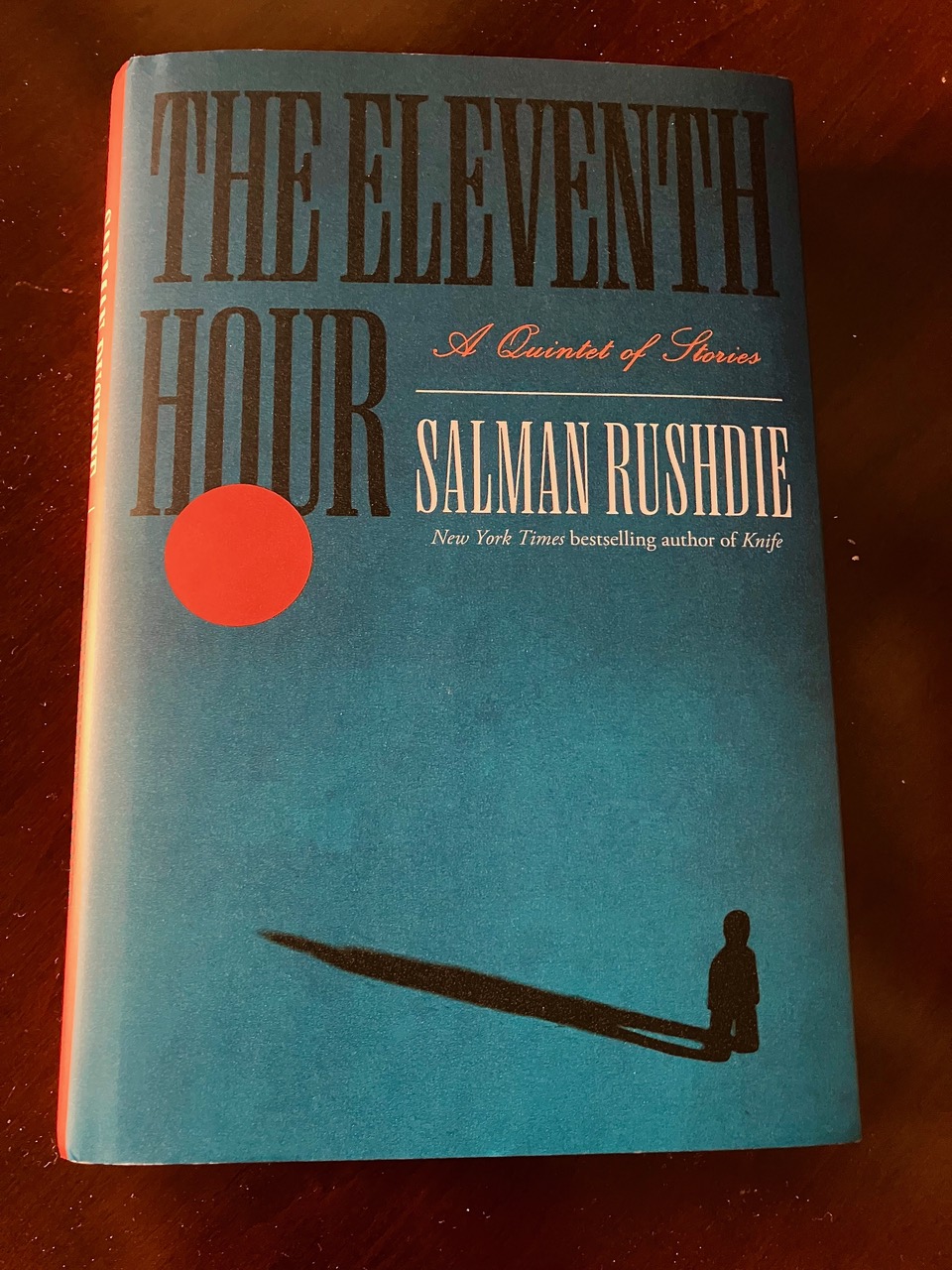
He was not here though to discuss what had happened to him that fateful morning, August 2022, when a knife-wielding young man rushed the stage, brutally stabbing him and causing irrevocable damage. Nor was he here to discuss his previous book, Knife, a devastating memoir about that violent day. Rather, he was in town to promote his latest book, a short story collection, The Eleventh Hour. The quintet of stories consists of two short stories and three novellas.
The Eleventh Hour is a return to the kind of work that brought Rushdie acclaim in the first place: fiction. “I didn’t choose it. It chose me,” he said about the writing of the stories. He wrote the long middle story, a ghost story, first. And then a few other stories and “it ended up being this book.” He calls it “an accidental book.” Two pieces, “In the South” and “The Old Man in the Piazza,” were written before the attack. Overall, the stories are “in conversation with each other” with a “thematic unity.” His familiar themes are here—big themes like art, love, and death––and stories revolving around issues of age and aging, remembrance, mortality, chance and fate, truth and lies, the power of language, the loss of faith, and “the metaphor of being wounded and filling up a hole that can never be filled.” The inspirations are wide-ranging: his college days at Cambridge University, Franz Kafka’s manuscript papers, and stories about stories themselves.
With the Nigerian American author Chris Abani acting as moderator, Rushdie, an affable and charming presence, engaged the audience in an animated give and take. He discussed aspects of his long career and his more than 20 books, including the postcolonial magical realism of Midnight’s Children (1981), which won the Booker Prize in 1981; his most infamous work, The Satanic Verses (1988), inspired by the life of the prophet Mohammad; and The Ground Beneath Her Feet (1999), his riff on the myth of Orpheus and Eurydice. The Satanic Verses, of course, led to allegations of blasphemy toward Islam and a subsequent fatwa issued by Iran’s Ayatollah Khomeini calling for Rushdie’s death. But lesser-known works were also discussed such as Grimus (1975), his literary debut, a fantasy and sci-fi novel and Imaginary Homelands (1991), a collection of his essays and criticism.
Throughout the evening, Rushdie referred to plenty of writers who have inspired and influenced him over the years such as Anton Chekhov and Joseph Conrad and individual works, including Toni Morrison’s Beloved and Gabriel Garcia Marquez’s One Hundred Years of Solitude. One Thousand and One Nights is another favorite. “It has a lot of sex and violence” and then with the timing of a comedian adding, “Excellent book.”
Humor is important to Rushdie. Citing an example of a novel that he believes lacks this important literary ingredient he mentions George Eliot’s 1871 novel of manners Middlemarch, which he calls “absolutely humorless,” before noting, “There’s not a lot of gags.” Citing the current political climate, he referred to humor as “a powerful weapon when used as power.” That line generated loud applause. “You all seem to be thinking of somebody,” he joked.
“Life is funny,” he said. “It’s black funny. But it’s funny.” His own family appreciates dark humor, although, he admits, “It doesn’t translate everywhere,” but “This is who I am. I think we’re a funny family.”
When Abani asked what art forms have had the greatest impact on his writing, Rushdie didn’t hesitate. Movies. Rushdie loves movies. “I come from Bombay. We have movies in our blood,” he said. Specific film genres (Italian and French new wave), individual directors (Ingmar Bergman, Alain Resnais), and individual films resonate with him (Luis Buñuel’s The Exterminating Angel and Satyajit Ray’s Apu Trilogy). But he loves popular movies too: The Wizard of Oz, Star Wars, Who Framed Roger Rabbit?
A persistent theme in Rushdie’s work is mortality and as the years pass by it has taken on more urgency. The notion of legacy looms large, too. What do the struggles of a life amount to in the end? Will his work survive? Will he be remembered as an artist? What are books, or art in general, he implies, but physical evidence of our time on earth?
Another topic was writing as a creative act. “I feel most like myself in the act of writing. In the moment of the act of creation,” he admitted although he differentiates between himself and the characters on the page. “You have to abide by the characters you created,” but “they are not you. They are something else. Something that you created separate from yourself.” To Rushdie, the purpose of a novel is to create a world “that the reader wants to be in. Isn’t that why we read?” he asks. “Fiction is a way toward the truth. Telling the truth about societies. That’s the art of the novel.”
Rushdie is dubious about the adage to “write what you know,” especially for writers with limited life experience. As he points out, authors like Joseph Conrad and Herman Melville lived full lives before they began to write. “They both had lives,” he said. Instead, he encourages prospective writers to “Go find something out. Find a story. Tell it.” But he adds a caveat. “Unless you really have to write a book, don’t write it.”
Other themes included the idea of home or, more accurately, homes since Rushdie has lived in three cities he considers home: Bombay, London, and New York, cities that he says are “very like and unlike each other.” Having been born and raised in India before moving to England as a teen to attend school, he calls himself “a double migrant.” Home is a complicated issue. “The idea of home becomes plural.” This thread led to the discussion of other themes in his works: honor and shame and the tyranny of families––and their web of secrets. “My books in the West are read as fantasy.” In South Asia, “they’re seen as history novels,” he says.
As the evening was about to conclude, the notion of retirement came up. Abani wondered if the 78-year-old Rushdie has given any thought to putting his pen down altogether. Or, as he delicately put it, “Is it hot cocoa and slipper time for you?”
Rushdie was having none of it. “What else would I do?” He shook his head. “Bop ‘til you drop.”
Support arts and culture journalism today. This work doesn't happen without your support. Contribute today and ensure we can continue to share the latest reviews, essays, and previews of the most anticipated arts and culture events across the city.
