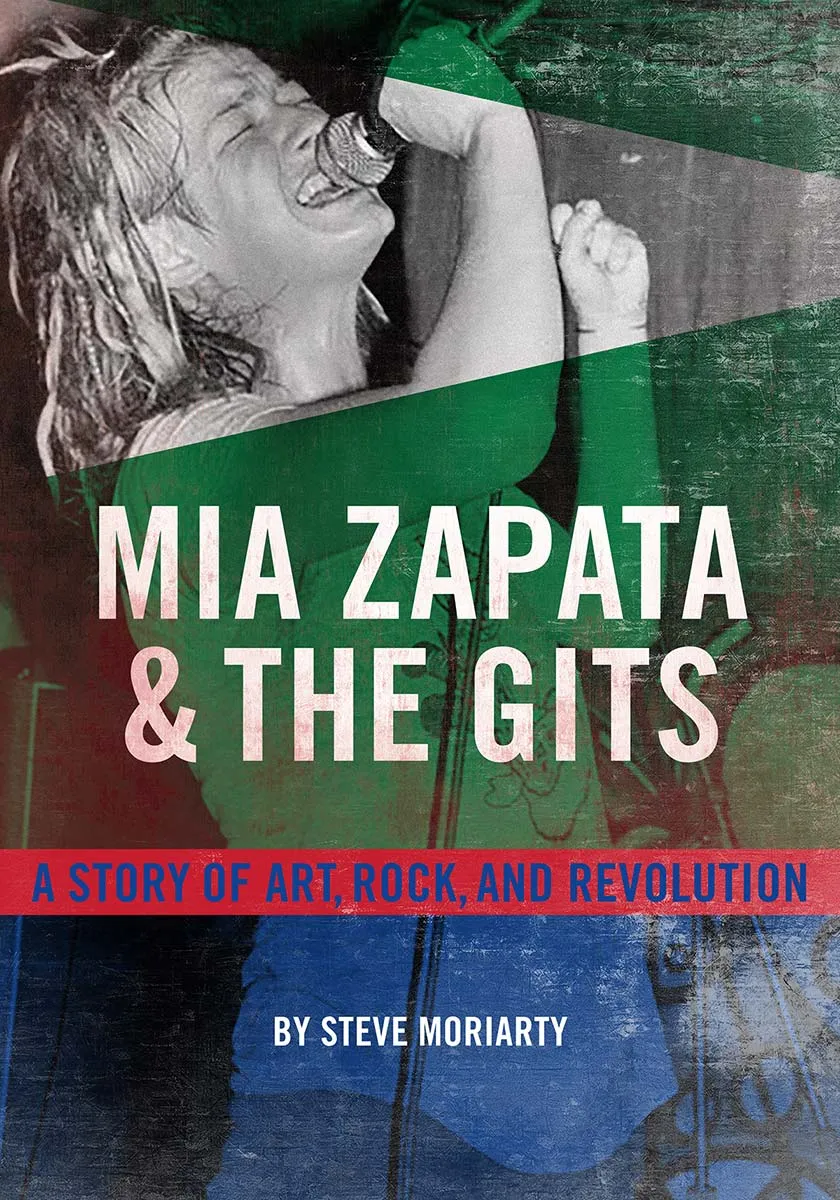
Some people are born with an inner light that fills every room they enter. By all accounts, Chicago-born Mia Zapata, singer/songwriter for the Gits, had talent, presence, and charisma to spare. That light was horrificallly snuffed out when she was murdered in 1993, just as the Gits were about to get their big break. But while her murder has long overshadowed the band’s history, it’s not Mia Zapata and the Gits' primary focus. While Zapata gets top-billing in the title, the book is really about the band, and the collective we that arises between artistic colleagues with a common vision and goal.

Author and Gits former drummer Steve Moriarty, is up to the task of sharing the band's tumultuous history, though he admits he’s not a professional writer or even, God forbid, a journalist. Still, he does right by the band with the words he has. He clearly paid attention to what was going on around him in those grungy p-rock days. At times he even achieves moments of transcendence.
As Moriarty points out, Zapata’s life tends to be overshadowed by the circumstances of her murder, which went unsolved until 2002. He chooses to avoid dwelling on her death and instead concentrates on the band’s life, albeit without skipping the unpleasant parts that sometimes come with a life of making music.
Scenes—music, art, and otherwise—aren’t single events or individuals. Mainstream, and too often, underground media tend to short-sightedly focus on the ostensible kings and queens of a movement. In most music writing, particularly with rock and punk music, the instinct is to write large and loud. Every meeting is momentous. Every sight and sensation explosive, devastating, dangerous. We get some of that here as well, with gutter nostalgia for punk gigs, framed and punctuated with blood, sweat, and sputum. Yet, Moriarty finds the high points and humor as well. Refreshingly, he records the shift away from punk shows as misogynistic asshole festivals to a supportive community of fellow freaks, weirdoes, artists, planners, fans, venues, and resources that make or break a scene.
La Boheme is a documentary for every generation, where young middle-class artfucks pursue aesthetical dreams amongst the grim grubbiness at society’s bottom—or at least an incredible simulation of it. If my rapidly decaying Generation X memory and braincells still serves me, however, Moriarty captures the zeitgeist of the early 90s performance circuit, sharing a familiar story of gleefully making music in dive bars, lodge halls, urban ruins, and similar shitholes. Patrons pogo and expectorate, HVAC systems groan and fail, alcohol and pharmaceuticals pop, squirt, and flow freely, and The Truth is exclaimed at top volume (or whatever level the current shitty sound system is capable of reaching). More importantly, Moriarty gets at the joy of creating and performing music, and the professionalism that separates a resoundingly tight combo like the Gits from the assorted half-asses and posers.
Moriarty’s style is a lean but fruitful gab session about his many adventures. But while he’s not a particularly potent wordsmith, he manages frequent kernels of excruciating insight. Every scene offers both agony and ecstasy, with young, dumb performers making young, dumb mistakes, and sometimes paying dearly. When Moriarty and Zapata’s friend Stefanie Sargent of 7 Year Bitch died a irritatingly cliched rock and roll death, he offers the following observation, which cuts to and through the quick:
“One of the hardest parts of the death of a close friend or family member is how little it matters to the rest of the world.”
Interestingly, while most biopics put the main subject front and center—at times even looking into their thoughts and feelings—we largely encounter Zapata from Moriarty’s view. Just walking through the door or around the corner; suddenly reappearing for a show after a particularly long bender; viewed across a room speaking with someone; and, of course, performing with seemingly boundless energy. It’s a refreshing perspective that makes her seem all the more fun, fragile, feisty, and human. How often do we know what our own friends are doing “off-stage”? How often do we renew our acquaintanceships with them over time?
Blessedly, Moriarty never sounds like he’s writing for a future screenplay, pretends to read minds, or concocts scenarios that play into his vision of who Zapata was. Mia Zapata and the Gits has a realness. For all the talk back then of Generation X being steeped in irony and sarcasm, it wasn’t always so. Close to retirement, but several decades shy of the grave, Gen X is currently hard at work producing scene histories, completist zine anthologies, and seemingly every band’s biography, for better or worse. Mia Zapata and the Gits is for better, with the tone of a no-longer-young individual grown smarter, wiser, and more mature, but no less pleased and happy to share their anarchic contribution to those turgid and turbulent 90s. We lived, we were young, we yet remain. Hear our stories before we fade away. Please.
Mia Zapata and the Gits is available at most bookstores and through the Feral House website.
