Despite her fame as a rock and roll singer, Patti Smith is a poet at heart. Poetry has always been her passion. Even her prose sounds like poetry.
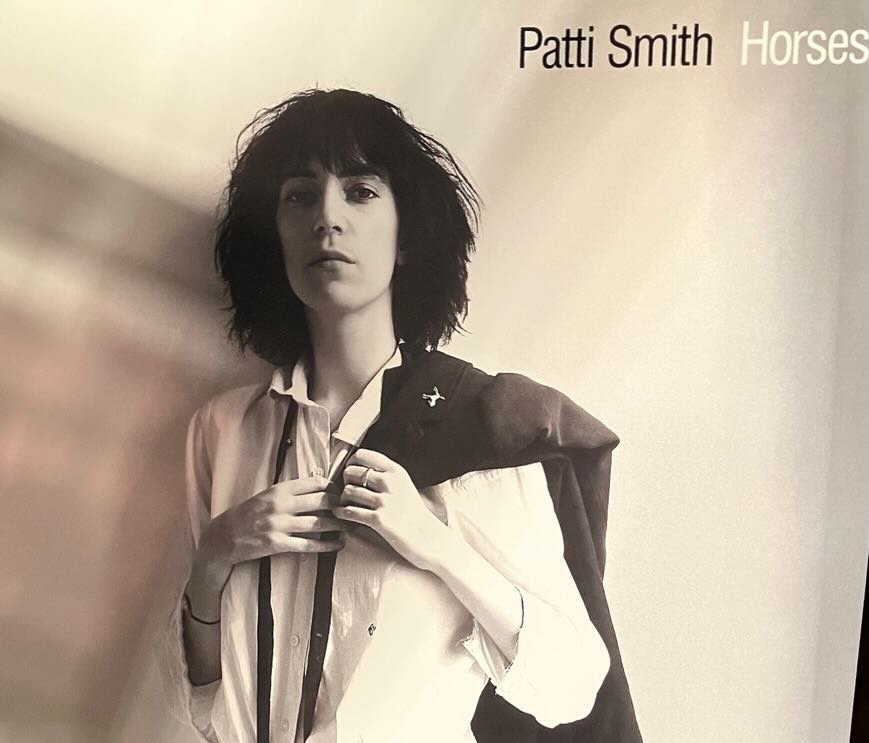
At the Chicago Theatre during her sold-out two-night shows celebrating the 50th anniversary of her debut album Horses, her passion for words and music came together in glorious fashion. When she sauntered onto the stage, instantly recognizable with her long mane of white frizzy hair to the familiar piano riffs of “Gloria,” the crowd stood up and roared. As an homage to Robert Mapplethorpe’s iconic album cover photograph, which caused such a stir at the time, she wore a variation of it: a white shirt, long dark jacket, worn black jeans, and black boots, a cross around her neck. Smith and her band—guitarist Lenny Kaye, drummer Jay Dee Daugherty, pianist Tony Shanahan, and her son Jackson Smith––put on a great show. Smith’s voice was loud and firm and full of conviction. Each time she spelled out the name G-L-O-R-I-A, the house lights came on, and the audience went wild, swaying in their seats, raising their fists in unison. Some even danced in the aisles.
On the mesmerizing “Birdland”—all cascading chords and surreal imagery—she put on glasses and began reading from a book, blurting out a torrent of words accompanied by her band’s guitars, piano, and drums, before tossing the text aside to recite the song from memory. At times it appeared as if she was speaking in tongues; her eyes closed, lost in the moment.
She reminded the audience that she was born in Chicago, during a blinding snowstorm no less, at Grant Hospital—now gone—in Lincoln Park. She was not “a special child,” she said, but rather a “sickly” girl. (During her first six years alone, she suffered a litany of ailments: bronchial pneumonia, tuberculosis, German measles, mumps, and chicken pox.) At one point a woman in the theater yelled out, “Fifty years, Patti.” Another voice from the dark, a man this time, “Thank you.” “No,” she says. “Thank you.”
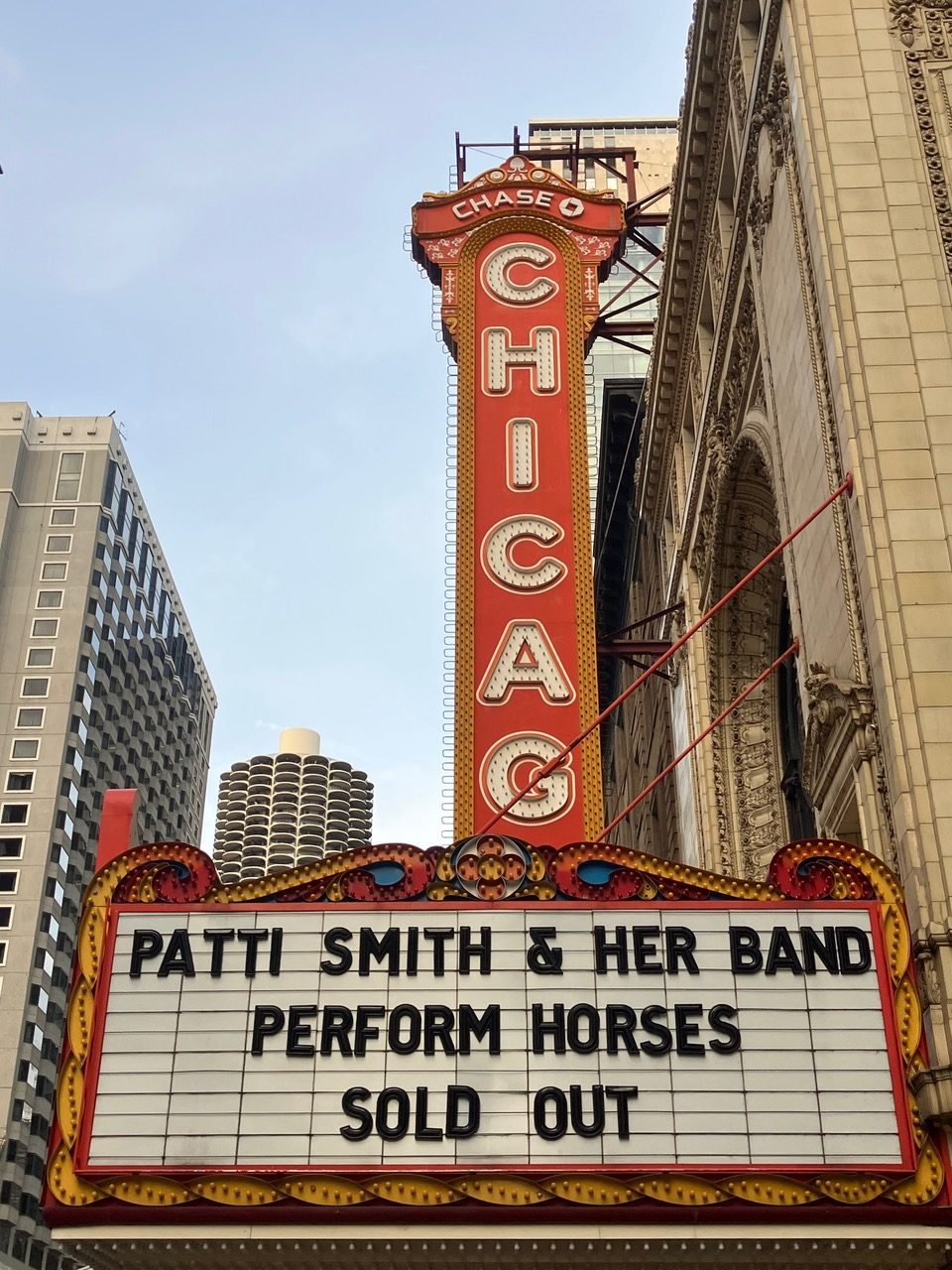
As the show came to a close, she sang the lovely and ethereal “Peaceable Kingdom,” its striking imagery evoking the spiritual and earthly harmony of the famous painting by the Quaker folk artist Edward Hicks. But the song was written years ago, she says, for the Palestinian people. During the encore, her daughter Jesse, on piano, accompanied the band on the Hopi-inspired song “Ghost Dance.” The evening ended with her timeless paean to democracy, “People Have the Power.”
Smith may be on tour to promote the 50th anniversary of Horses but she is also celebrating the publication of her latest volume. Bread of Angels. It's another memoir—her fifth. The others include Woolgathering, a small jewel of a book, that set the template for her subsequent work; Just Kids, about her relationship with photographer Robert Mapplethorpe, which won the National Book Award; the elegiac M Train, a sublime meditation on travel and coffee, life and death; and Year of the Monkey, a dream journal and travelogue. Her books have a homemade quality about them—many contain family photos. She also often includes her own Polaroid prints—she likes the immediacy of the camera—that she has taken over the years. They serve as souvenirs, mementos, and relics—tokens of daily life. Quite a few are of objects or places associated with artists she admires: Frida Kahlo’s crutches, Virginia Woolf’s walking stick, Sylvia Plath’s grave.
“When I was very young, my mother took me for walks in Humboldt Park…” she recalled in Just Kids. The family lived in Logan Square before moving to Philadelphia and then, finally, New Jersey. As a teen she danced and listened to the music of James Brown and the Shirelles. Music became her salvation, the radio her lifeline. But she also loved the images she saw in books by such artists as Modigliani, Picasso, and Albert Ryder. On her 16th birthday her mother gave her a copy of The Fabulous Life of Diego Rivera. “I imagined myself as Frida to Diego, both muse and maker. I dreamed of meeting an artist to love and support and work with side by side,” she writes. But she read all kinds of books, plenty of them. She was especially taken by the tales of two Scottish dreamers, the sickly Robert Louis Stevenson, who in his physical frailty she found a kindred spirit, and James Barrie, who created a magical place called Neverland where no one ever grew up. And when her mother bought her Another Side of Bob Dylan on sale in a drugstore for less than a dollar, she fell hard for the young man from Minnesota’s Iron Ore country.
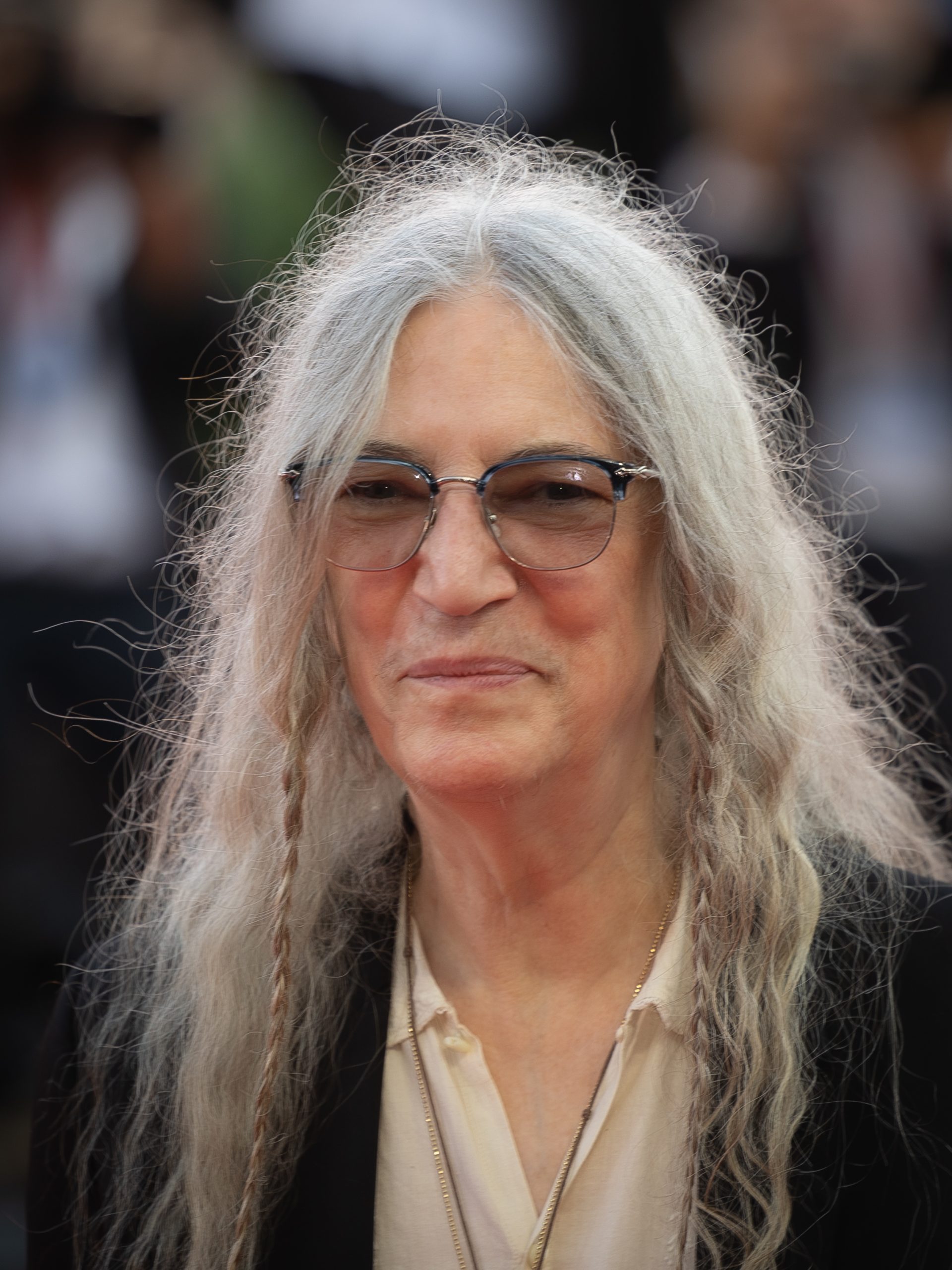
During her early days in New York, she was often homeless, spending hours in Washington Square Park. She took the subway to the end of the line at Coney Island. She fell asleep in subway cars and cemeteries. She worked for all of three hours at an Italian restaurant in Times Square—she learned quickly she could never be a waitress––before finding jobs in a series of bookstores: Brentano’s, Argosy, Scribner’s (where Edward Gorey and Katharine Hepburn were customers), and the Strand.
She published small collections of poetry. Her heroes were Rimbaud and Corso. Significantly, Mapplethorpe liked her singing voice. She sang him to sleep with the songs of Edith Piaf and the Child ballads. She bought a Dylan songbook and learned a few simple chords on a cheap guitar. She recited poetry with the immediacy and urgency of rock and roll. She co-wrote a play, Cowboy Mouth with Sam Shepard, her boyfriend at the time and she did some acting too but she knew acting was not for her. Her best role was just being herself.
All these bits and pieces are in her books. But her latest, Bread of Angels, offers a deeper and fuller look at her life, more autobiographical in ways than the others. She discusses her childhood and upbringing, growing up as a Jehovah’s Witness. She may have had the instinct of a preacher but instead of being an evangelist for the lord, as her mother may have wished, she chose art over religion because to Smith being an artist was also a sacred calling. She knew that at a young age: when she was barely 13, she made a vow to pursue the artistic life.
Smith is a singer who writes poetry, a poet who sings. She loves the sea but cannot swim. She’s an adventurous traveler who has been all around the world but cannot drive. But everything comes together in the art she has created over a lifetime. Transcendent. Luminous. Radiant. With her music, she combines body, mind, and voice and turns it into something unique. With her words, she creates gorgeous poetic prose that celebrates the wonder of language. She’s a natural vagabond, her notebook always at the ready, drinking coffee in a café. Smith turns ordinary acts into spiritual visions, her works elegies to life.
What is her secret? Nothing more than three chords and the power of her words.
Bread of Angels is available at bookstores and through the publisher's website.
