
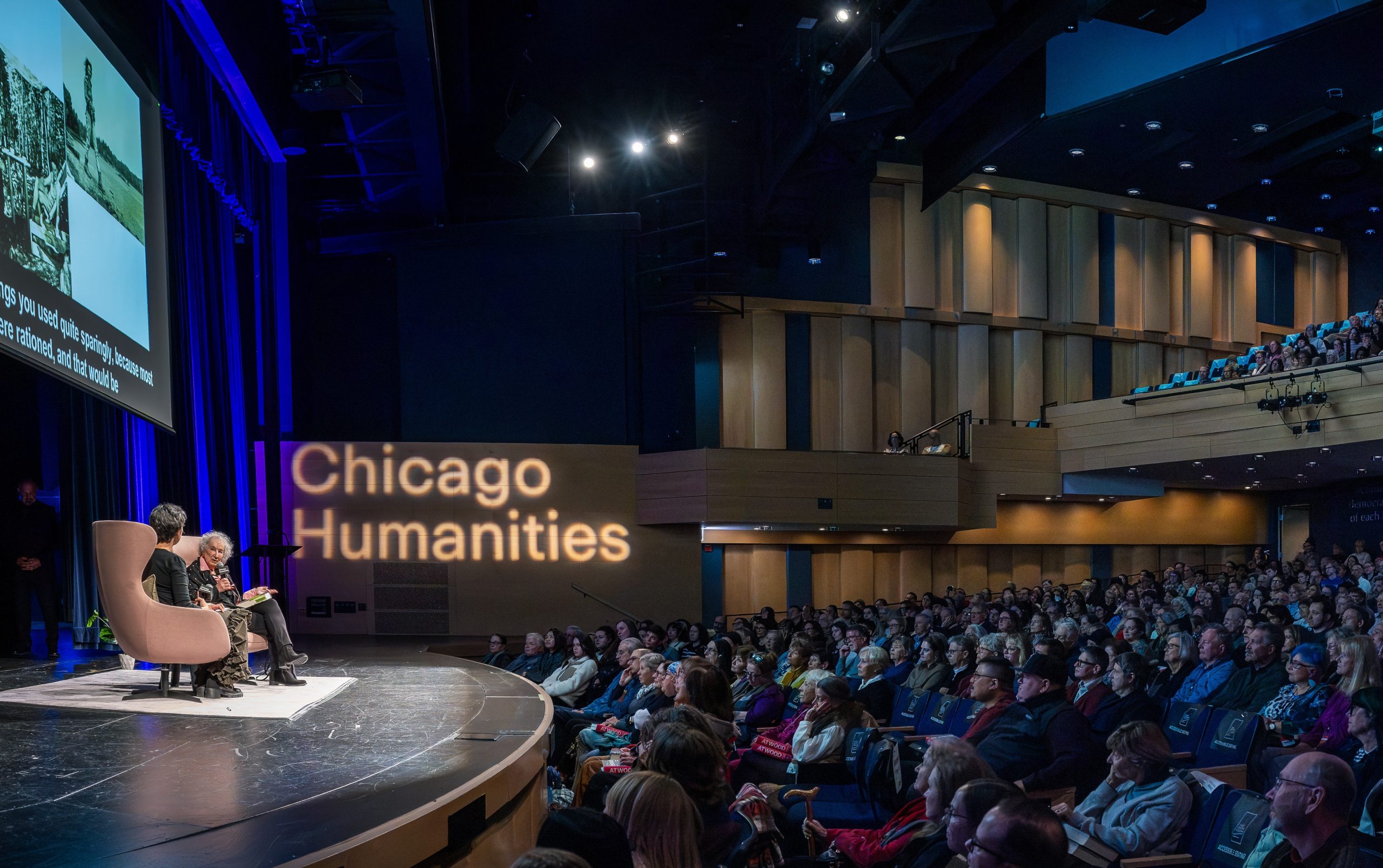
“There are many ways to do the work in this moment,” Women & Children First Co-Owner Lynn Mooney said by way of introducing prolific novelist and poet Margaret Atwood at a Chicago Humanities Festival conversation last month.
Outside the Francis W. Parker School auditorium, women dressed in Handmaid-style red robes with white bonnets were handing out anti-fascist pamphlets to event attendees.
But before Atwood’s celebrated dystopian novel The Handmaid’s Tale became a six-part Hulu series—catapulting the image of the Handmaid into a cultural icon representing modern-day women’s rights and reproductive freedoms—she spent her nomadic childhood running around the wild, isolated forests of northern Quebec with her scientifically minded parents.
Atwood is the author of more than 50 books of fiction, poetry, and critical essays. In her first memoir, Book of Lives: A Memoir of Sorts, she unfolds the story of her life from those early years in the woods to the moments and places in her life that inspired acclaimed books including Cat’s Eye, Alias Grace, The Blind Assassin, the MaddAddam trilogy and, of course, The Handmaid’s Tale and its 2019 sequel, The Testaments, which was a global bestseller and won the Booker Prize.
In her wide-ranging conversation for the Chicago Humanities Festival with novelist and The New Yorker staff writer Elif Batuman, Atwood read from the memoir and shared vignettes from her life. Batuman spoke about the humor throughout the book, and how it follows the different “characters” Atwood has inhabited throughout her life.
For instance, Atwood’s childhood nickname was “Peggy Nature.” She was known as Peggy instead of Margaret until she became a writer, and a friend told her Peggy was a frivolous name and she would not be taken seriously.
“But then I moved on to Margaret, and that’s the person who writes the books,” Atwood said, adding in a whisper, “It’s not me.”
At the time, she worked at a coed summer camp in Canada. “There’s north, northity north, northy north north north. And this was just sort of north,” she explained to much laughter from the audience. “I knew a lot about nature because I grew up with a biologist father. And he was a field biologist at that time, and we spent a lot of time in the woods.”
Atwood noted that when she meets people, she always asks when they were born so that she knows what they lived through and will remember firsthand, versus what they have just heard from others in stories.
“I do the same for my characters in books,” she said. “I find out their birth date to the month and day—sometimes I cast their horoscopes.” She then writes the months down the page, and years at the top, so she can pinpoint how old they are at any given point in the story, and what they would remember.
On the topic of memories, Batuman noted one of her favorites in Book of Lives, saying, “I love that this book shows you throwing tin cans as a child, throwing tin cans at a cutout of Hitler.”
“It was something you did,” Atwood said to more laughter. This was representative of the overall tone of the night: very serious topics (World War II) juxtaposed with humorous asides at the things we do to get by, to survive, when things are hard.
“A lot of people describe you as prescient,” Batuman said later on. “I totally understand why they say that… The most striking example is maybe The Handmaid’s Tale TV show, where it starts filming in the fall of 2016 and everyone thinks Hillary is going to win, and then in the middle you realize that you are making the defining show of the Trump era. How do you feel about the term ‘prescient’? Is there something more or less complicated going on?”
Fiction writers are always working from the starting point of “what if,” Atwood explained. She went on to explain her thinking around the creation of her now-iconic novel:
"What if some of the things that people were saying in the early 1980s—which saw the rise of the “religious right” as a political force—what if they had the power to enact some of the things they were saying they would like to do, and then actually did it? How would that work out? If you wanted all women to be back in the home, how would you get them there? How would you round them all up, now that they’re running around having jobs, and credit cards, and apartments of their own—perish the thought—how would you get them back into, say, 1850? It’s partly working that out. Some people object to having you say out loud the thing that they have said themselves they want to do."
The auditorium was brought to silence.
“I’ve never believed, having been born in 1939, I’ve never believed anyone who has said ‘It can’t happen here.’ Because anything can happen anywhere, given the circumstances,” Atwood continued.
She then turned her attention to current events in Chicago, and the first thought she had when she saw news of the ICE raids.
“It’s a real big invitation to actual criminals to send people out in marked cars with their faces covered to grab people off the street,” Atwood said, “because the next thing that’s going to happen is that other people are going to pretend to be those people. And you will not be able to tell the difference… Just really a bad idea, kids, to let unidentifiable people go around grabbing people off the street.”
The audience began to applaud, and she concluded: “Because you’ll be next.”
Margaret Atwood’s Book of Lives was published in November and is now available at independent bookstores everywhere.
The Chicago Humanities Festival’s Spring 2026 festival dates are April 18, May 9 and May 17, with programming to be announced next year. For more information, visit chicagohumanities.org.
Now through December 31, Third Coast Review is raising money to support the diverse roster of writers you know and appreciate for their thoughtful, insightful arts and culture coverage in Chicago and beyond. Everything raised during this time will go directly to paying these writers a well-deserved year-end stipend; you can make a contribution here. Thank you!
