With the opening of Robert Weinberg’s poem—“On North Broadway/Middle aged women roll their pushcarts into Rexalls”—you know you’re not in Kansas any more. Instead, you’re back nearly 40 years to a younger Chicago, before Michael Jordan and the Bulls had won even a single championship, before the death of the Democratic Machine, at a time when you still bought your books (and poetry journals) at bookstores.

Weinberg’s poem “French High Kickers” appeared in October 1988, in Volume 3, Number 4 of the Oak Park-based poetry journal Lucky Star, near the end of the magazine’s seven-year run.
Those opening lines are a reference to the Rexall drugstores that, into the 1980s, seemed to occupy every corner in the city and many of the close-in suburbs although long gone now, elbowed aside by CVS and Walgreens. They also recognize the Chicago habit of putting an “s” on store names, such as Jewels for Jewel.
“French High Kickers” is a short imaginative journey into an alternate universe inside the Rexall in which, among other things, there is “No January White Sale in June/With loads of wash on the lines over the courtyard/On days we show flags of all the nations of the world.”
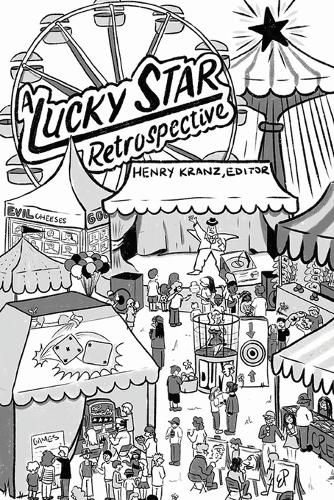
How many people hang laundry on the line anymore? Nonetheless, we can read about such “loads of wash” again and get a glimpse into a 1980s literary magazine and its 300-plus poets, long after they’ve shuffled off to Buffalo or are creaking through their retirement, because of the newly published A Lucky Star Retrospective from editor by Henry Kranz and his Erie Street Press.
One thing that hasn’t changed is that poetry ain’t the road to big bucks, and, as Kranz makes clear, the fifteen issues of Lucky Star, published between 1982 and 1989, never came close to turning a profit. Despite many editorial strategies to boost reader interest, no way was found “to overcome the lack of cash flow that drove Lucky Star from the firmament.”
Brought Back to Life
It’s a common story for poetry magazines, probably since the invention of the novel: An idealistic editor wants to make ripples in the literary pond and battles against storm tides to win readers but, ultimately, goes belly up.
Kranz’s 83-page Retrospective brings Lucky Star back to life in a way, giving a taste of its poetry and some examples of the journal’s feisty, collegial spirit
Kranz’s 83-page Retrospective, however, brings Lucky Star back to life in a way, giving a taste of its poetry with one poem for each of the 15 issues and some examples of the journal’s feisty, collegial spirit. In addition, Kranz is hosting A Poetry Carnival of the ‘80s at 4 p.m. on Sunday, March 22, at the Dandelion Bookshop, 129 S. Oak Park Ave. in Oak Park.
One of the strategies to make Lucky Star more than a run-of-the-mill poetry magazine was a feature called Perturbations in which readers could praise or complain about the journal and the editors could praise or complain about the poets and readers.
For instance, one reader wrote and Kranz printed: “I like the name Kranz; sounds like cranking up one of those old stereos.” Another: “I just received Lucky Star 3/4. It looks great, and I think the mix of editorial satire and serious poesie is engaging.”
“Serious poesie” was represented by the likes of Ray Bradbury, Maxine Chernoff, and Lyn Lifshin as well as an array of Chicago-area writers, such as Agnes Wathall whose poem “The Chess Set” opens: “My sister dreamed/about carving a set/out of basswood and walnut—/one where the queens would have/the ballooning bosoms and midget waists/of television stars/and the kings would be short and thick,/wearing business suits and carrying/attaché cases…”
The “editorial satire” included Kranz making fun of his contributors, particularly those who failed to send in a biographical note. In such cases, he’d make one up, such as “NANCY BERG—grew up the daughter of David Berg, the hot dog” and “MARGOT TREITEL—lives in a planned community so that everything that will ever happen to her is already known.”
And, sometimes, serious poesie and humor were found in the same piece, such as in the fourth part of Pamela Miller’s “Excerpts from a Report on Urban Crime”: “Street gang names on a/library wall:/The Samuri Bishops/The Bronto Boys/The Radiation Riders/The Flaming Lady Tadpoles From Hell.”
"And not to be outdone by any parish carnival dunk tank, we ran a feature entitled, What’s Wrong with This Poem?"
What’s Wrong?
And then, as Kranz explains, there was perhaps the most unusual aspect of Lucky Star:
And not to be outdone by any parish carnival dunk tank, we ran a feature entitled, What’s Wrong with This Poem? This involved presenting a poem and asking the readers to provide criticism of it. Naturally, this resulted in a flurry of perturbations that we gladly shared with our readers in subsequent issues.
This happened to a poem by Ron Schneider, and his note to Perturbations is included in the Retrospective:
“Utterly outrageous to find one’s own poem retitled, ‘What’s Wrong with This Poem?’ But, hey, the commonly seen alternative is the high seriousness of poets and poetizers who think of their art as eternal or at least striving for establishment. So, I am quite amused and pleased. And wonder what anybody will say.”
Four decades ago, Lucky Star was that kind of magazine. It’s fun to have it back again, for a little bit.
A Lucky Star Retrospective is available at bookstores and through the Erie Street Press website.
