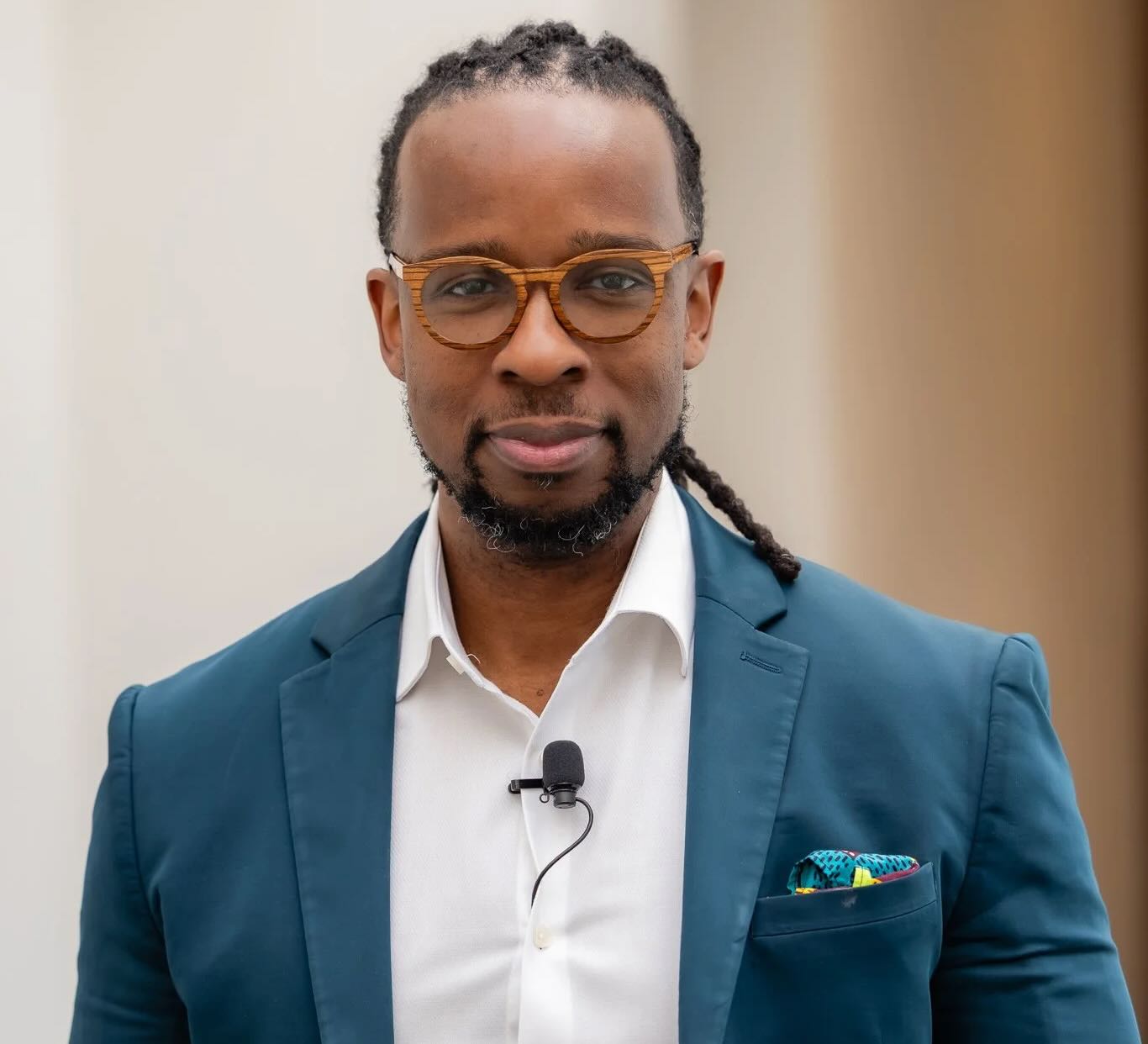
Chicago Mayor Brandon Johnson interviewed noted anti-racism writer Dr. Ibram X. Kendi at the Chicago Humanities Festival’s Bridgeport Day on April 18. The New York Times-bestselling author of How to Be an Antiracist and inaugural director of Howard University’s Institute for Advanced Study, Dr. Kendi engaged in a lively discussion about his historical work with Mayor Johnson, an engaged interviewer, former CPS social studies teacher, and Chicago Teachers Union organizer.
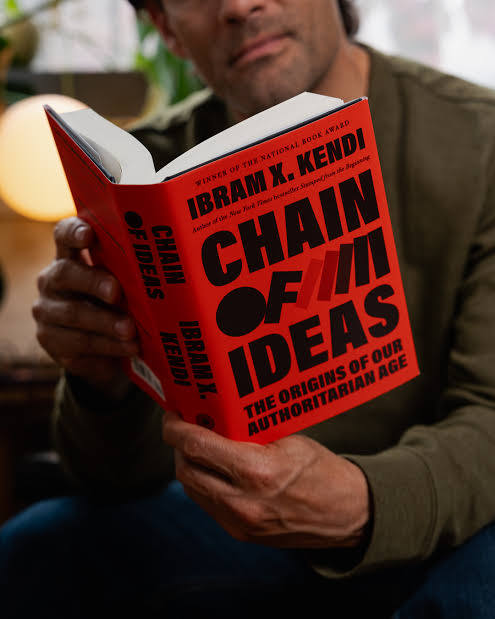
In front of an enthusiastic crowd at the recently reopened Ramova Theatre, the mayor handily engaged the Howard history professor about his new book, Chain of Ideas: The Origins of Our Authoritarian Age, which explores how “great replacement theory” (GRT) drives our current authoritarian political landscape. This March publication is a counterpoint of sorts to French writer Renaud Camus’s 2011 book Le Grand Remplacement, which claimed white Europeans are being demographically and culturally replaced by non-European immigrants from places like Africa and the Middle East, in an “emotional, not empirical, sense.”
They noted that about 91 percent of European Union residents are born there, and about 86 percent of Americans are born in the States, hardly a cause for this racist replacement panic. “The data doesn’t support these fears,” Kendi said, “but mainstream media and social media do, so it's become propaganda masquerading as journalism.” (Johnson also touted Chicago’s homicide rate at a 60-year low.) “Privilege is a relational concept,” Kendi said, and he also talked about trying to treat migrants with more dignity, as with Lakeview’s District 19 Mutual Aid charity.
“We should circulate the truth in all its complexity,” Kendi said, especially since the wealthy are buying and consolidating large media entities, promoting skewed access journalism and “fake news” when reports are supposed to be holding the democratic line as the fourth estate. “Replacement theory is the engine of authoritarianism,” Johnson said.
The pair compared similar origin stories—Johnson on Chicago’s West Side and Kendi in New York’s Jamaica Queens neighborhood—where each were loyal to their regional sports teams, of course. After Kendi’s “hoop dreams failed,” he got a newspaper internship in Mobile, Alabama, which changed his career trajectory. He recalled interviewing local high school students, asking “would you prefer to play for a Black coach,” and their answers revealed the impact of questions about race.
Johnson concurred, citing that one of his top five favorite books is The Mis-Education of the Negro by Carter G. Woodson, the “father of Black History Month,” a 1933 tome about the impact of slavery on the Black psyche. Kendi then noted that he is also the Woodson Endowed Chair in History at Howard, leading to the question, “why are people consenting to their own domination?”
This query is the root of the “great replacement theory” conversation, “the ultimate hoodwink” fabricated by lies, propaganda, mis- and disinformation, predicated on the false idea that “whites lose when Blacks win.” Globalist elites use racism, sexism, homophobia, and more to create anger and divide communities who then flock towards authoritarianism, as seen with Putin in Russia, Modi in India, and Meloni in Italy.
This division also shows up in Thomas Jefferson’s Notes on the State of Virginia, a 1785 book (his only full-length publication) that surveys the commonwealth’s geography, natural history, culture and laws. Jefferson seemed to be an early adopter of these continuous race wars, considering that either “they or we” will go extinct.
Dr. Kendi and Mayor Johnson’s chat moved from America’s colonization to its gradual emancipation, including covering some back-to-Africa movements intent on sending the formerly enslaved to Liberia and Sierra Leone. Kendi likened white assassins, both literally and figuratively, to racist foot soldiers, from Dylan Roof to Elon Musk. Kendi then listed the issues that have propelled GRT over the last decade or two at home and abroad: ongoing inflation, the 2008 recession, the 2015 EU migrant crisis, the COVID pandemic, and ongoing terror attacks.
Of course, the aforementioned social media thrives on rage bait like the GRT, which can also coordinate authoritarian leaders around the globe, from Hungary to Venezuela. “We need a transnational working class to combat these repressive movements,” Kendi said, “as well as the idea that ‘if I can’t be supreme, I’m nothing’ and that power is more important than privilege.” He decried hoarding wealth to create artificial scarcity.
After the hourlong discussion, audience members asked questions like “how do we engage white Americans in this fight?” First, it was noted that “Black people tried to tell y’all” about this encroaching oligarchy, but now that it’s here, we should link people to these struggles and be a mirror to our neighbors to make connections. Our collective humanity, which GRT undermines, combats the hysteria and denial of racism. “Even in our differences, we are linked as humans,” Kendi said. “Macro changes come from micro changes,” Kendi added, referencing recent social experiments like Stockton, California’s two-year Universal Basic Income project.
Mayor Johnson also applauded Chicago’s own grassroots ICE-resistance network, and encouraged Chicagoans to participate in May Day Strong “Workers over Billionaires” event, with no work, no school and no shopping on Friday, May 1.
Aristotle (and others’) “Great Chain of Being” (scala naturae) first categorized nature as a hierarchy, evocative of today’s GRT. Shakespeare’s lovesick servant character Malvolio observes that "Some are born great, some achieve greatness, and some have greatness thrust upon 'em," in a Renaissance meditation on who’s on top and why. Today’s ubiquitous “Make America Great Again” slogan is merely that recycled racist slur. Those who appropriate “great” terminology to divide humanity are society’s weakest links because they don’t understand crucial connection among all.
Check out the Chicago Humanities Festival’s programming for Lakeview Day on Saturday, May 9, and Northwestern University Day on Sunday, May 17, as well as additional events in June and October.
Did you enjoy this post? Please consider supporting Third Coast Review’s arts and culture coverage by making a donation. Choose the amount that works best for you, and know how much we appreciate your support!
