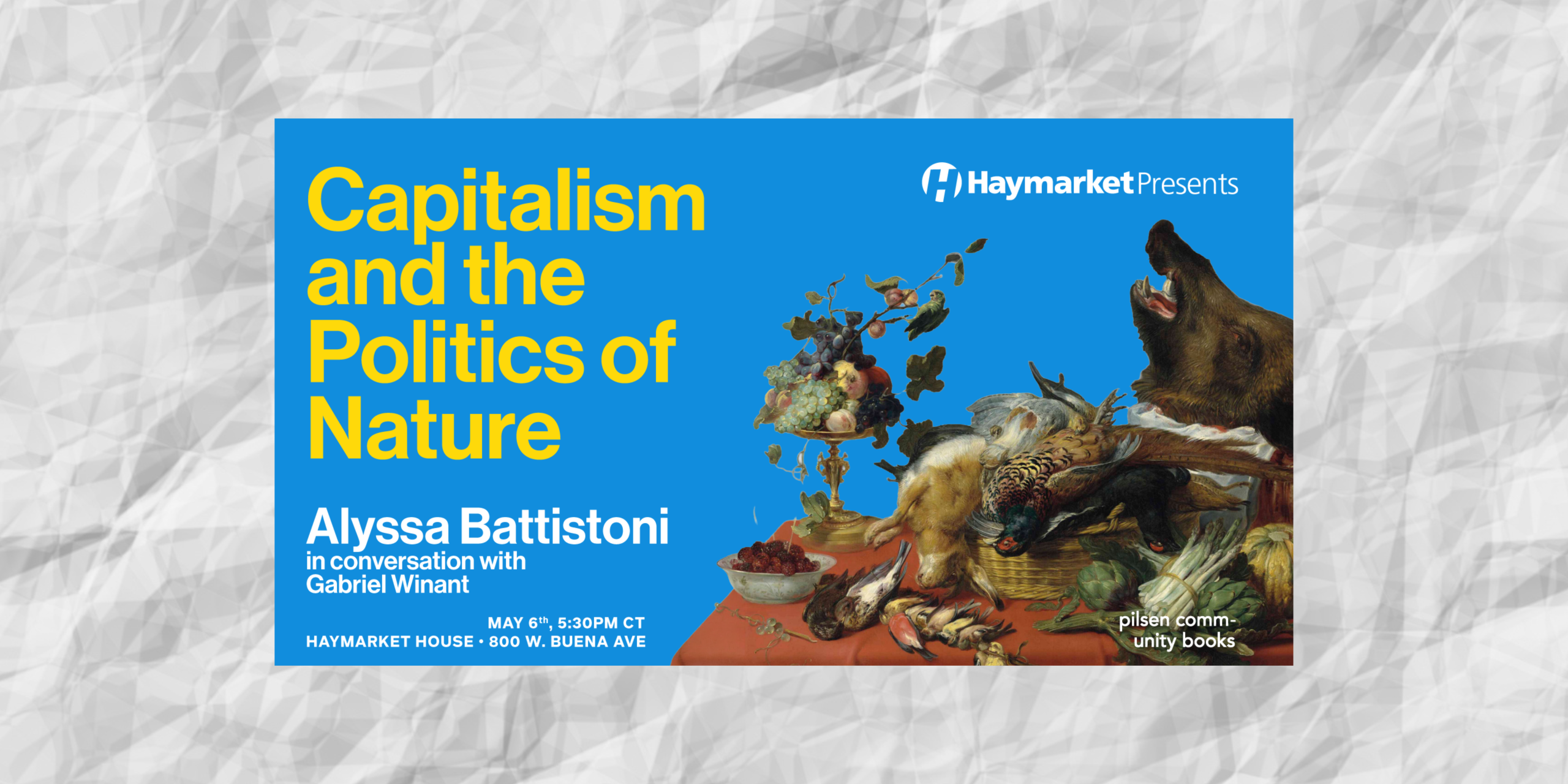
My entire life, I sought the language to push up against the idea that God made animals to eat. After reading Alyssa Battistoni’s Free Gifts: Capitalism and the Politics of Nature (Princeton University Press, 2025), the journey has ended. Battistoni’s work presents significant philosophical inquiry into the value of nature within free market economics. A professor of political science at Barnard College, Battistoni is the co-author of A Planet to Win: Why We Need a Green New Deal. Free Gifts expands upon Marx’s articulation of capitalism's relationship to the elemental and material world while offering ambiguous freedom as an antidote to our existential dread.
Capitalism’s greatest trick is making consumers believe that we have a choice. In actuality, every choice is made within the rule of markets. The destruction of our planet isn’t a consumer choice–it’s writ into capitalism, from the very moment that it plumed out of the factory. Where Marx calls capitalism a vampire, Battistoni reveals capitalism to be an alchemist. It doesn’t just consume, it “flows to whatever it can find returns.” Neither malicious nor benevolent, capitalism ceaselessly transmutates everything it touches. We must go further than moral debates on environmentalism and imperialism. Another problem with consumer responsibility is that “market coordination is premised on our ignorance.” Consumers become estranged from our actions under capitalism, therefore alienating us from any meaningful action we may want to take against pollution and deforestation. How are we to take responsibility for being complicit when we aren’t allowed any real choices at all?
Answers have emerged over the past several decades and Battistoni addresses their nuances. In contemporary discourse, the dilemmas we’re facing are met with either climate nihilism or techno-fascism. Either we’re all doomed to extinction, or some humans will survive through the abdication and neglect of those who can’t afford it. Instead of going down either path, Battistoni suggests that “conscious planetmaking...simply means taking collective responsibility for maintaining, remaking, and cultivating the multispecies world upon which rely.” By collective responsibility, she directs us towards the political; that we as a species must develop the political will to put an end to market rule.
At the time I began my undergraduate education at the University of North Texas, neighbors and citizens were organizing to ban fracking due to various environmental and health concerns. While residents successfully moved Denton City Council into putting the ban on the ballot—which had been voted in favor—Texas Governor Greg Abbott made it illegal for any municipality within the state of Texas to “regulate” oil and gas within the next year. His top campaign donors for 2014 and 2015 were from the energy and oil/gas sectors. This anti-democratic and authoritarian corruption is one of many examples of the inherent unfreedom of capitalism. Battistoni argues that the consensual exchange which capitalist market freedom was premised on does not truly exist. For, in terms of the “free market” being an alchemist, the transmutated “surplus matter” must go somewhere. This exchange violates the bodily autonomy of those who do not have the power to refuse the poisonous matter. Like the people in Denton, Texas, we are all trapped inside of a larger political mechanism that denies autonomy. Though our challenge has been getting political bodies to “make different kinds of decisions than the ones that capitalism offer,” the hypocrisy of capitalism lies in the “disparity in power at the heart of class rule.”
Though Free Gifts does not provide a blueprint, it does fiercely address the limitations of free-market capitalism. Borrowing from Simone de Beauvoir, Battisonti states that ambiguity can provide “a different path through the dilemma of necessity and freedom.” Ambiguity presents “the Earth as grounds for our consciousness and our being, the outline for our projects, the world that we attempt to grasp and in which out actions necessarily unfolds.” In other words, interdependent freedom can get us closer to understanding the needs of both the human and more-than-human world in order to work towards a more sustainable future. Ambiguity can collapse our separation from the nonhuman world and open us up to a fuller spectrum of existence.
Battistoni does not want the burden of solving our climate crisis. Her argument never claims a solution. I don’t have any answers myself, either. I have a Master of Fine Arts in Creative Writing. I temper my climate anxiety by writing poetry. This is not unique, for I am among dozens of poets concerned with ecopoetics. I thought of a poem as I read Battistoni’s book. The poem is called “Hereafter” and it comes from Rose McLarney’s Forage (Penguin Books, 2019). The poem sinks the reader into an oceanic world where “crashed cars” become “a place to live” for fish. The speaker of the poem imagines the known world completely under water–free from human control and domination, full of aquatic life–and suggests, “No notion that a next life / above the one here / is ever to be had. Not even the halos / of opalescent motor oil / making the motion of ascending elsewhere.” Everything that we are and everything that we need exists here on this earth, right now. In the race against ruin, what will we make of it?
Alyssa Battistoni will be discussing her latest book with activist-historian Gabriel Winant at Haymarket House, 800 W. Buena Ave., on the evening of May 6. You can order tickets here.
