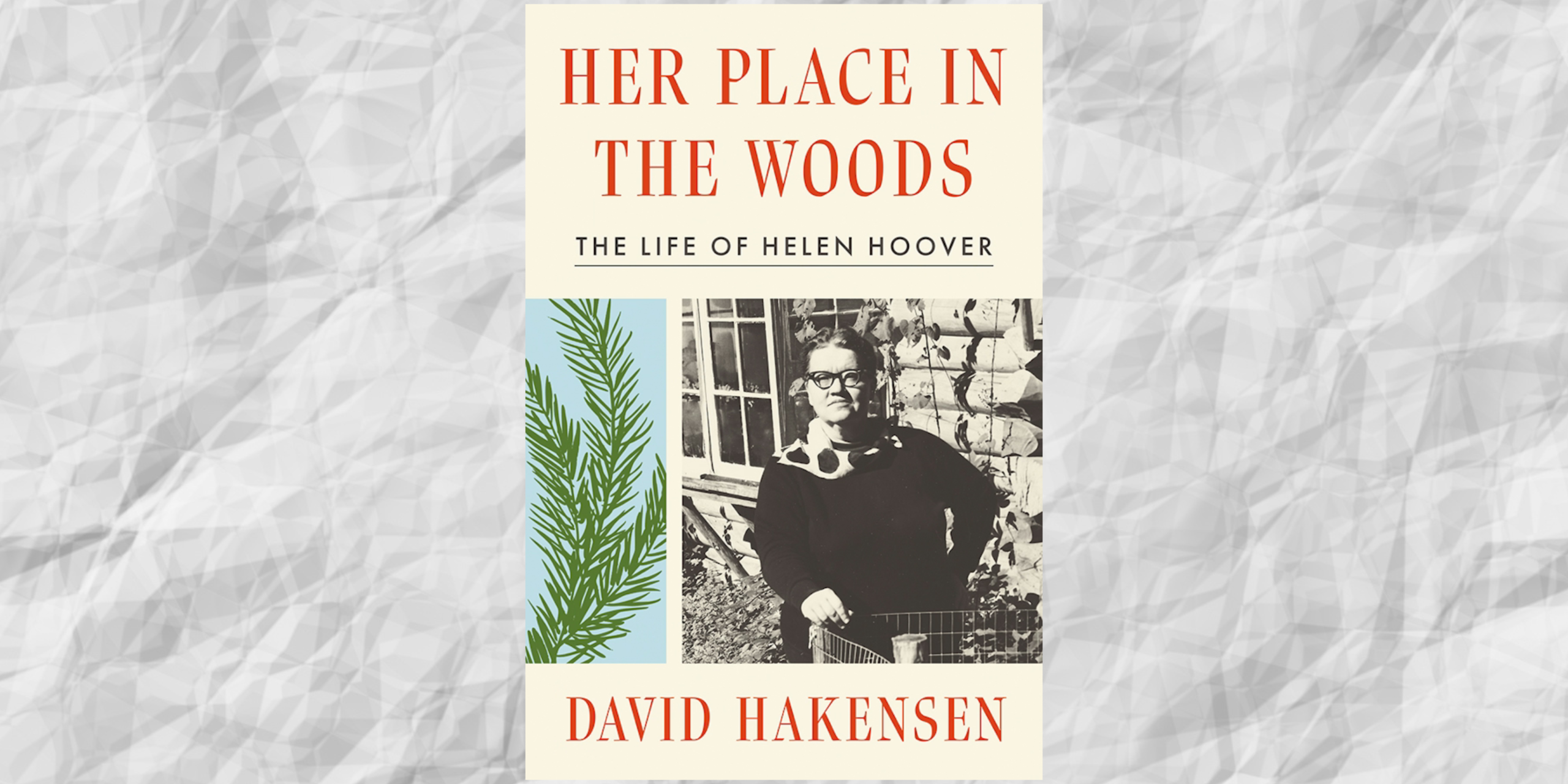

I restrict my relationship with Nature to short forest preserve visits. I prefer my body sheltered, my water tapped, and my immediate environment free from things that might kill, injure, or induce a rash, thank you very much. I never understand the desire to “go off the grid”—a phrase often accompanied by “hikers discovered the remains.” But for those who choose to leave civilization behind to face every fresh, organic hell Nature throws at them and survive… Yeah, no, I still don’t get it. But it takes all kinds.
Helen Hoover and her husband Ade were “all kinds.” As Her Place in the Woods: The Life of Helen Hoover by David Hakensen makes clear, they found their place—and a successful regional writing career for Helen—in the forests of Minnesota.
Her Place in the Woods isn’t a book I’d ordinarily seek out. Man versus Nature nonfiction is an occasional taste, especially survival tales or…whatever the opposite of survival tale is (cessation tale?). They have their rewards, if only to prove that staying out of the remote stretches of the woods/arctic/seas/desert is a good idea.
Her Place in the Woods, isn’t a tale of survival so much as existence far and away from the madding crowd. Helen and Ade sought a little place far—but not too far—from others, where Nature provided a modicum of challenge. No one dies of dysentery nor becomes grizzly bear chow in Her Place in the Woods, and yet it managed to hold my interest with nary a death or self-amputation.
Helen Hoover was a chemist and metallurgist who (with husband and artist Adrian) chose to live in the woods at a time when ditching civilized society for the Great Outdoors was an odd thing to do. After living and working in Chicago for a number of years‚ the two bought land and a pair of cabins off the Gunflint Trail in northeastern Minnesota in the late 1950s. They lived there for quite some time, earning money through illustrations and stationery designed by Ade and Helen's writings. First imagining herslf as a writer of fiction, she joining the ranks of nature writers like Rachel Carson. Helen turned out numerous magazine articles and a handful of books about living amidst the wild things and whispering pines.

While she’s not a household name today, Helen’s writing caught, doing well in a world where people still read magazines. Urbanites and suburbanites and their children—presumably feeling disconnected from the Green—lived vicariously through her accounts of Minnesotan flora and fauna and life in the cabins. Helen and Ade’s lifestyle seemed exotic at the time, perhaps, the hippie-powered back-to-the-land movement still a few years away. Hoover shared stories of befriending and feeding a family of deer, raising chickens, keeping bears out of their food stocks, and other folksy anecdotes and observations of the life in the woods.
Hakensen turns up some interesting tidbits about Helen herself. The early years of bitter struggle in Chicago, spent working as a metallurgist in a male-dominated field, and making ends meet during the Depression. Stories of Helen's interactions with another unpleasant beast, her torturously genteel and clearly troubled mother Hannah, make for compelling reading. Hannah attempted to separate Helen from the rest of their family back in their Ohio hometown, tossing out her mail and accusing Helen of being licentious hussy even as she worked to support them both. Helen was not to be denied, however, and when Ade showed up they made a formidable couple. Their adorable courtship alone is worth preserving under a bell jar. Hardcore Chicago history nerds will enjoy the charming descriptions of recreation on a budget for young couples in 20s, 30s, and 40s Chicago. Beaches, forest preserve picnics, and other familiar Windy City sites and practices that are still with us.
When Helen’s mother died, the two pursued their dream of escaping to the woods. They had no romantic notions about it, which was good because the woods were entirely unsympathetic. We read tales of the Hoovers running out of oil during the winter months, forcing them to burn rags, scraps, and a mattress to stay warm. Most of their meals came from cans, gardening being a challenge owing to hungry critters, and leading to a yikes-inducing story of Helen bleeding pink after cutting herself—a self-diagnosed iron deficiency. And while they made friends with a nearby lodge owner, more than a few of their neighbors were suspicious of the city-slicking kooks who fed wild animals. Not that that stopped the occasional hunter from sneaking onto their land in search of overly trusting game. This does lead to a few amusing stories of Helen and Ade confronting and chasing off interlopers with a rifle or bullwhip.
Most of Hakensen’s book feels like side views of the experiences Helen shared in her main books: A Place in the Woods, The Years of the Forest, and The Long-Shadowed Forest (all reissued and conveniently available through Her Place in the Woods publisher University of Minnesota Press). Their life isn’t one for the big screen, or even the little screen. Yet, it recalls a time when, as the United States grew more connected, escaping to the woods had a last-stand appeal. At the same time it reminds us that getting away from it all also means leaving behind fresh produce, emergency healthcare, and other basic comforts that seem far less frivolous when they’re several miles away. But it was, at least for a few years, a good life for the Hoovers. She left her mark on many readers, since old and new fans continue to make the trek to the Hoovers’ former cabin to this day.
Her Place in the Woods is not an thrill-a-minute. It lacks a payoff, but few lives have one. Still, it’s a heartening tale of two oddballs who knew what they wanted, did the work to get it, and stuck it out no matter how unpleasant the "wild life" might've gotten. Not so much Man versus Nature as Helen and Ade seeking a separate peace with it.
Her Place in the Woods: the Life of Helen Hoover is available at bookstores and through the University of Minnesota Press website.
