The second day of the Chicago Jazz Festival veered into the unexpected for me. The Pritzker Pavilion stage featured an international roster of musicians and singers.
Opener Sarah Marie Young blew me away with her high-voltage vocals and cool approach. Young electrified the international jazz scene with appearances at the Montreux Jazz Festival and fired up Chicago audiences with a live album recorded at Schubas.
Young's range is impressive. She belts out the stratospheric high notes without a hint of shrillness, unlike some of the more recent popular music. I walked into the pavilion as she was performing a soulful rendition of John Lennon's "Jealous Guy." The rhythm and arrangement sounded familiar, tugging at my heart. Young announced that the arrangement was a tribute to Donny Hathaway. Now, Young's version joins his in my favorite renditions of that song. A solo performance of Lennon/McCartney's "With A Little Help from My Friends," featured Identity Performing Arts dancer Joey Castillo. Perhaps it's the times we are living in or my own sense of hope, but this performance particularly moved me.
Young continued the journey with a song she heard in a Hallmark Christmas movie! Harry Connick Jr wrote it, and it features Kim Burrell. "Song for the Hopeful" followed the theme of the set and featured Young's husband, guitarist Guy King. It is a beautiful song, and something about hearing it performed so beautifully, while surrounded by my fellow Chicagoans, drove it home. Look for Sarah Marie Young's upcoming performances and discover her amazing and soulful voice on streaming services like Spotify.
Next up was a journey to Brazil, led by bassist Marcel Bonfim and singer Silvia Manrique. There are ASL interpreters at all of the Chicago festivals, and while they could not translate Brazilian Portuguese, they were swaying and grooving to the music. It was still a perfect translation. Bonfim and Manrique glided into that familiar Brazilian tempo that calls forth the multi-colored sand of the beaches in Rio and throughout Brazil. The tempo is languid and sexy.
Manrique's voice is a silky and lilting alto. She has performed with Paulinho Garcia, another favorite from Chicago by way of Brazil. Bonfim is an excellent bassist and also possesses a mellow, refined singing voice. The bossa nova and samba rhythms infused the set. It was challenging to sway in my seat. The music evoked the beautiful tropical plants and brilliant colors of Carnival in Rio.
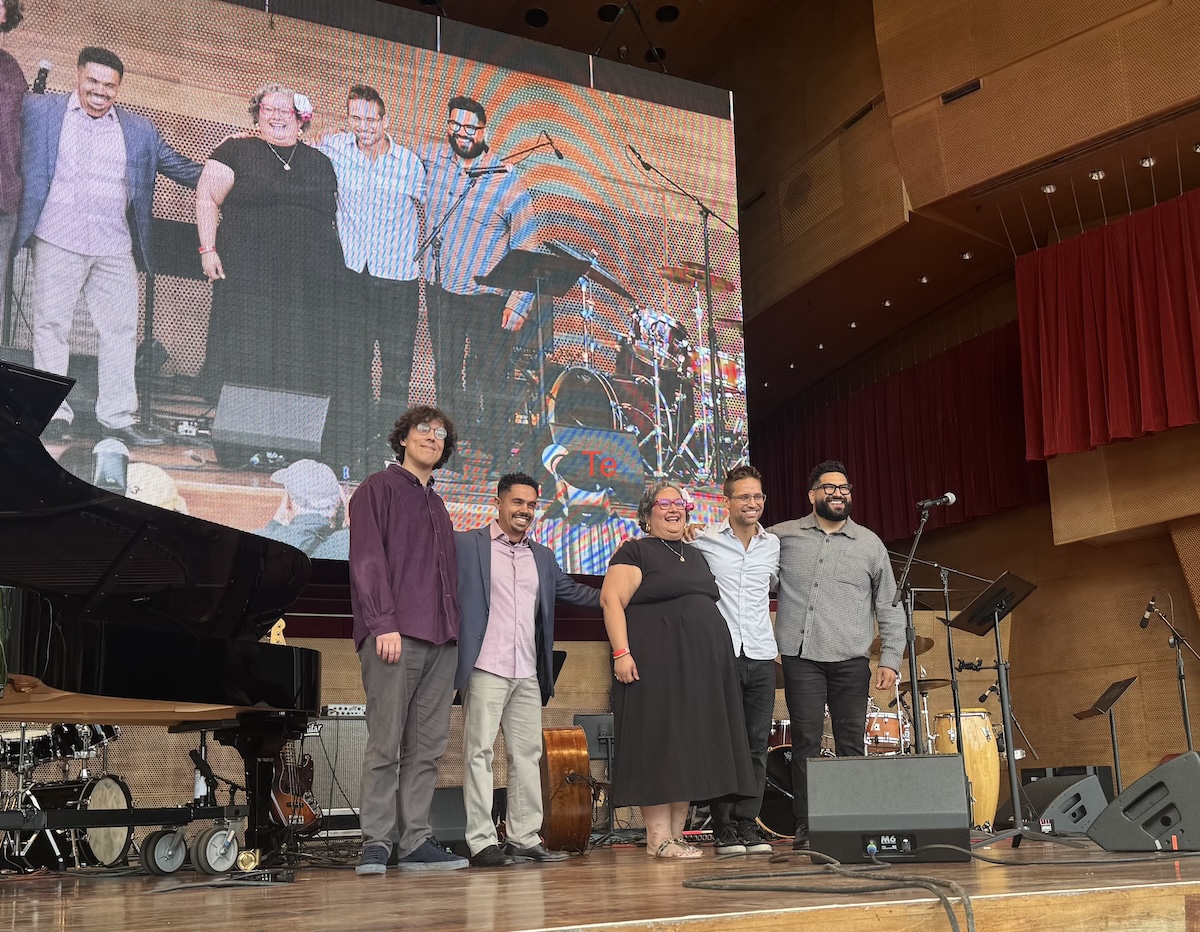
An excellent band accompanied the duo. Casey Dahl on piano, Johnathan Wenzel on drums and percussion, and the amazing Gerald Garcia on flute and saxophones. Samba and bossa nova are atmospheric and evocative of warmth, skin, and languid afternoons in a hammock. Well, that's what I was feeling. It was a bit chilly in the park that day, and I welcomed the warmth transmitted from my mind's eye to my body. Manrique has an EP titled Sonho with Paulinho Garcia, and Bonfim has an album titled Farewell/Despedida. They are worth listening to for a taste of their musical prowess and songwriting.
Patricia Barber is a Chicago star. Back in the day, she played at places like Gold Star Sardine Bar and, of course, The Green Mill. Her piano playing and singing style are unique, and I found myself spellbound by her set, accompanied by an excellent group of musicians. Emma Dayhuff on bass, Neal Alger on guitar, and Jon Deitemyer on drums formed the perfect combination, each outstanding without overshadowing the others.
Barber has a sultry alto and excellent phrasing for both her poetic compositions and the covers she performed. Barber and Dayhuff performed David Bowie's "Wild is the Wind" for an ecstatic crowd. Dayhuff's bass played melody and harmony to Barber's piano and voice. Dayhuff used her bow, which I rarely see in jazz performances, but she used it to spectacular effect.
Guitarist Neal Alger was jamming on every song with two guitars. One was a dreamy-sounding seven-string acoustic. He played Spanish-style interludes with Barber's poetic and spacy song styling. "If I Were Blue" was a sensuous play between Barber's voice and piano, and Alger's atmospheric strumming and picking. Barber's intonation and enunciation are as perfect as her studio work. The emotion in her lyrics has a palpable quality, particularly in this song. She mentions artists such as Picasso, Goya, and Edward Hopper, who contributed to the visibility of the music. The muted colors of Hopper against Picasso's Blue Period paintings, and Goya's "Fighting Cats" (a personal favorite) came to life in my mind's eye.
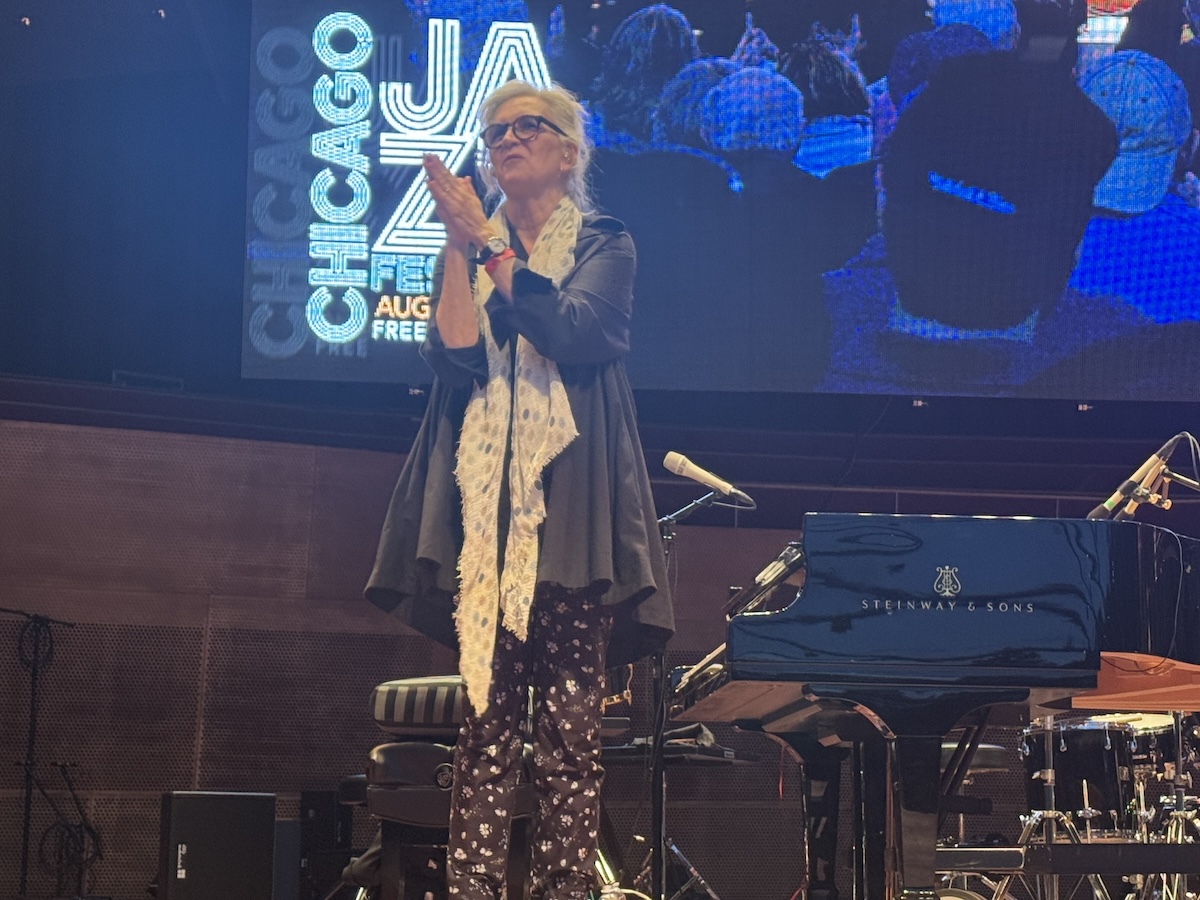
I loved Barber's arrangement of Rodgers and Hammerstein's "Shall We Dance" from The King and I. If her arrangement had been in the movie, I think Anna would have been the Queen of Siam, especially if it were Yul Brynner. I love Barber's lyrics in particular, as only she can interpret them. They are deeply personal, and that depth of feeling came across even on the giant Pritzker stage. I was carried back to the Green Mill, listening to her whispered lyrics and drawn-out consonants: "a culture short of classsssss."
Drummer Jon Deitemyer recalls Joe Morello, Dave Brubeck's drummer, on "Take Five." Deitemyer hit every quirky beat and enhanced it rather than drowning it out. The drummer is the glue of most successful combos, but this year, bassists like Dayhuff and Esperanza Spalding, as well as Marcel Bonfim, are redefining rhythm keeping.
Barber is a unique artist who comes across as shy and reserved, but she did manage to get in some jabs. She mentioned her first time at the Chicago Jazz Festival and how she was told not to play any original music, so she played all originals. My very favorite came at the expense of the ridiculous threat to send the National Guard to Chicago. She thanked the audience and remarked, "I don't know, Chicago doesn't look like a hellhole to me." Brought the crowd to a thundering roar as did her set. I hope it is not another 20 years before she graces the Jazz Festival again.
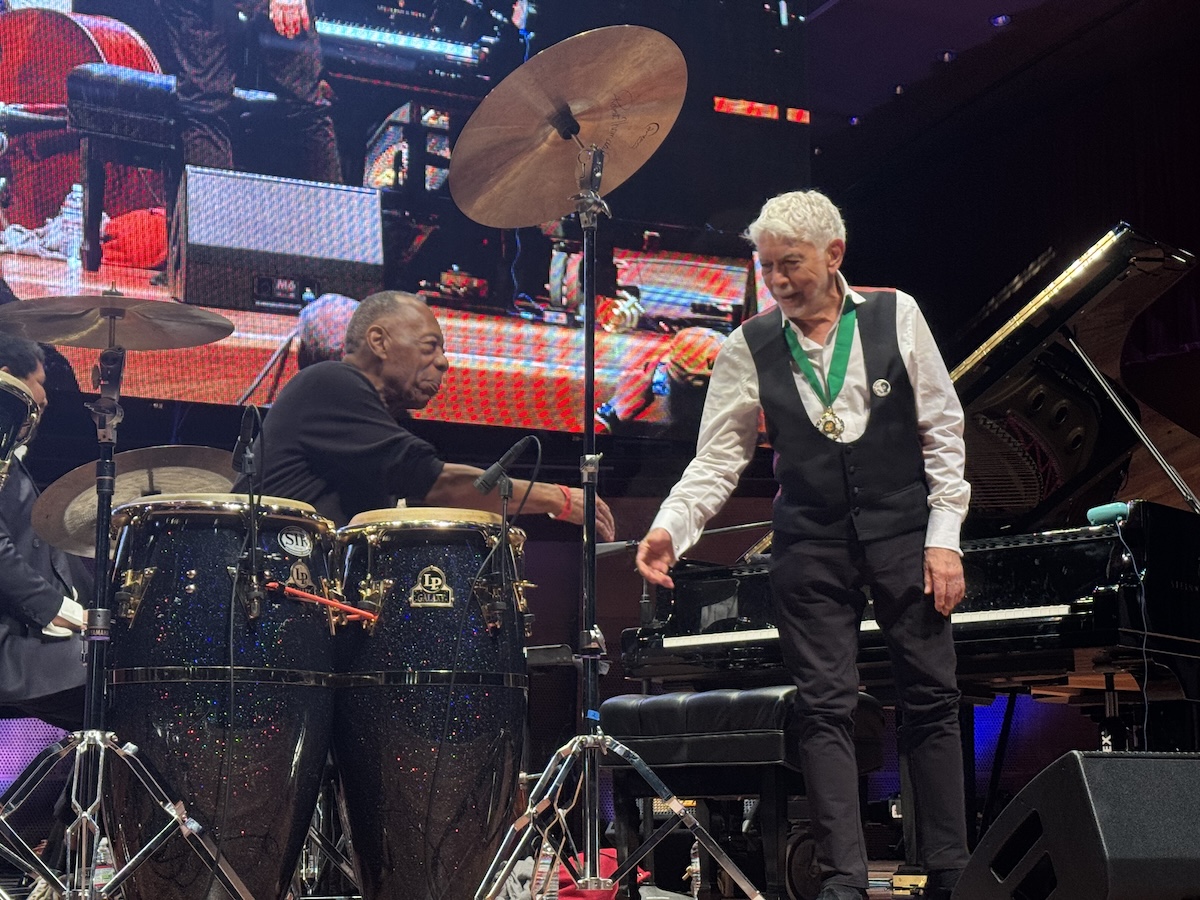
The headliner for day two was Monty Alexander and his trio. His warm thanks to the other performers and comments about how Chicago is the greatest city in the world won me over, and the crowd as well. Alexander is a Jamaican-American and gave tribute to music legends who had an impact on jazz in Chicago. He mentioned Ramsey Lewis, Ahmad Jamal, and Muddy Waters, but first he started with a Harry Belafonte hit. Day-O! "The Banana Boat Song" had that Ska beat that Alexander managed to work into his versions of "Summertime" and "Got My Mojo Workin'. "
His band consisted of drummer Jason Brown and Luke Sellik on bass. His longtime friend Bobby Thomas Jr. joined in on percussion. The group has a beautiful vibe of camaraderie, seen in how he mentored and encouraged his young bandmates. The big screen in Millennium Park gives everyone an intimate view of the interaction between the musicians. The look of reverence on Sellick's face spoke volumes about how thrilled he was to be on stage with Alexander. Drummer Jason Brown had a serene smile throughout the performance. The comfort level and trust were projected in the music. It was great music and one big love fest.
Thomas brought an island flavor with congas, bongos, and cymbals. Watching his hands fly and using his arms to change the pitch of a conga was so cool to witness. Every time Brown had a solo, Thomas would step aside to make sure that the drummer had his place in the spotlight. Alexander paid tribute to his adopted country with "God Bless America" with a Ska beat. His theme for the night was peace, love, and an end to genocide wherever it was happening.
Alexander dug into history with tributes to two Jamaican music superstars. Bob Marley's "No Woman No Cry" and Burning Spear's mighty "Marcus Garvey" plus Marvin Gaye's "What's Goin' On" and "So What" from Miles Davis. He pulled out the melodica to add some island flavor to the music. Also, it was the first time I had seen anyone use the string piano technique, where he strummed the strings inside the piano. I was reminded that the piano is a percussion instrument. It was a fitting end to a day of island influences of Brazil, a sultry stream of consciousness, and a trip to Jamaica in the fabulous Chicago evening by the lake.
Every singer who took the stage commented on how Chicago is the birthplace and nurturer of music that is known worldwide. Where there is music, there is bonhomie. Everyone is having a great time and feels a kinship in that moment. It was wonderful to see people smiling at each other as they exited the park. People started conversations about the music with me. I saw very few people glued to their devices. There was a connection within that huge crowd—"My Kind of Town."
If you enjoyed this post, please consider supporting Third Coast Review’s arts and culture coverage by making a donation. Choose the amount that works best for you, and know it goes directly to support our writers and contributors.
