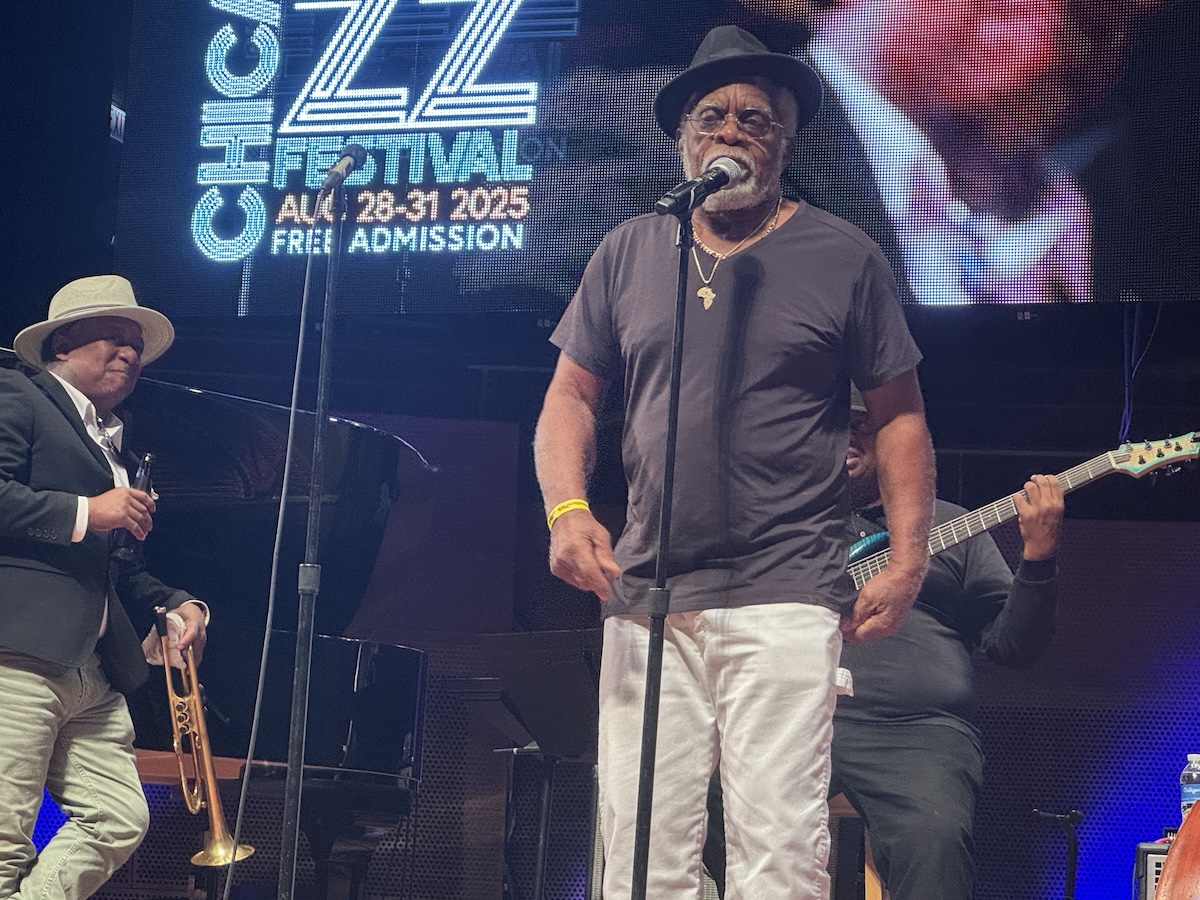
It was another fabulous summer day in Chicago with some familiar names on the Pritzker Pavilion stage. First up was Ava Logan, who has been in at least two productions for Black Ensemble Theater. She has played Ella Fitzgerald and Nancy Wilson. If you have ever seen a Jackie Taylor production, you know that the vocals will be dynamite. Logan lit the fuse to start the main stage performances. She has a rich and flexible voice that can easily reach the high notes and dip into contralto without breaking a sweat.
Logan sang a great set of classics, including "I Ain't Got Nothin' But The Blues," and ended with an extraordinary version of "Colors of the Wind" from the animated film Pocahontas (1995). Disney songs usually trend toward the treacle anthem, but Logan turned it into a rousing number that brought the audience to its feet. She was accompanied by a stellar group of musicians, with Roger Harris on piano, Jim Cox on bass, Charles Heath on drums, and Jarrard Harris on saxophone. Fun fact: It's Ava Logan, DVM. She is a veterinarian by day and a great singer in her off time. Like I said, fun fact!
The second set was by the formidable Ernest Dawkins Ensemble New Horizons Redux. Dawkins is a long-time member of the Association for the Advancement of Creative Musicians (AACM), which embraces Black music in all of its forms in America, Africa, and the world. Dawkins is a musical griot, sharing the stories of the songs, composers, and some crazy performance lore. I have attended many AACM performances, and the music has always been avant-garde and cutting-edge. The original compositions embrace the roots of Bop, Bebop, Hard Bop, and Afro-Futurism. The New Horizon Ensemble Redux featured up-and-coming musicians and veteran performers. Dawkins has been a mentor to generations of musicians.
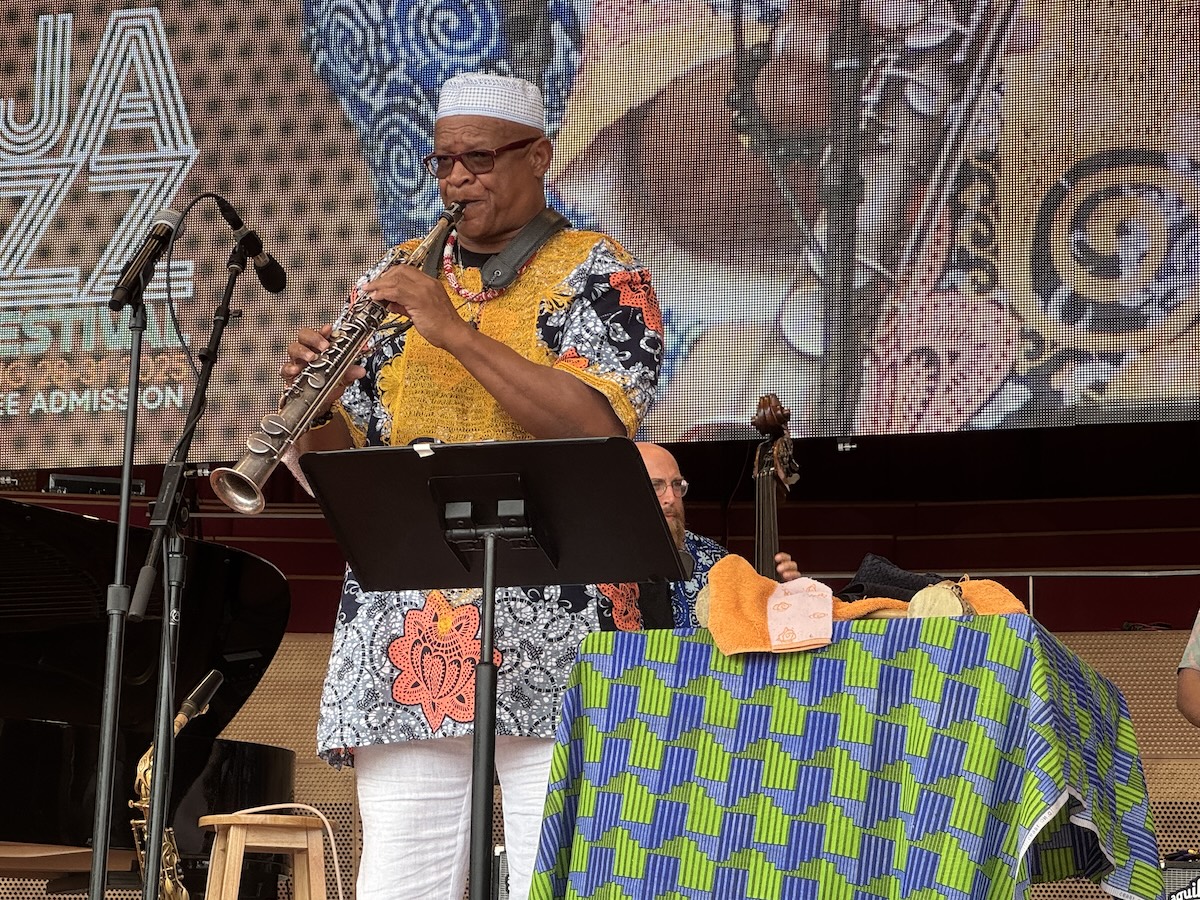
New Horizons Redux featured Elio Wijaya on piano, Jamal Damien on trumpet, Senya Rogers Kaufman on guitar, Ethan Philion, and Micah Collier on bass, with Frank Morrison on drums. Special guests included rising trumpet star Marquis Hill, Kevin King on tenor sax, and Isaiah Spencer as guest drummer. The music was played as a tribute to Emmet Till, the March on Washington, and the 60th anniversary of the founding of the AACM.
Some of the highlights were a Charles Mingus composition called "Peace". It was played after an anecdote about a fistfight Mingus had with a fellow musician at a beloved Chicago club, the Quiet Knight. "Ameen" was dedicated to AACM member Ameen Muhammed. It featured both double basses sounding like a locomotive rumbling through town with hairpin turns and nearly jumping the tracks. Kevin King tore it up on the tenor sax. Dawkins called King a tenor from the Gene Ammons school of saxophone. Ammons was a Chicago-born saxophone legend who played with Charlie Parker, Miles Davis, and Sonny Stitt. King could hold his own with any of them.
They played the Erroll Garner classic, "Misty," and then a Dawkins original titled "Blues for the Black Cowboy," written for the AACM. Dawkins played saxophone but also had a table of items used as sound. An accordion tube produced a whistling sound, and silk fans created a weird reverb effect. He shook rattles and shells as if administering incantations over the music. Before the music started, the band faced east to clear away all negative energy. There is a deep spiritual and metaphysical bent to the AACM that makes the music all the more entrancing. While I loved the stories that Dawkins shared, I wish that he played more music and talked less. He could have gotten at least two more songs.
The third set was another jazz legend, Gary Bartz, and the NTU Troop. NTU is a Bantu word meaning unity, and the Troop was formed in the volatile late 1960s to explore Black people in society through music as a socio-political medium. Bartz is a Jazz legend who has played with notable artists such as Abbey Lincoln, Roy Hargrove, and McCoy Tyner, among others. His blend of soul, jazz, and funk inspired generations of musicians.
The musicians with Bartz have some serious musical chops. This Troop was a live wire featuring Theo Croaker on trumpet, Kassa Overall on drums, Paul Bollenback on Guitar, Joe Black on drums, and Marcos Valera on bass. Like Dawkins and the New Horizons Redux ensemble, this band was comprised of veteran musicians and newer players mentored by Bartz. There was a vein of funk running through the set on "I Have Known Rivers and Other Bodies" and "Loving Kindness." I find no irony in the fact that musicians are making the same political statements now as they did in the 1960s. There are the same issues, and the "bright side" is that they are still here to provide guidance. Excellent set from an American Jazz Master and future masters.
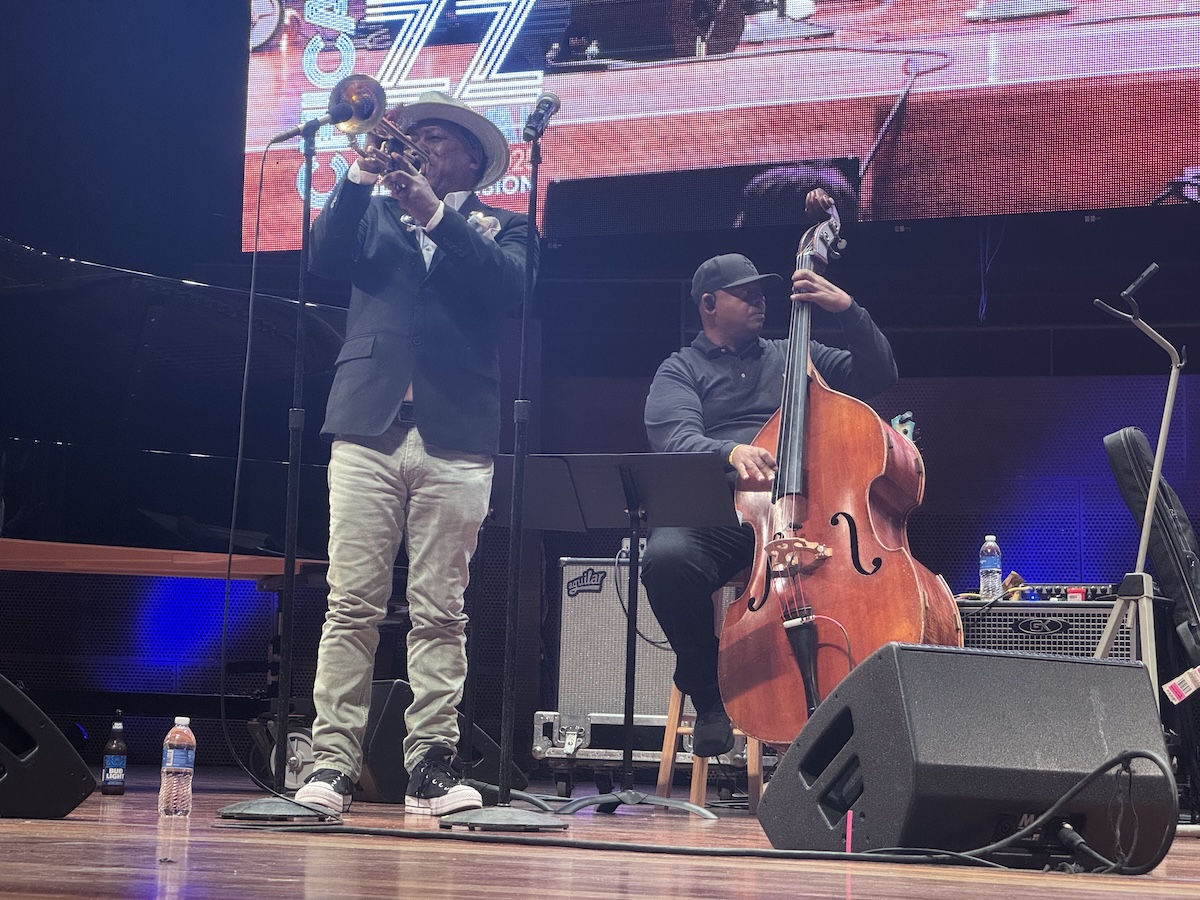
The headliner for the evening was New Orleans native Kermit Ruffins and his band, the Barbeque Swingers. He was born and raised in Tremé in the Lower Ninth Ward of New Orleans. It was the area hardest hit by Hurricane Katrina in 2005, and Ruffins dedicated his set to the memory of all that was lost, and the strength of those who survived to carry on cultural traditions. Ruffins was in the HBO series Tremé playing himself.
Ruffins founded the Rebirth Brass Band, inspired by the Dirty Dozen Brass Band, before founding The Barbeque Swingers. Ruffins is known for barbequing at his gigs, thus the name. I wish that he were ruling the grill at Millennium Park. The gumbo and andouille sausage needed some NOLA magic. Ruffins unabashedly pays tribute to Louis Armstrong in his trumpet and singing style. He sang "What a Wonderful World" and "Aiko" before diving into other NOLA-style music. The Barbeque Swingers are a great group that elevates the music to a masterful level of jazz. They are Yoshitaka Tsuji on piano, Kevin Morris on bass, and Jerry Anderson on drums. I would say that Tsuji is on a level of piano playing New Orleans jazz that I have not heard surpassed by anyone other than Allan Toussaint and Mack Rebennack (aka Dr. John).
Ruffins's daughter, Neshia Ruffins took a turn at the mic with classics like L-O-V-E and Stevie Wonder's "Overjoyed." She has a lovely voice, if untrained. It must have been an incredible experience for her to perform on the Pritzker stage, and hopefully, she will continue to hone her singing skills. I usually cringe at the 'nepo baby' performances, and this was no exception. This is the Chicago Jazz Festival, not a holiday at Granny's where every kid had to sing, dance, or recite. Yes, it's a flashback experience. The other special guest was a seasoned veteran of New Orleans Music. James Winfield took the stage and sang an awesome "Hallelujah, I Just Love Her So." He is still kicking and jamming at the age of 99!
The band played "It Feels So Good" to honor Chuck Mangione, who died this year. Kermit Ruffins is an engaging performer and a lot of fun to watch. He's got jokes. "I quit smoking weed. My wife ran off with the weed man. I sure miss him!" It was a party on stage with Ruffins. The bottled water that is usually set out for the performers was an ice-cold beer for Ruffins. He closed out the show with a relatively flat vocal performance of "Lovely Day." I don't think it mattered to the crowd, which was pumped up on the contagious energy of New Orleans in Chicago.
If you enjoyed this post, please consider supporting Third Coast Review’s arts and culture coverage by making a donation. Choose the amount that works best for you, and know it goes directly to support our writers and contributors.
