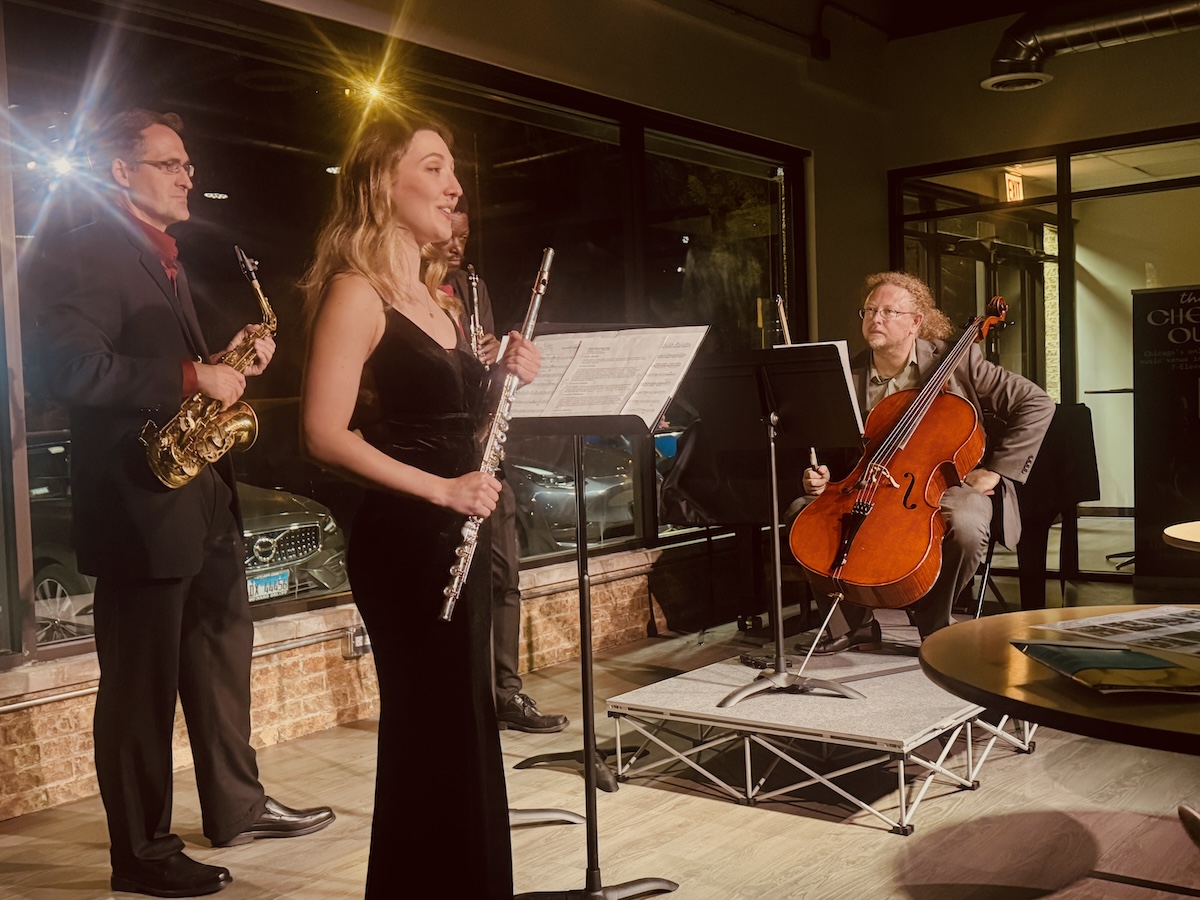

The CheckOut opened its doors to a great performance by the Amos Gillespie Chamber Quartet on Saturday night. This abandoned 7-Eleven was formerly an eyesore at the end of the hip and chic Southport Corridor. When Seth Boustead of Access Contemporary Music saw that it was for rent, he envisioned an ideal performance space for contemporary classical music.
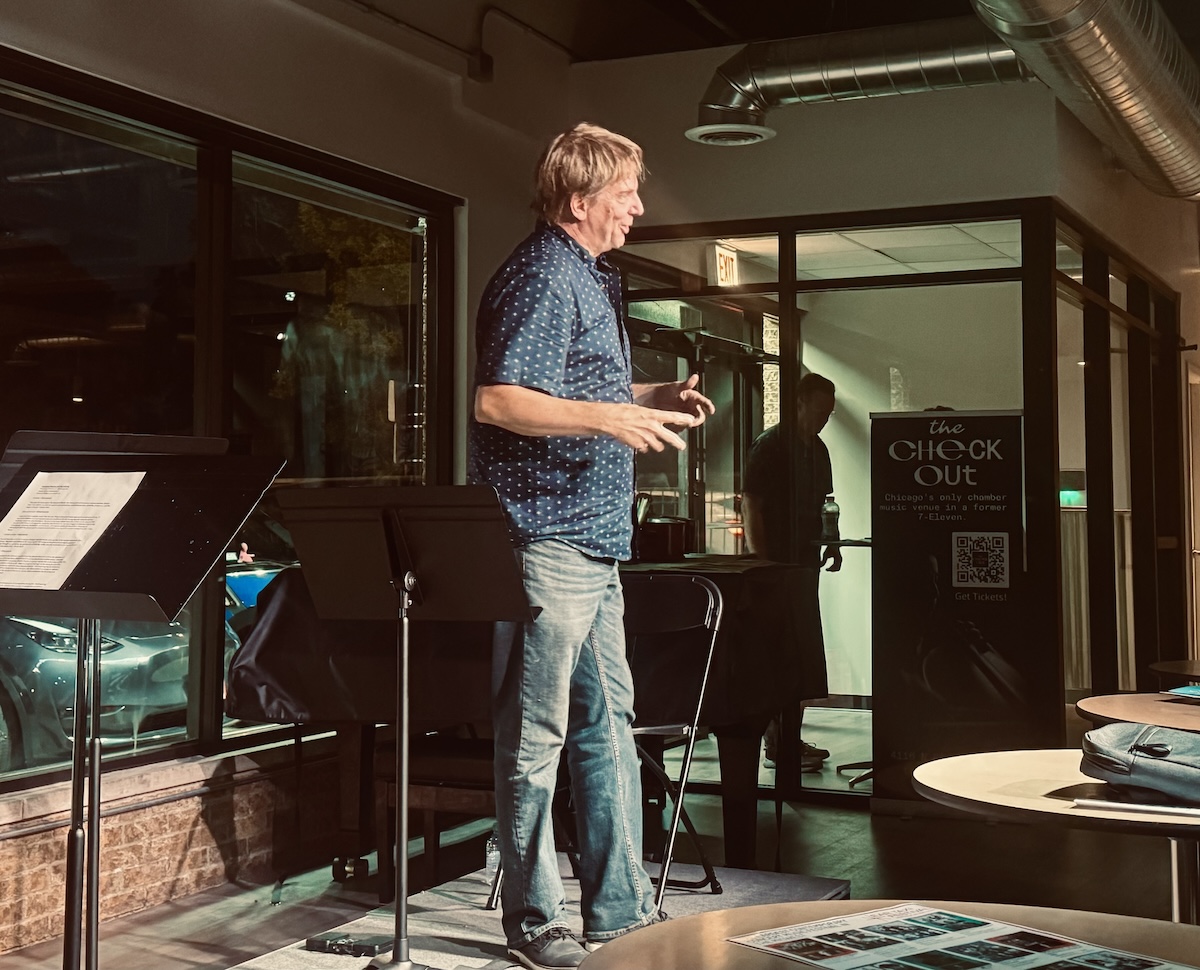
In introducing the performance on Saturday, Boustead described the complete rehab needed to create this non-pretentious, finger-snapping vibe. There is a full bar, but the only reminder of the space's former identity is a double Slushie machine that swirls bright blue adult beverages to enjoy. Boustead is a musician and composer. Attending this opening concert felt like being at the launch of making history.
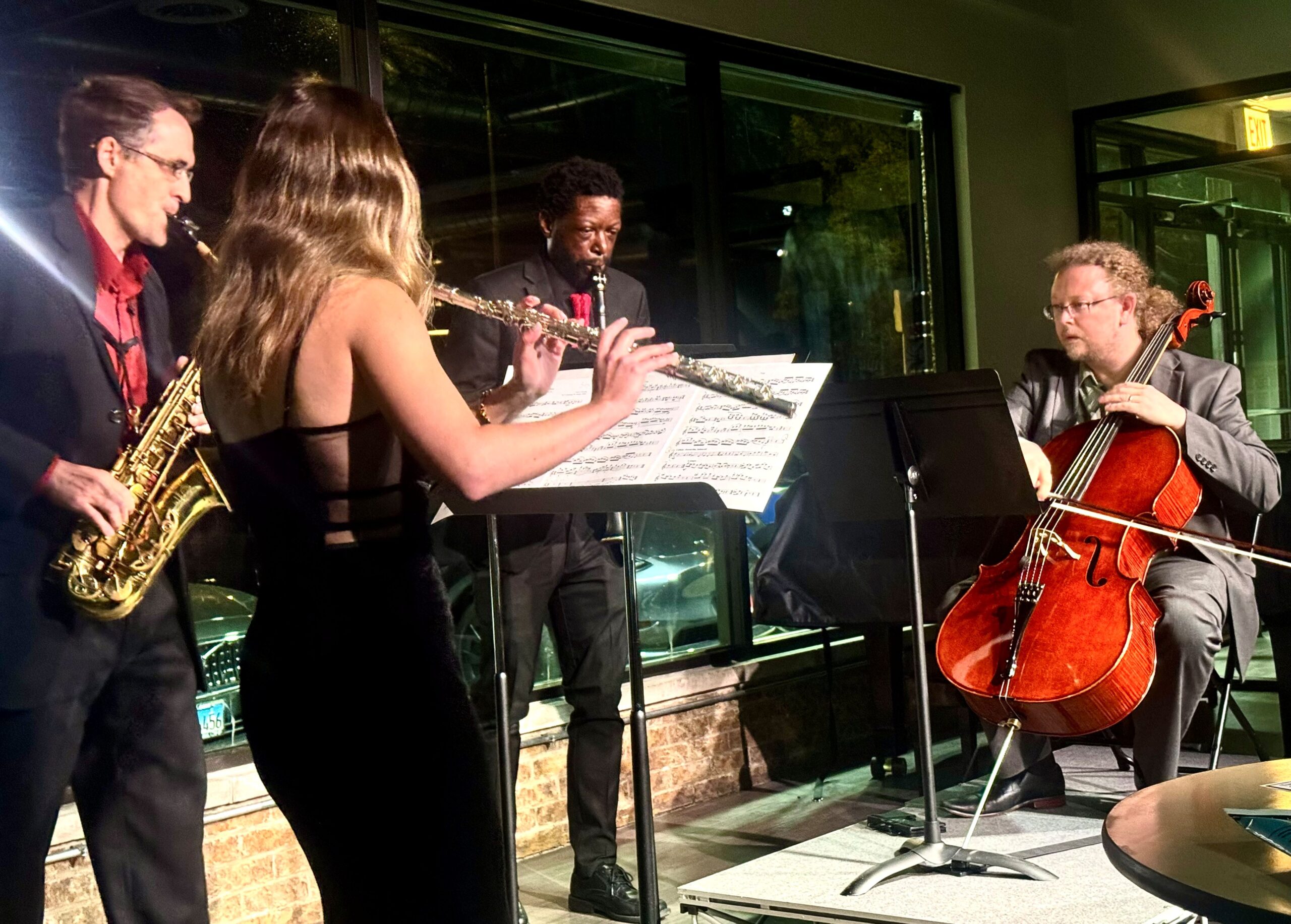
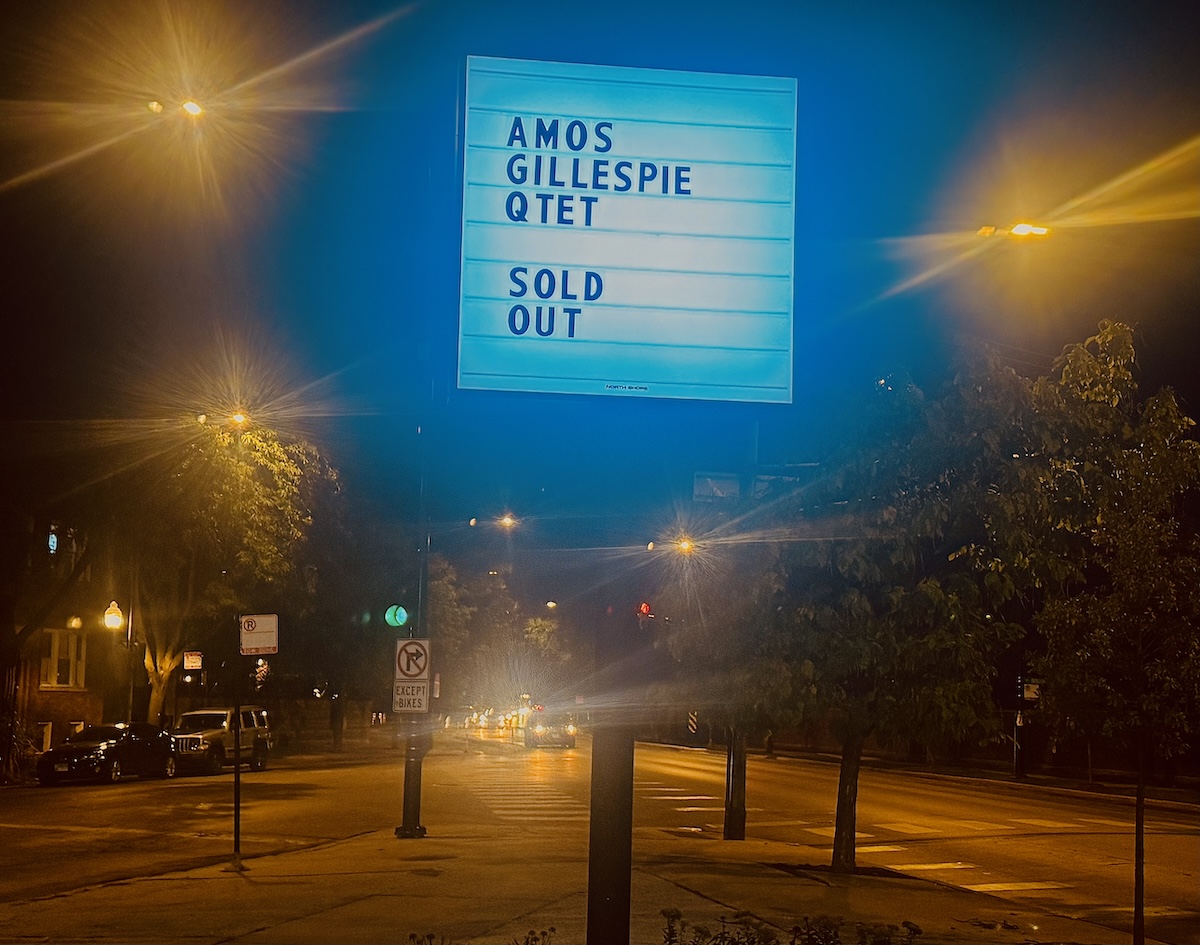
With a program entitled Celebrate Uptown on Saturday, the Amos Gillespie Chamber Quartet played music by local composers, some of whom have lived or been raised in the Uptown neighborhood. Gillespie plays alto sax and shares the stage with Priya Fink on flute, Richard Zili on clarinet, and David Keller on cello. They were a beautifully balanced and versatile group, allowing the audience to interpret and feel what the music meant to them. Accompanying the performance was a slide show that evoked visions of Uptown in the late 1970s, dodging people on the sidewalk who sometimes appeared from nowhere, or sitting in the smoke-filled Riviera, watching Midnight Express (1978), while drunk men wandered the aisles, sometimes shouting obscenities at the camera.
Gillespie himself composed the first piece, Jasper Johns Movement I. It was played vivace with adagio interludes that evoked the Dadaist anarchy and kinetic post-war buzz of Johns' art. I like that three woodwinds made up the quartet, with the cello providing rhythmic sound and some percussion on the body and strings. On a metaphysical level, we were breathing in the music, and I found it to be powerful.
Seth Boustead's Galactic Drifter was next, and it had a feeling of space and the universe as experienced here in Chicago. David Keller's percussive pizzicato and the sound of Gillespie tapping the pads on his sax layered the piece beautifully, peppering it with a beat motif. The lovely pastoral phrases of Galactic Drifter gave a holiness to Boustead's love of Uptown.
The members of the quartet read some artists' statements before playing. Angelo Hart's Embrace was about family, endurance, and longing. In my experience, the urban family is nothing like the ones depicted in commercials from the "golden age of advertising." Images of life in Chicago, viewed through a child's eyes, are imprinted and revisited as adults. I felt a sense of film noir as I listened to Embrace. The notes had more intimate shading than the bright, colorful notes of some of the other compositions. It was a beautiful piece of noir music with chiaroscuro elements.
I felt a visceral kinship with Amy Wurtz's Song of Survival. Wurtz's statement about the piece spoke of growing up in an Uptown family and the "monsters" that were a part of that experience. The composition has bursts of bright notes with minor notes blended in, creating a rollercoaster of hustle and then waiting. This was a tribute to the oddness that is Clark and Wilson. It can be a harrowing monster of survival, and that is brilliantly conveyed throughout Song of Survival.
Sara J Ritch's statement regarding her composition was a tender remembrance of neon glowing outside her window and the sounds that have been 24/7 to this day along Wilson, Sheridan, and Clark Street. Uptown Lullaby evokes the sounds of the city as soothing and reassuring. Keller's cello provided a bass line for the composition, and the tune weaved in and around that bass line. The woodwinds took turns as lead in a superb composition. Having grown up next to the Kedzie B train, I can attest that the grinding sounds of the L were like a lullaby.
Seth Boustead's My Uptown was another deeply personal composition reflecting his years living in the neighborhood that moved in and out of his life. It is in three parts. First is a piece called Homecoming about Essanay Studios on Argyle. If you didn't know, Charlie Chaplin and a constellation of silent film stars created movie magic at Essanay, including Ben Turpin, Wallace Beery, and Gilbert Anderson, who starred in the Bronco Billy western shorts. I liked the jazz-tinged phrases in part 1.
The second movement was an elegiac tribute to those who lost their lives to gang violence in Uptown. The Insane Unknowns and Latin Kings ruled the streets back then. Boustead collaborated with the nonprofit Kuumba Lynx to provide youth with an arts outlet. The piece celebrates the diversity and resilience of the people and the neighborhood. My Uptown is not somber. It is a beautiful piece combining sadness and joy. It takes grit and a backbone to create the beauty that Boustead captured in this composition. The third part is about the great memories and the range of emotions carried with reminiscing. The tempo changes and the blend of melody with minor chords were invigorating and moving.
Kyle Gregory Price wrote "Lost and Found" about embracing grit and finding your tribe. Price's composition had an environmental feel of urban and dense jungle. Fink's flute passages in this piece were quite lovely. I felt that it added a layer of mischief and beauty that is unexpected in the hood.
The final composition was titled Soul Food by Amos Gillespie. I do not recall the name of the restaurant, but I do remember places like The Lunch Pail and the taco place behind The Green Mill. The piece leans toward jazz with a touch of funk woven through. Considering the population makeup of Uptown, soul food is defined in multiple ways. Uptown was one of the only integrated neighborhoods that I experienced when I moved north. Black, Appalachian, Indigenous, and Asian people all wandered the sidewalks. Soul food is whatever brings comfort and evokes a sense of home, even in the saddest of times.
Gillespie's composition reflected that sense of home with sound. There were passages of frenzy and then the cool blue sounds of calm. It could be spaetzle, hot water cornbread, or chicken and dumplings. For years, Carol's at Clark and Leland proclaimed, "We serve hot sandwiches." That was a weird vernacular to me. Why not hamburgers, hot dogs, and grilled cheese? It doesn't matter; it was probably someone's soul food with a side of country music. The Amos Gillespie Chamber Quartet was the perfect choice to usher in an era of what I hope is healing and beauty.
I enjoyed the evening, and the music was an excellent example of new Classical music. It pushes the boundaries of Classical in the vein of Mozart, Wagner, or any of the original composers of the genre. This evening of music expanded the parameters of what is classical. The musicians no doubt learned to play music from the original classical era. I believe that is what fires up the imagination for music reflecting this era of the late 20th century, the Millennium music, and all forms of art born in this time.
ACM is an organization where the next generation can learn to play instruments and compose their own works. It is not limited to the youth but also to those of us wanting to take skills out of the mothballs and reignite the connection that first drew our hearts to music of any kind. The CheckOut brings access to beauty through music in the neighborhood. I applaud the effort and love that went into creating it. I would suggest that the slide show not play while the music is playing. It was a little too psychedelic for me, as the graffiti mural was projected onto my seat.
I highly recommend checking out the CheckOut at 4116 N. Clark in beautiful Uptown. They have a full bar, snack nibbles, and excellent service. Please support this vital work in our city. For more information and tickets, visit The CheckOut online.
If you enjoyed this post, please consider supporting Third Coast Review’s arts and culture coverage by making a donation. Please select the amount that works best for you, knowing that it will directly support our writers and contributors.
