
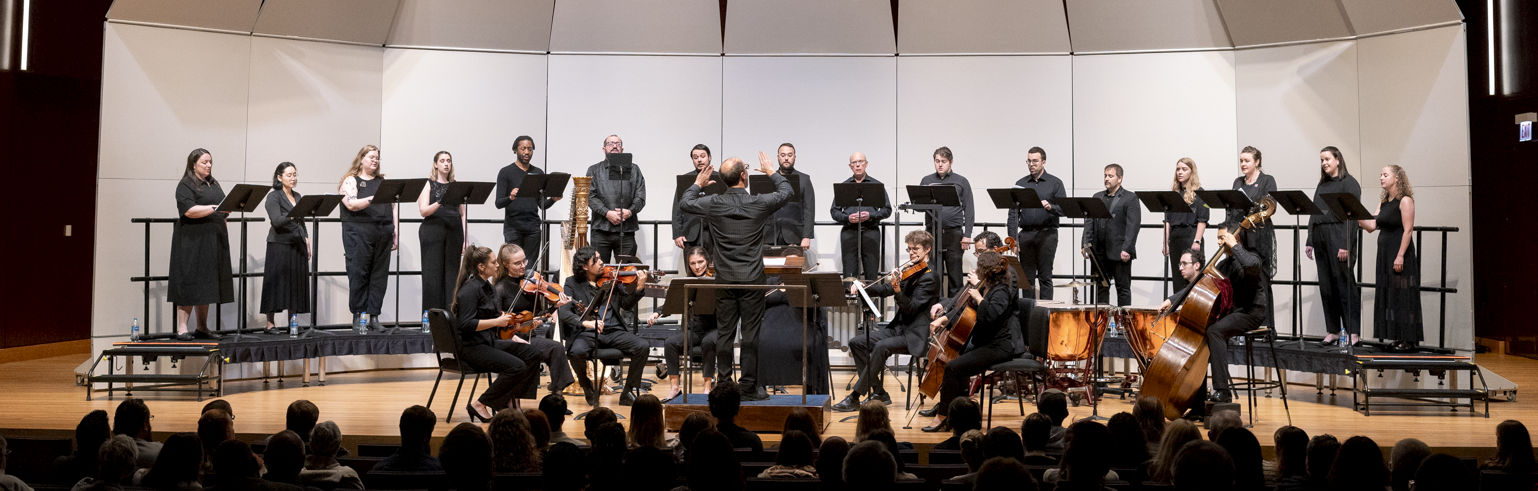
Ear Taxi Festival 2025 delivered another excellent concert on Saturday night, this one an Anchor Performance at Gannon Hall in DePaul University’s Holtschneider Performance Center. There, the William Ferris Chorale, conducted by Christopher Windle, performed music by Chicago composers Ben Zucker, Augusta Read Thomas, Stacy Garrop, and Ayanna Woods.
After intermission the Chorus and DePaul Ensemble 20+, conducted by Michael Lewanski, performed the biggest work on the program, The Lost Birds, a song cycle by Christopher Tin. He won a Grammy Award for the song Baba Yetu, a beautiful Swahili adaptation of “The Lord's Prayer,” which he wrote for the video game Civilization IV. It was the first music in that format ever won a Grammy Award.
As Tin wrote, “The Lost Birds is a musical memorial to bird species driven to extinction by humankind. Sweeping and elegiac, it's a haunting tribute to those soaring flocks that once filled our skies, but whose songs have since been silenced.” Tin was present on Saturday night.
The concert started with Windle conducting the 16-voice William Ferris Chorale, which performed a cappella several short works by local composers. First was Aneroidal by Ben Zucker. The title refers to aneroid metallic pressure gages that measure changes in air pressure, blood pressure, or other things without the use of fluids. The piece uses vocal effects, such as tones, percussion, and whistles to sound the changes that take place. It was a very interesting soundscape. Unfortunately, the chorale’s phrasing was a bit staggered. Voices did not always sound in unison when singing together.
Up next was Become the Sky by Augusta Read Thomas, who set to music the words of 13th Century Persian poet Jalāl al-Dīn Muḥammad Rūmī. A part of a longer work, this piece features lots of slowly changing long notes that form very distant chords and interesting harmonies. As is often the case with Thomas’ music, the resulting textured overtones were amazing, especially when sung in the great acoustics of Gannon Hall.
Stacy Garrop’s The Solitude of Stars was very similar to the Thomas, but it was not set to specific texts. Ayanna Woods Close(r), Now had a lot more movement and several contrasting sections. This piece set to music words based on a commentary by Charles McNulty from March 11, 2020 calling for theaters to close to fight COVID-19.
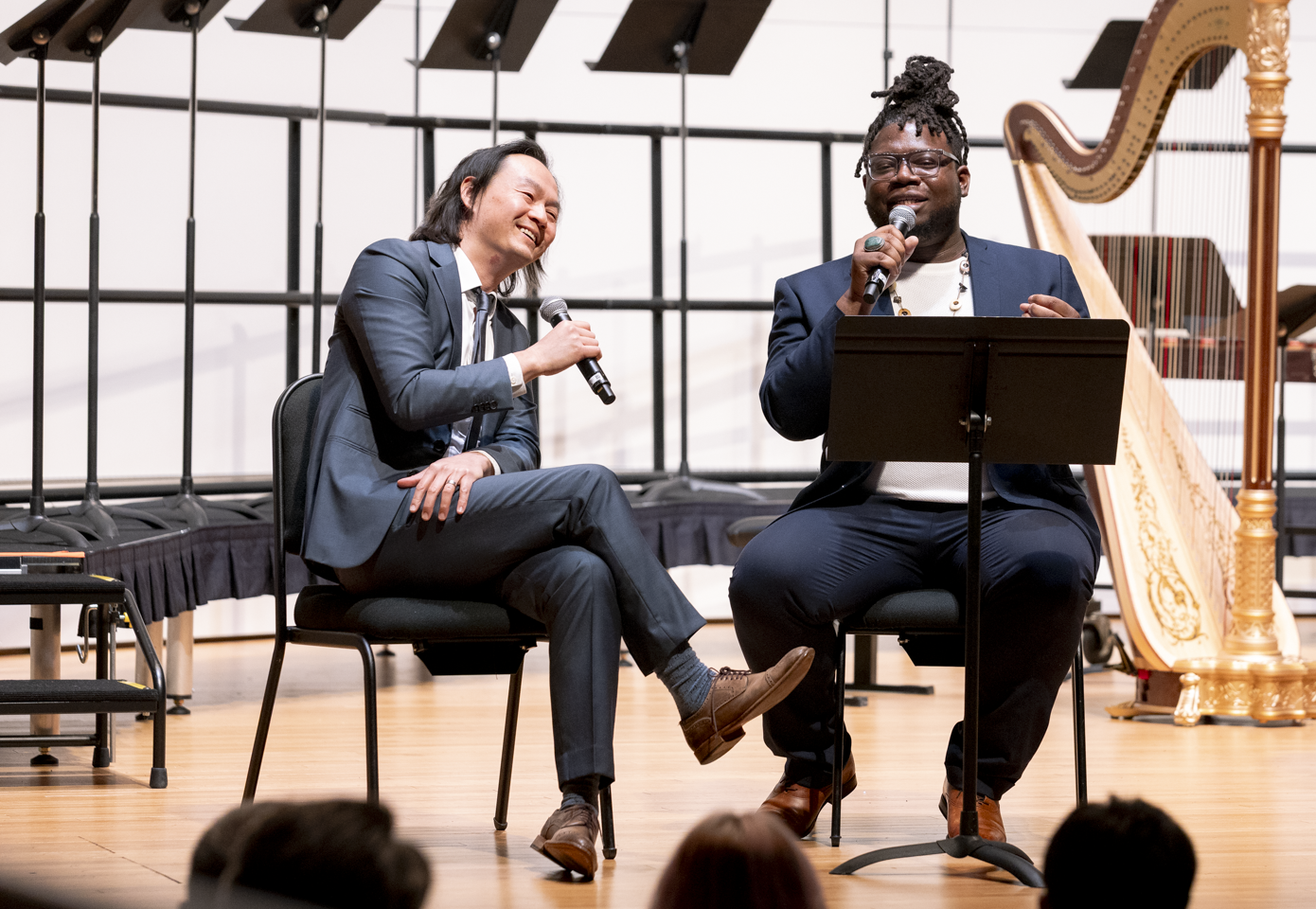
After the stage was set up for Ensemble 20+ to join the show, Ear Taxi Festival Artistic Director LaRob K. Rafael sat down for a lively conversation with Christopher Tin, who explained his approach to composition and general concerns about the environment. He sees the extinction of bird species at the hands of humans as a canary-in-a-coal-mine warning to humanity for its own degradation to the earth. He also talked about how the poetry of Emily Dickenson, Christina Rossetti, Edna St. Vincent Millay, and Sara Teasdale inspired him in writing the piece.
His mourning for the Passenger Pigeons, billions of which were hunted to extinction in America at the end of the 19th Century, came through passionately in the overture “Flocks a Mile Wide.” Ensemble 20+ brought to the stage a string nonet, a harp, and two percussionists, whose very tight ensemble playing wrenched every ounce of feeling out of this music. Conductor Michael Lewanski ensured that, when the chorus joined for the adaptation of Emily Dickenson’s “The Saddest Noise,” the blend was perfect, even if their starts were sometimes ragged.
The sad feelings of a requiem were pervasive, but Tin offered a lot of singing and playing variety as The Lost Birds progressed. “Bird Raptures” by Christina Rossetti opened with the a cappella chorus and later featured energetic playing by the strings, and Rossetti’s “One Hundred Thousand Birds” offered vocal counterpoint. Edna St. Vincent Millay’s “Wild Swans” was very poignant. There were also several vocal solos by Soprano Allison Selby Cook, alto Cassidy Smith, tenor Brett Potts, and bass Phillip Courington.
As the final notes sounded, the feelings I was experiencing were remarkably similar to the feelings I had at the Saturday night concert at the first Ear Taxi Festival in 2016. Both performances were so good, they felt like peak musical experiences where art does not get any better than this. Kudos to Ear Taxi Festival.
Tonight, The CheckOut hosts The Pleiades Improv Jam, 4116 North Clark Street, Chicago, Monday, October 13, 7:00 - 10:00 pm.
On Wednesday, also at the CheckOut, Flannau Duo + Quijote Duo and Picosa will headline a Taxi Concert with several world premieres. Wednesday, October 15, 7:30 pm. For more information on Ear Taxi Festival, click here.
