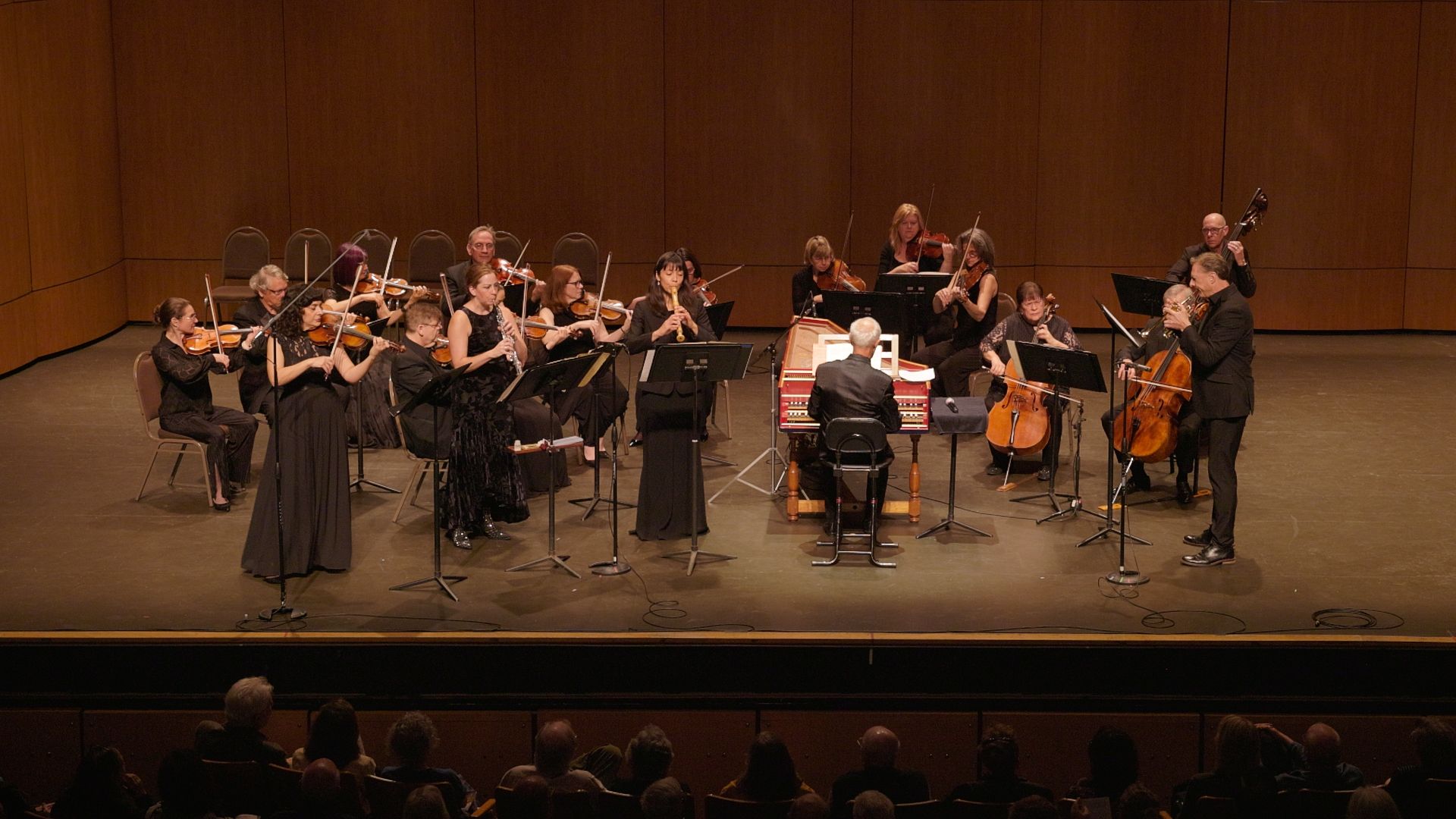

With Nicholas Kraemer directing from the harpsichord, Music of the Baroque gave an interesting if incomplete performance of Johann Sebastian Bach’s Brandenburg Concertos at Harris Theater on Monday night. It was interesting because Kraemer took the opportunity to explain some of the quirkiness of this music to the audience.
It was incomplete because they only played five of the six concertos. The one they didn’t play is my favorite, No. 5, which MOB is performing in March. Although this omission was expected, I still felt very unfulfilled as I was leaving the concert. Also, the reason for omitting it, as will be explained below, was very troubling.
While generally good, the performance, was not great. A couple of times the sound got muddy, which can happen when performers are not starting and ending phrases simultaneously. As the finale of the second concerto began, it broke down because Kraemer started before trumpeter John Thiessen was ready, and the trumpet plays from the very beginning.
In a very welcome pause, Kraemer explained the oddity of Concerto No. 3, where Bach provided no tempo or dynamic instructions to the players. The printed program reproduced several lines of the first violin’s part, which has nothing but the key signature, cut time mark showing 2/2 time, and the notes. This has given players very wide latitude of how to perform it and Kraemer led the players through four different versions of how it has been played and recorded. Some of them were very fast, others slower. Some were not in cut time, but 4/4. MOB’s version was moderately paced and honored the cut time.
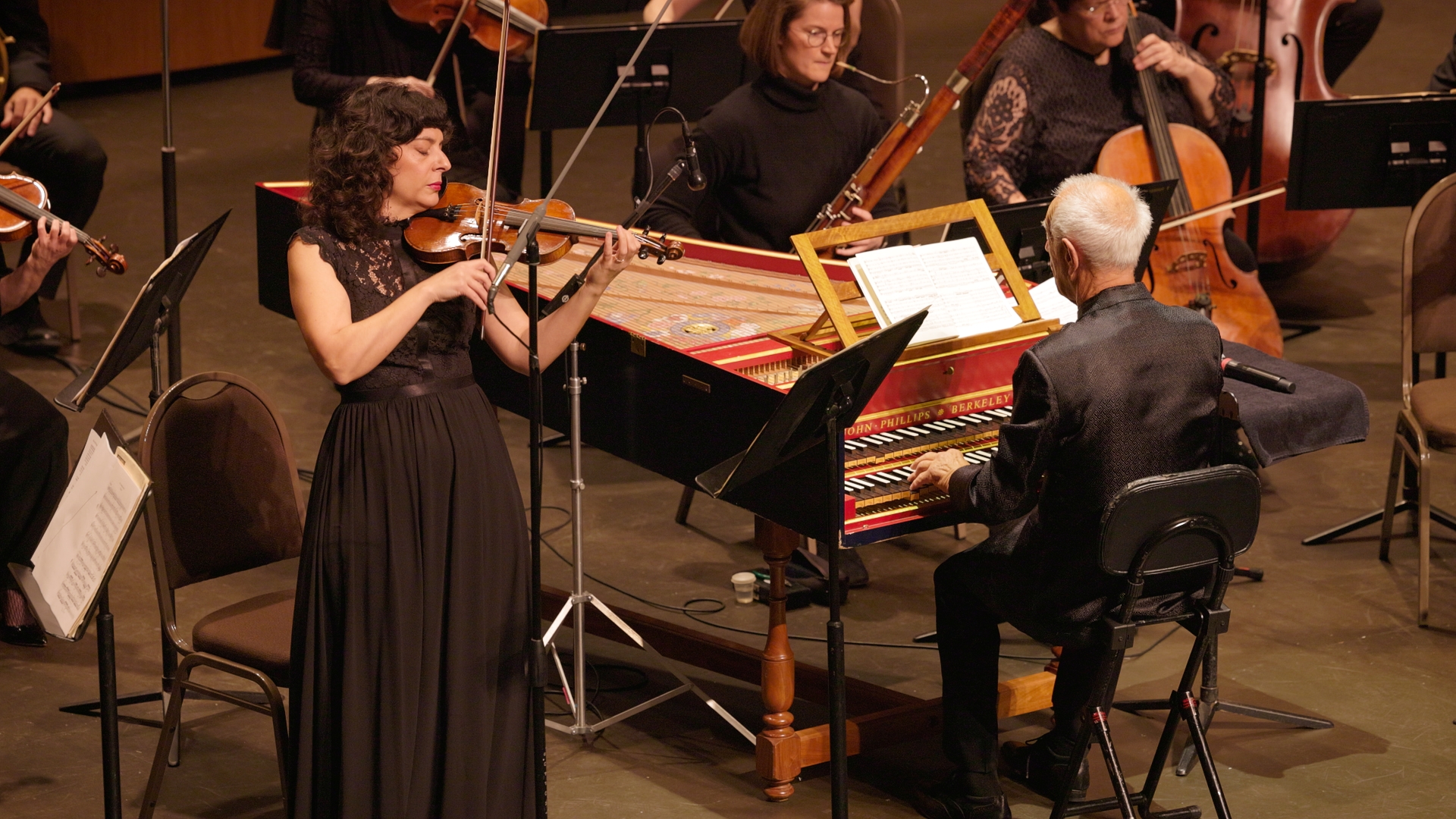
Throughout the performance, the aural balance was good, especially in the second concerto where the piccolo trumpet can overwhelm the other players and the recorder can hardly even be heard. Here, Thiessen on trumpet and Laura Osterlund on recorder sounded just right with the other soloists and ensemble.
These concertos are also special because Bach shares the solo responsibilities with just about everyone. In the first concerto, the two horns, three oboes, and several violins are in the solo spotlight, and their interactions were fabulous on Monday night. In the minuet finale, Bach assigns the solo parts to different groups of instruments in the trios. This movement can lag, but not Monday night.
Concerto No. 6 is scored for strings minus the violins. There are not many examples in classical music where violas take the spotlight, but Elizabeth Hagen and Terri Van Valkinburgh played it masterfully, with the help of cellist John Sharp. Bach also included parts for two viola da gambas, a six-string instrument with frets on the fingerboard. This instrument was already obsolete when Bach wrote the concertos in the early 18th Century. Modern performances often use cellos, but MOB kept it as scored with Craig Trompeter and Anna Steinhoff on the viola da gambas.
The star of the show was violinist and MOB concertmaster Gina DiBello, who soloed in several of the concertos. Her biggest moments were in Concerto No. 4, where Bach places enormous technical demands on the violin solo. There were also solo parts for two recorders, played by Laura Osterlund and Mirja Lorenz. Dibello must have felt exhausted after playing super-fast fingering and rapid bowing non-stop, only breaking for the slow middle movement. She was breathtaking.
One challenge of the mix is that the harpsichord can hardly ever be heard. Of course, it is impossible to control the volume of a harpsichord, but this is why Concerto No. 5 is so important. It has an amazing harpsicord solo that lasts several minutes. While the harpsichord is constantly playing back-up continuo throughout the concertos, sometimes even during passages with the soloists, it is hard to hear. Concerto No. 5 is the only time the harpsichord stands out.
The harpsichord solo is super difficult, which, as Kraemer explained, is why he hasn’t performed it in over 30 years. He said that he just doesn’t enjoy playing it. He noted that the Richard Egarr, who is scheduled to perform it with MOB in March, actually substituted for him to play it 30 years ago. While he might have been joking, to me that was a lame excuse, and it definitely colored my perception of him and the entire performance. Nicholas Kraemer was not the right programming choice to lead these concertos by Music of the Baroque. Neither was omitting Concerto No. 5.
Dame Jane Glover will be returning to the helm to conduct the MOB Chorus and Orchestra through Handel’s Messiah. Also performing will be soprano Yulia Van Doren, mezzosoprano Sasha Cooke, tenor Miles Mykkanen, and baritone Will Liverman. North Shore Center, Skokie, Sunday, November 30, 2pm, and Symphony Center, Chicago, Monday, December 1, 7:30pm. They will also be doing a virtual, on-demand performance on Friday, December 5, 5pm. For more info, click here.
Did you enjoy this post? Please consider supporting Third Coast Review’s arts and culture coverage by making a donation. Choose the amount that works best for you, and know how much we appreciate your support!
