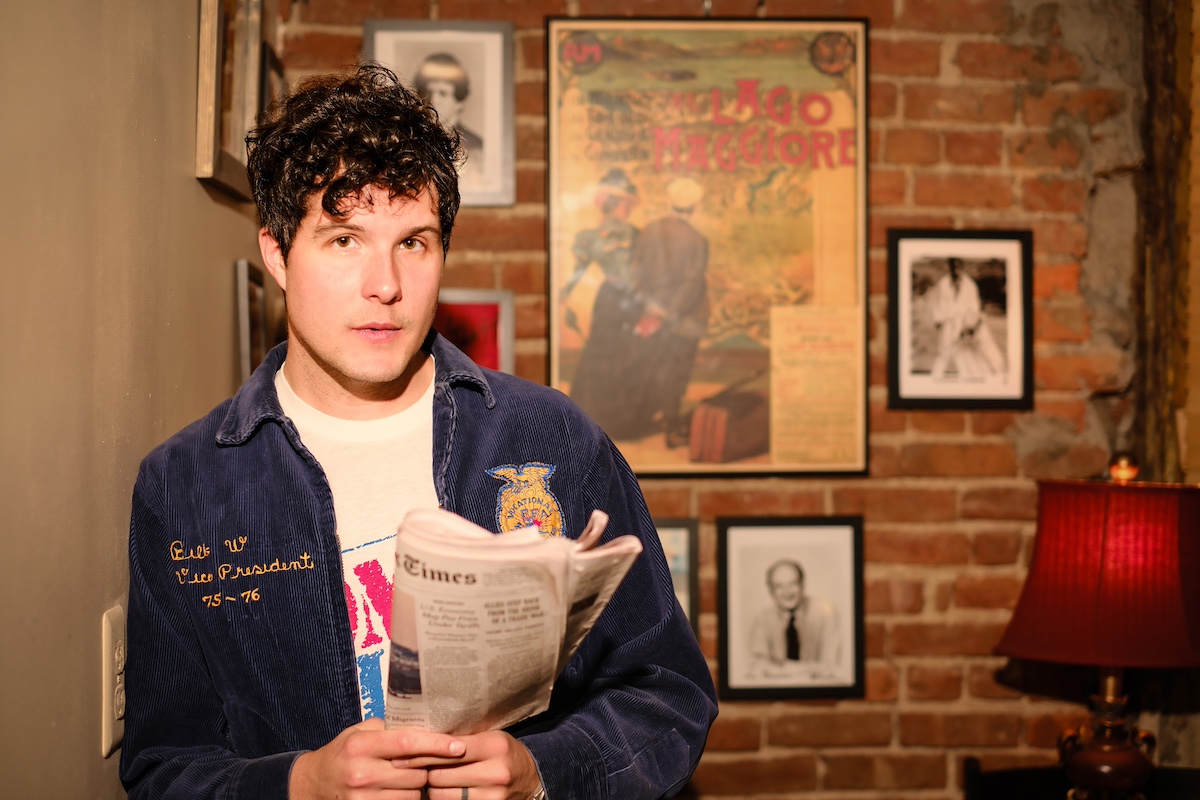
In an alternate universe, singer-songwriter Brian Dunne’s latest album, Clams Casino, was a multiplatinum hit in the early 1980s, widely heralded as a cushy McCartney-esque masterpiece. Despite the throwback vibe of its unassuming cover—look out for that “Compact Disc” logo in the top left corner, even on the vinyl release—it’s very much an album of the moment in 2025. Dunne wears his influences on his sleeve with keen admiration, but he also embraces modern music-making techniques.
We talked with Brian about demos, influences, and the tenth anniversary of his debut album as he prepares to prove his power pop bona fides at the Beat Kitchen on Sunday.
Clams Casino was recorded at your home in Brooklyn. How did that environment influence the production and approach to the album?
The inspiration for that was I was working on a deluxe version of my last record (Loser on the Ropes), and I had recorded that in Athens, Georgia with a producer. We had taken my demos, and we had a strict “no listening to the demos” rule in the studio when we made that record. I'm super-proud of it. When I was going back to make this deluxe edition, I was listening back through the demos because we were going to release some of them, and I started to feel like there was a certain magic to the demos—a certain swagger that I had vocally when I was singing the lyrics for the first time. I started to think, could I make a record where I worked off the demos and re-recorded everything off the template of the demos, but anytime I didn’t beat something from the demo, I could keep it? And that’s where I started.
So basically, I would record this demo for a song like “Clams Casino.” I would program the drums, play all the guitars, and then when it came time to make the record, I would replace the drums, the bass, the guitars, and the vocals—replace everything. But as I went, if I felt that anything didn’t have as much intention or excitement as the original demo, I just wouldn’t keep it. So there are certain songs like “Some Room Left” on the record—that’s the original vocal from the very first time I sang the song. “Play the Hits,” I just couldn’t beat those vocals, and so that’s what I kept. Other things were completely replaced by a more professional-sounding recording, but it was all built off that.
Where did the slide guitar on “Play the Hits” come in? Because I was getting George Harrison vibes from that.
Yeah, I was obviously thinking about Harrison, and I was thinking a lot about—that song is kind of a Tom Petty pastiche, so I was thinking about those Jeff Lynne productions, which obviously the Traveling Wilburys are part of, and I was just trying to see if I could really ape that sound. Mike Campbell is also one of my heroes, so I was thinking about his playing on the song “Kings Highway,” which is track two, side one off Into the Great Wide Open, and just referencing a type of music that I love.
If you had to take a guess, what percentage of the album is taken from those original demos?
I would say only like 12% maybe, but it was just great to have it there to A/B, you know? It was a game of “beat the demo.” It sort of followed the production strategy of an album like (Bruce Springsteen’s) Tunnel of Love, where they went in and had to beat the demo. You’d have Max Weinberg come in and play over the drum machine, but if the drum machine had a certain tastefulness that carried the song better, then so be it.
What were some of the closest calls in terms of beating the demo?
Well, on “Clams Casino,” I actually mixed the song first with the demo guitar, and as we came down to it, something wasn’t working. I really loved the trashiness of the demo guitar, and I did go in and recut that guitar, which was the last thing left over from the demo. That song is a full reproduction, but we kept testing everything. Something wasn’t working in the mix, we kept remixing it and remixing it. Finally, I brought in another mixer, and these are the sort of inside-baseball problems with a record. Ultimately, it was a total blast to make. Honestly, I would do it again this way.
I’d love to talk a little bit more about your influences, because this record has tons of gems. The title track is very McCartney-esque, and my two favorite songs, “Rockland County” and “Fake Version of the Real Thing,” reminded me of Fountains of Wayne. Who were you listening to as you were writing and recording this album?
I was thinking about a couple of things. Obviously, I'm always listening to Tom Petty and Bob Dylan and Bruce Springsteen and the guys that inspired me to do this. It almost feels a little simple to say that, but I go deep on that, and I think there's value in it. Sometimes people, because that stuff has been categorized as classic rock, take a big bite of it and go, “OK, I got it.” But I feel like, no, there's meat on the bone, man. You can treat Tom Petty like you would treat The Replacements, with that sort of rarefied interest, and mine those records for all they’re worth.
But I was also thinking a lot about where I come from, which is the East Coast and a working-class background, and the chip I have on my shoulder about that. I was thinking a lot about Billy Joel, frankly. The music doesn’t sound like Billy Joel, but there’s a type of ethos that I was trying to capture—the sort of working-class cynicism of that music that I really wanted to convey.
And obviously, a lot more contemporary artists. When I was working on “Fake Version of the Real Thing,” I was thinking a lot about Jeff Tweedy, and with “Rockland County,” I was thinking a lot about the band Alvvays, which is a huge influence on me, and sort of ping-ponging back and forth between contemporary indie rock influences and classic influences. It’s all just sort of floating around my head at all times.
I noticed you didn’t mention Paul Simon, who Rolling Stone compared you to.
There were a couple moments that I was really referencing Paul Simon. The song “Some Room Left” very much follows the Simon-esque chord structures, but I think what they’re probably glomming onto is that I'm a New York-based singer-songwriter, and I have a tenderness for that part of the world. I’m interested in writing stories about people there, with a slightly bizarre but grounded point of view. That would be my best guess. You’d have to ask them what their association was. But Paul Simon is a huge influence on me—he’s a hyper-musical singer-songwriter—and I'm a pretty well-trained musician, so I do put interesting chord structures in my songs to try to color them with more than just cowboy chords, and I try to do that tastefully.
There's quite a bit more power pop than normally would be on a Paul Simon record. I was thinking a lot about the trashy power pop of (Springsteen’s) The River. I was thinking a little bit about glam rock, T. Rex. I was thinking about things that have always spoken to me. But I feel like we’re in an interesting moment in alternative music where, if the mainstream is alternative—if Phoebe Bridgers is duetting with Taylor Swift and Jack Antonoff is putting a Massive Attack beat on a Sabrina Carpenter song—then what is alternative? Is John Mellencamp on the table to be mined in the way that Springsteen and Dylan and Hornsby and Dire Straits have become viable sources of indie rock production?
Because to me, I live in Brooklyn and I feel like if somebody came on stage referencing (Mellencamp’s) Scarecrow, that in a way would be more interesting than a band coming out of New York sounding like Television. To me, it's almost like the paradigms have been flipped. That is rarefied air. It’s so rare to hear a band come out and fully embrace, say, Billy Joel. It’s almost like they’re so highly rated that they’ve become underrated. That was sort of what I was thinking about.
I noticed that most of your albums fall into that “around 10 songs, around a half hour” mark. Is there something that makes you gravitate to that in creating albums?
(Loser on the Ropes) was a bit longer. I think it was about 45 minutes, with 11 or 12 songs. I just think that the record is a perfect paradigm—it’s the perfect amount of time to hang out with a band. I do love a double record, and I will make one someday. But I think that 40 minutes, 10 songs—that is just a great amount of time for somebody to make their case.
You've got the Compact Disc logo on the top left corner of the Clams Casino album cover. What inspired that creative decision?
I really wanted to capture a certain spirit that I hold very dear in my heart, which is—I grew up in a super working-class family, East Coast. My dad worked at a factory. My childhood felt very ingrained in this pre-internet, red-sauce, darkly lit bar, quarters in the jukebox, (Bob Seger’s) Stranger in Town, upper deck seats at the Yankee game, and a jewel case from Nobody Beats the Wiz. I had this vision of the entire thing, and I felt like I could build a record in this universe that felt like you were picking up a 1993 reissue of (Joel’s) The Stranger. That was very much what my childhood felt like. I wanted to capture that spirit on the album cover—that this was working-class music made for and by working-class people to listen to in their car on the way to work. And I have the Compact Disc logo on the vinyl too, which makes no sense.
Your debut album, Song from the Hive, just turned 10 this year. What are your reflections on that album and its place in your discography a decade later?
Yeah, it felt like a good start. I was still very green. I was broke. I made that record with basically chump change. It was a good start. I don’t feel like I came into my own until the next record. I don’t feel like I really came into my own until Selling Things, the third record. But to me, that record represents something bigger than the record itself, which was a choice that I made. I moved to New York in my early 20s to be discovered. I had sort of a vintage idea of how music and the music business worked. And I was very heartbroken when I wasn’t discovered. I wasn’t pulled out of obscurity and sent up the chain at Atlantic Records, which I thought might happen for a little bit. And that record represents to me the decision to do it myself. Come hell or high water, I was going to make records and tour. If I had to make them on my own and book those tours, I would do that, because that was what I was put on this earth to do. What I feel sentimental about when I hear that record is that it was a bold choice for a 24-year-old to just say, “I'm going to do this no matter what.” That’s where I started.
What are you most looking forward to when you bring your tour to Chicago this coming weekend?
Well, Chicago is one of my, if not my favorite, cities to play. I love playing for Chicagoans. I feel like people in Chicago really, really value art and artistry. And I love playing Chicago. I'm on the fifth night of tour tonight. I'm in Nashville, and this is the first time I'm getting to play these songs solo. I'm really encouraged by how well it's been going over. I'm basically playing the whole album because it just works. People are showing up. They’ve learned all the words to the album, which just fills my cold, dead heart with joy. And yeah, I can’t wait. We’re bringing a great show to Chicago, so see you on Sunday.
Brian Dunne appears at Beat Kitchen (1243 Chicago Avenue, Evanston) on Saturday, October 4, at 8pm. Tickets ($33.14) are available now. All ages.
