“You don’t have to waste your time/Hiking up a hundred hills/You don’t have to, but I will”
-"Husbands"
“When I went deaf I used my eyes/They stood me in line ‘til I went blind/Get in asshole, let’s drive”
-"Trinidad"
“There were a hundred horses dancing/Maybe a hundred and twenty-four/All the horses must go dancing/There is only dance music in times of war”
-"100 horses"
“Each time my heart is broken it makes me feel more adventurous…but one of these days there’ll be nothing left with which to venture forth.”
-“Meditations In An Emergency”, Frank O’Hara
If you’re tapped in to the general Music Nerd Extended Universe, broadly encompassing platforms like Pitchfork, theneedledrop, rateyourmusic, and more, you’ve no doubt at least heard about prodigious NYC songwriter Cameron Winter and his expansive art rock outfit Geese, who took over Thalia Hall last week for a two-night stint. Their third record, Getting Killed, is one of the most critically acclaimed of 2025 and has quickly come into consideration as an album that will “save rock and roll,” a popular marketing sentiment since rock music’s mainstream recession in the 2000s and 2010s. Fall Out Boy even made it the title of their underwhelming 2013 album, which ironically was the beginning of their abandonment of rock music entirely for more pop-radio friendly hits.
Thankfully for young people interested in rock music (and music in general), the aforementioned Music Nerd Extended Universe has established something of its own alternative canon, in which music is divorced from record sales and, supposedly, discussed and judged on a more high-brow scale of merit. Due to the downfall of radio and the rise of streaming, this is the canon most “alternative” young people interact with, leading to their perception of good rock music being shaped by bands like Neutral Mill Hotel and Unwound more than whoever the biggest rock act is in the current mainstream (the 1975? Tame impala? Olivia Rodrigo?). This new internet-democratized alternative canon is who have championed Geese, just as they did MJ Lenderman and Wednesday before them, Alex G before them, and King Krule before him, as the next standard bearer for artistic and intelligent early-20s angst. It doesn’t matter that Getting Killed won’t win the Grammy for Best Rock Album. That doesn’t change the fact that it is the best, and most consequential, rock album of the year. From a Strokes and Sonic Youth influenced NYC high-school band, to a coming-of-age detour through the desert on sophomore album 3D Country, on Getting Killed both Geese and its members come through more fully and uniquely realized than ever. This is the shape of rock to come.
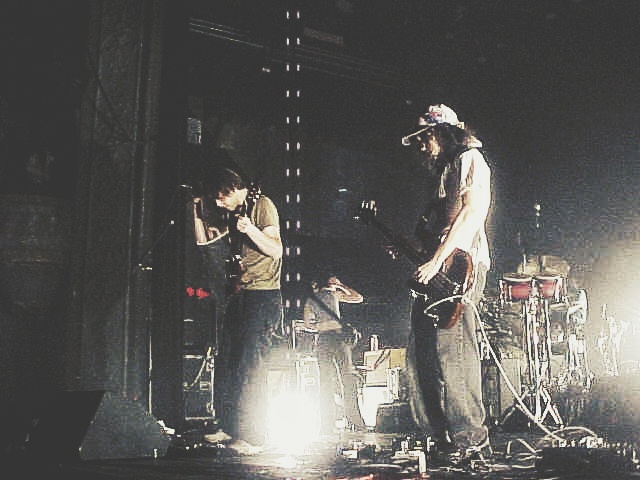
After an impressive and ambitious opening set from Ann Arbor post-emo band Racing Mount Pleasant, the sold-out Thalia Hall crowd was practically jittering in excitement for the currently reigning coolest band in the world to take the stage. As the lights dimmed and the crowd roared, the lumbering tableau of Geese's Cameron Winter came into the picture, along with the sharp presence of Emily Green and the buoyant Dominic DiGesu. The show opener came as a surprise, as drummer Max Bassin began the methodical thump of “Husbands,” a Getting Killed highlight that finds Geese at their most reserved and Winter at his most vulnerable. I expected the explosive album opener “Trinidad,” or hyper-catchy lead single “Taxes,” to open the show, but Winter chose to wear his wounds on his sleeve immediately.
The choice proved fruitful, as the sold-out crowd went from frenzied to silent as soon as Winter began singing, showing a reverent respect for the song that is unfortunately increasingly uncommon at live shows. The energy in Thalia Hall was almost religious as Winter recanted his Sisyphean fable of walking up a hundred hills; this church-like atmosphere was not due to Winter’s proclivity for biblical imagery, but rather the hymn-like texture of “Husbands”’ vocal melody, boasting one of the most moving choruses on the entire record: “Will it wash your hair clean/When your husbands all die?/Will you know what I mean?” Winter went falsetto on the first chorus, a playful subversion of expectation acting as a sign of what was to come. I was at first disappointed, since Winter’s vocal tone on said chorus is one of the highlights of the album, but it was immediately rectified the second time around, when Winter finally unleashed the force in his voice and sounded, arguably, better than on the record. Winter’s voice is like water: still, then rippling, then crashing, but always pure.
So much of Geese’s appeal (and a key factor in the excellence of their live show) is the foundation of diverse influences and raw ability each musician brings to the mix. Emily Green’s lead guitar playing, which ranges from sparse and intentional to wild and riveting, Dominic DiGesu’s driving, funk-inflected bass lines, drummer Max Bassin’s ability to be tasteful, idiosyncratic, and crushing, and of course Cameron Winter’s inimitable, anguished-beyond-its-years voice. Winter wages war against the indie rock paradigm of milquetoast detached vocal stylings, wailing and belting as if trying to escape his own diaphragm. Even in his quietest and most melodic moments (of which there are many), his undeniable vocal chops carry through.
Lyrically, Winter and Geese interweave vivid metaphor with thudding blunt emotion, embracing both earnestness and unpredictability. Winter’s stream of consciousness surrealism evokes New York School poets like Frank O’Hara and Alice Notley as much as it does his more direct lyrical forebears like Tom Waits and Berman/Malkmus. The songs are personal and vivid, only lacking clarity when they choose to.
“Enough kidding around,” Winter mumbled into the mic at the conclusion of “Husbands” before rip-roaring into the grungy country-rock cut “2122 from 3D Country. It was at this point that Sam Revaz, the band’s touring keyboardist, emerged from behind his throne donning a massive keytar, visually reminiscent of Masayoshi Takanaka’s surfboard guitar from the 2000’s. Geese is deeply earnest, but not without a sense of humor and firm grasp of kitsch, which seems almost necessary to write an experimental country-rock album despite growing up in the least country place imaginable (New York City). The title track off Getting Killed came next, featuring scuzzy, twangy guitar from Green that hearkens back to their previous record, and pounding, reckless drum fills from Bassin. Winter summoned all his voice’s roughness on the growling of the lyrically apt line “I’m trying to talk over everybody in the world.”
After the anthemic and falsetto-heavy 3D Country track “I See Myself,” we got our first taste of Winter’s between-songs crowd work; as his speaking voice, which is somehow equally deep and meek, stumbled through the sentence “Let’s…keep going. Let’s…do the show,” followed by an affectionate giggle. Winter has the lumbering awkwardness of a person who is always banging their shins into the corners of tables, and his nervous affect is exactly what makes him so appealing. It’s not quite the anti-rockstar ethos of the 90’s slacker rock scene, rather a young man who is acutely aware that he is a rockstar and doesn’t quite know what to do with that fact. “Cowboy Nudes,” followed, as the mosh pit and the sing-along intensified with Winter’s proclamation of “Be my warrior,” followed by the localization of the lyric “New York city is underwater,” to “Chicago, Illinois is underwater.” DiGesu hopped on the hand-drums during this section, rhythmically pitter-pattering a chaotic accompaniment to Bassin’s frenetic percussion.
Following a pair of 3D Country songs Geese returned to Getting Killed, playing stand out tracks “Islands Of Men,” and “100 Horses,” both of which were injected with quite a bit more electricity and energy than they carry on record, with the latter sporting a noisy no-wave tint reminiscent of debut record Projector. “There is only dancing music in times of war,” Winter belted, before an extended moaning yell as their intensity continued to ramp up into a crushing climax. A couple more 3D Country tracks, as well as “Space Race,” off the B-side EP 4D Country later and the show was nearing a full hour. I was nervous that some of the marquee tracks from Getting Killed may not make the cut, wondering if they were really going to go 90 full minutes to include all the recent crowd pleasers. They didn’t, they went 105 minutes, ending the main set on a 4 song sequence that showcased the incredible range and purpose behind Getting Killed.
The closing sequence began with “Bow Down,” a galloping, tumbling track that finds its conclusion after working itself into a climactic ascent towards one of the most memorable climaxes on the entire record. Geese then took a step back into one of their quietest and most harrowing tracks, “Au Pays Du Cocaine,” a pathos-heavy “please don’t leave me” ballad that is emotionally wrenching without melodrama or pretension, displaying a heartache that is matter-of-fact and cutting. The gorgeous but understated instrumental gently ushers Winter along as he traces his own bruises. The nursery rhyme-esque chorus describing a sailor in a big green boat in a big green coat has its quirkiness replaced with overbearing weight as winter pleads the line “you can be free, you can be free, just come home, please.” Followed by a very unconvincing “I’m alright…it’s alright.” Emily Green’s minimal but moving guitar lead sounded even crisper than on record. In the quietest moments of the set, when each note meant the absolute most, her pristine playing of such a simple melody was a masterful use of pointed brevity. The song’s climax comes with the tension and release of one of the better love lines in recent memory: “Baby you can change and still choose me.” Winter indulged in an extra round of repetition on “you can change,” making the vocal turn of “and still choose me” a near tear-inducing moment.
The bouncy and morose “Taxes,” followed, featuring one of Geese’s most straightforward pop riffs of their entire career front-and-center, inducing the type of jump-up-and-down excitement from the crowd usually reserved for intentionally filmed music videos. It was during this song that the two men standing next to me, each at least 5 years my junior, completely lost it. “Dude! This is the best show I’ve ever been to! This is incredible,” “Bro, I KNOW, this is fucking AMAZING,” they bantered back and forth, in awe of their own experience and the band they were seeing.
Winter ascended to the keyboard for the final song of both the main set and Getting Killed, the six minute mammoth “Long Island City Here I Come,” a personal favorite on the album due to its unrelenting frantic build and inspired mid-song transition bassline from DiGesu. Witnessing this song live felt monumental, both musically riveting and packed airtight with some of Winter’s most casually brilliant lyricism. “The lord has a lot of friends, and in the end, he’ll probably forget he’s met you before,” and “A masterpiece belongs to the dead. There are microphones under your bed, and there’s footage that will prove us both wrong,” both stand out as catchy and potent dialogue, as Winter recounts hypothetical conversations with Joan of Arc and Buddy Holly (Charles Holley).
After a titanic 90-minute, 14 song set I assumed the album closer was also the show closer. The runtime was stretched due to Geese’s propensity for odd tunings and lack of immunity to the occasional jam. The constant tuning and switching of guitars between songs actually added a dimension to the listening experience, visualizing for the audience the variance of their sonic palette album to album and track to track. Thankfully, I was still in the considerable merch booth line as they came back out for their encore.
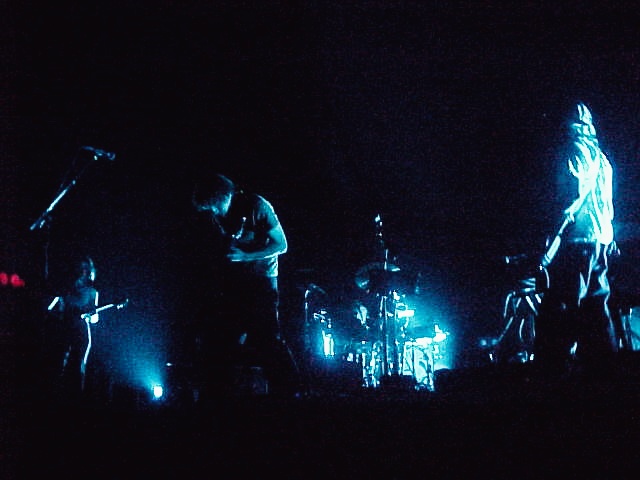
The encore was comprised of 3D Country’s “Domoto,” relative deep-cut “4D Country,” and finally, the bombastic and exhilarating Getting Killed opener, “Trinidad.” Geese indulge their most avant-garde sensibilities on “Trinidad,” as rebellious, wilting horns accentuate the crashing chaos of the chorus. The stage was dark for the thoughtfully meandering verses before exploding with strobe lights during each window-shattering chorus, as hundreds of acolytes echoed Winter’s exasperated scream of “There’s a bomb in my car!”
As the jubilation inside Thalia Hall spilled onto the sidewalk, it occurred to me that Geese is the contemporary band with the clearest case of early-onset dad rock. Not in the sense that it sounds dated, but in the sense that in 20 years Getting Killed is one of the albums that parents will show their children to teach them about their concept of real music. Their children will performatively dislike it, then accept that they love it five years later, just like I did with my mom’s Patti Smith and Clash CD’s. For a generation defined by anxiety, and a world constantly getting worse, Geese provide not only a reassurance that you’re not crazy, but a promise that beauty can be found and created despite it all. Why have oceans of devoted fans chosen Geese as their embodiment of all that is good in contemporary rock? The answer is plainly stated in their own lyrics, “I see myself in you.”
