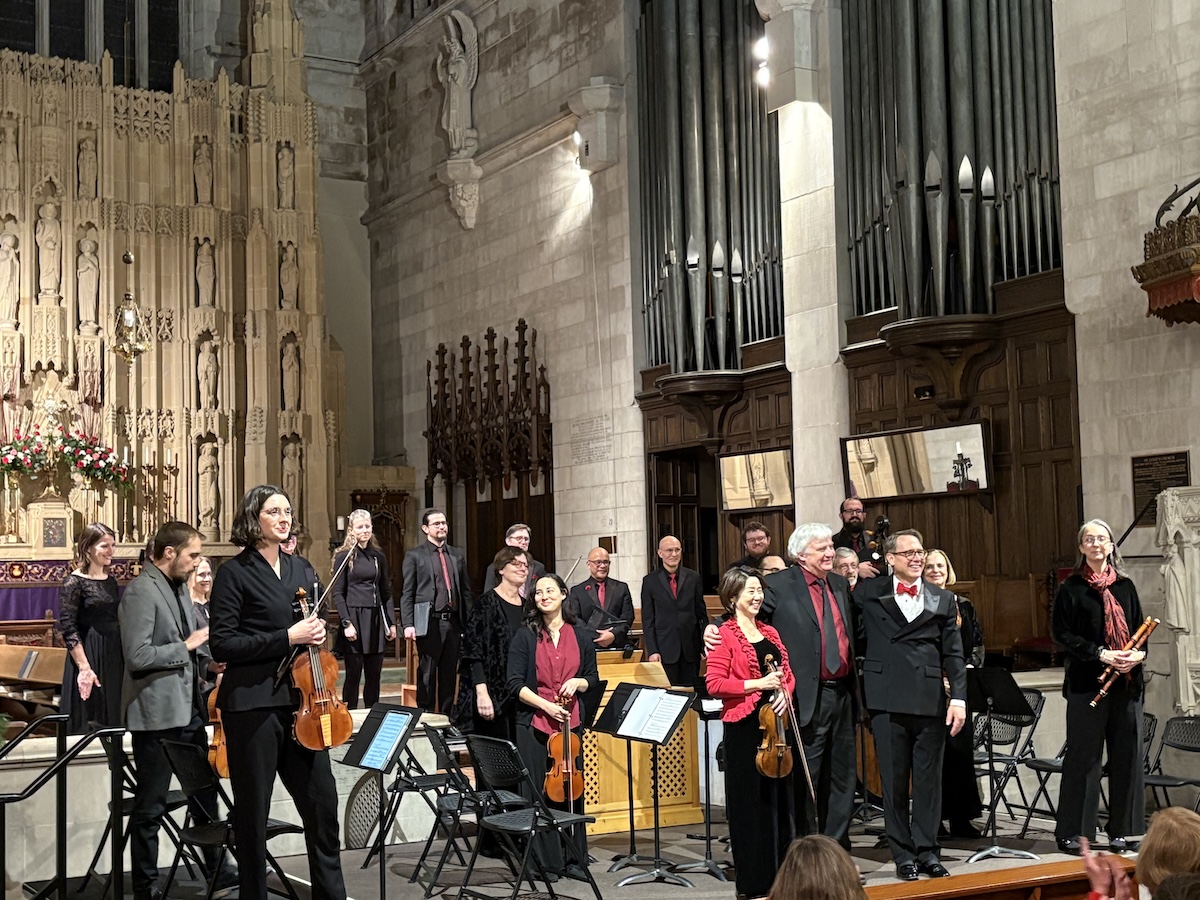

Some of the best Christmas music I have ever heard has come from churches of every denomination. On December 14, I ventured out on a frigid 5° afternoon to St. Luke's Episcopal Church in Evanston to hear the Bella Voce Chorus led by artistic director Andrew Lewis. They were joined by the accomplished Madison Bach Musicians led by artistic director Trevor Stephenson. The program was titled "Christmas with the Baroque Masters," featuring music by Georg Frideric Handel, Heinrich Schütz, Isabella Leonarda, and others.
Lewis and Stephenson collaborated in an in-depth preconcert talk Lewis is an alumnus of Northwestern University and studied with Daniel Barenboim and Asher Fisch. He received his master's degree from the Eastman School of Music and is a scholar of the Baroque, having both sung and conducted. Stephenson is also a scholar of the Baroque, with a doctorate from Cornell University in historical performance and 18th-century music.
They spoke of the intricacies of Baroque music, concentrating on Heinrich Schütz's compositions "Hodie Christus Natus Est", SWV 456, and "Ein Kind Ist Uns Geboren SWV 384. Both pieces are motets that date to the end of the Thirty Years' War (1618-1648) between Catholics and Protestants in Europe. This is significant because Germany lost 50% of its population, and Schütz's music reflected the sorrow and longing for peace. He created music with the fourth held over into the next measure, voices overlapping, and counterpoint. There are variations in tempo and parts between the upper and lower voices, layered over each other.
The discussion also emphasized the difficulties faced by women composers in that era. Women were not educated; instead, they were trained to be wives. They were given music lessons to entertain in the parlor. The only education available for women was to join a convent. Fanny Mendelssohn's music was published under her brother Felix's name. Isabella Leonarda joined the Ursuline Order when she was 16 and received an education, where she was free to compose music. Leonarda's "Magnificat," Op.19, sets music to one of the best-known prayers attributed to Jesus's mother, Mary. I considered it the most beautiful piece of the concert: intricate and beautifully composed, with flowing voices reaching high notes and balanced by the lower voices.
Leonarda is the second nun I have come across from the Baroque period. Sor Juana Inés de la Cruz was a Hieronymite nun in colonial Mexico. Her poetry and music inspired Amos Gillespie's "Shadow Effect" at the Ear Taxi Festival with the KAIA String Quartet.
Throughout the concert, gorgeous Christmas music filled St. Luke's Presbyterian. The Madison Bach Musicians played Handel's Concerto in B-Flat Major for Organ and Strings, Op 4 No 6, with Stephenson on his own hand-built harpsichord brought from Madison for the occasion. Handel is perhaps best known for The Messiah, but he was also a virtuosic organist who wrote many other instrumental works. The Madison Bach Musicians played beautifully with strings that included a bass and two recorders. The list says flutes, but the recorder is more appropriate for the Baroque era.
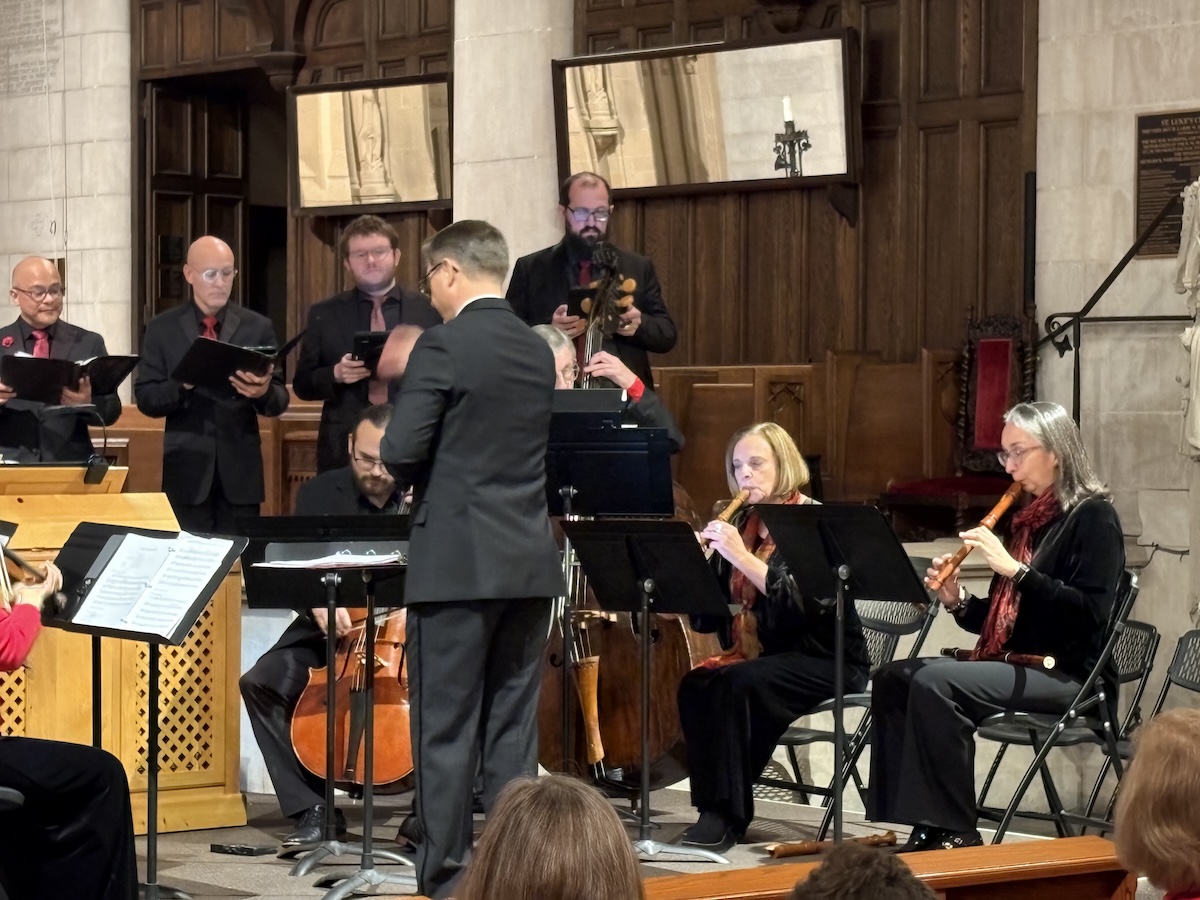
The beautiful, sweet tone of the recorder was featured in Marc-Antoine Charpentier's Messe de Minuit Pour Noël, H.9. This composition for the French Midnight Mass featured both ensembles in a beautiful collaboration. Some solos featured high tenor voices. Lewis pointed out that it wasn't the same as a countertenor or a castrato, but more like an alto. In any case, it was gorgeous, featuring tenor Oliver Camacho and J. Alfredo Jiminez. Basses Eric Miranda and Ed Frazier Davis sang with rich and full voices that sounded awesome in the church space. Kirsten Hedegaard and Eleanor Walters were featured soprano soloists. Midnight mass is one of my favorite memories from growing up Catholic. I was baptized while Vatican Two was in conference, and this Mass was sung in Latin, similar to what I grew up hearing. It was beautifully done and more nostalgic for me than I was expecting.
Arcangelo Corelli's Concerto Grosso in G Minor "Christmas Night," Op. 6 No. 8, was published after Corelli's death, but the program notes suggest it may have been played earlier for Corelli's patron, Cardinal Pietro Ottoboni. This was my favorite instrumental of the concert. It was violins, cello, and bass, which was unusual to me because the cello usually takes the bass part in most string groups I have heard. I feel that adding bass to the cello deepens its richness.
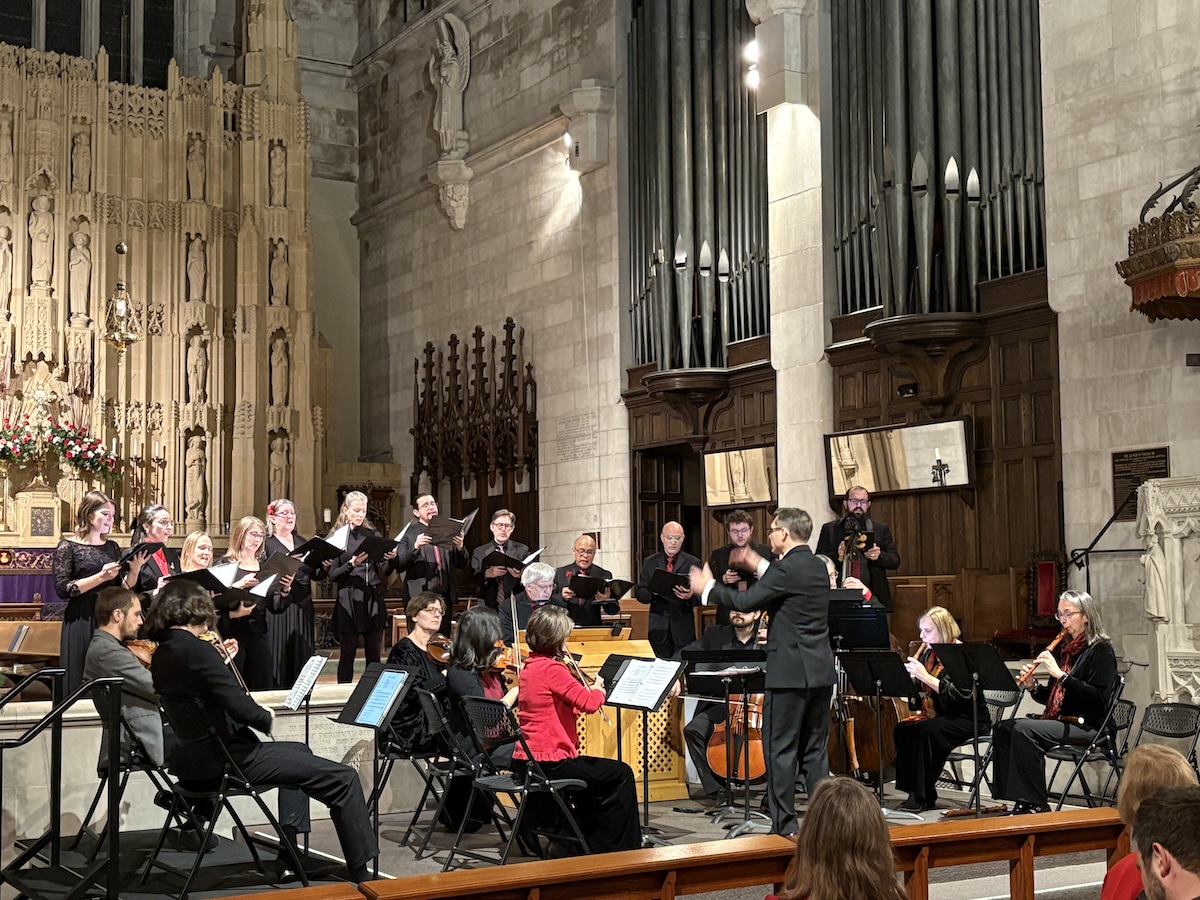
The concert was about two hours, including an intermission, but I could have listened even longer. The Bella Voce and the Madison Bach collaboration was such a pleasure to listen to in the soaring sanctuary of St. Luke's. My experience is that traditional churches are built for music like this, and the acoustics were fantastic. I could almost smell the frankincense and feel the heat of the voluminous candles at Holy Name of Mary at Midnight Mass. The musicianship of both groups was excellent, as was Andrew Lewis's conducting. This is season 43 for the Bella Voce Chorus, and I hope there are many more to come. I also wish for another collaboration between Bella Voce and the Madison Bach Musicians. An encore of Christmas with the Baroque Masters is a musical treasure that should have a wider audience.
Christmas with the Baroque Masters, featuring the Bella Voce Chorus and the Madison Bach Musicians, was performed on December 14 at St. Luke's Episcopal Church, 939 Hinman Avenue in Evanston. For more information, please visit www.bellavoce.org and www.madisonbachmusicians.org.
Now through December 31, Third Coast Review is raising money to support the diverse roster of writers you know and appreciate for their thoughtful, insightful arts and culture coverage in Chicago and beyond. Everything raised during this time will go directly to paying these writers a well-deserved year-end stipend; you can make a contribution here. Thank you!
