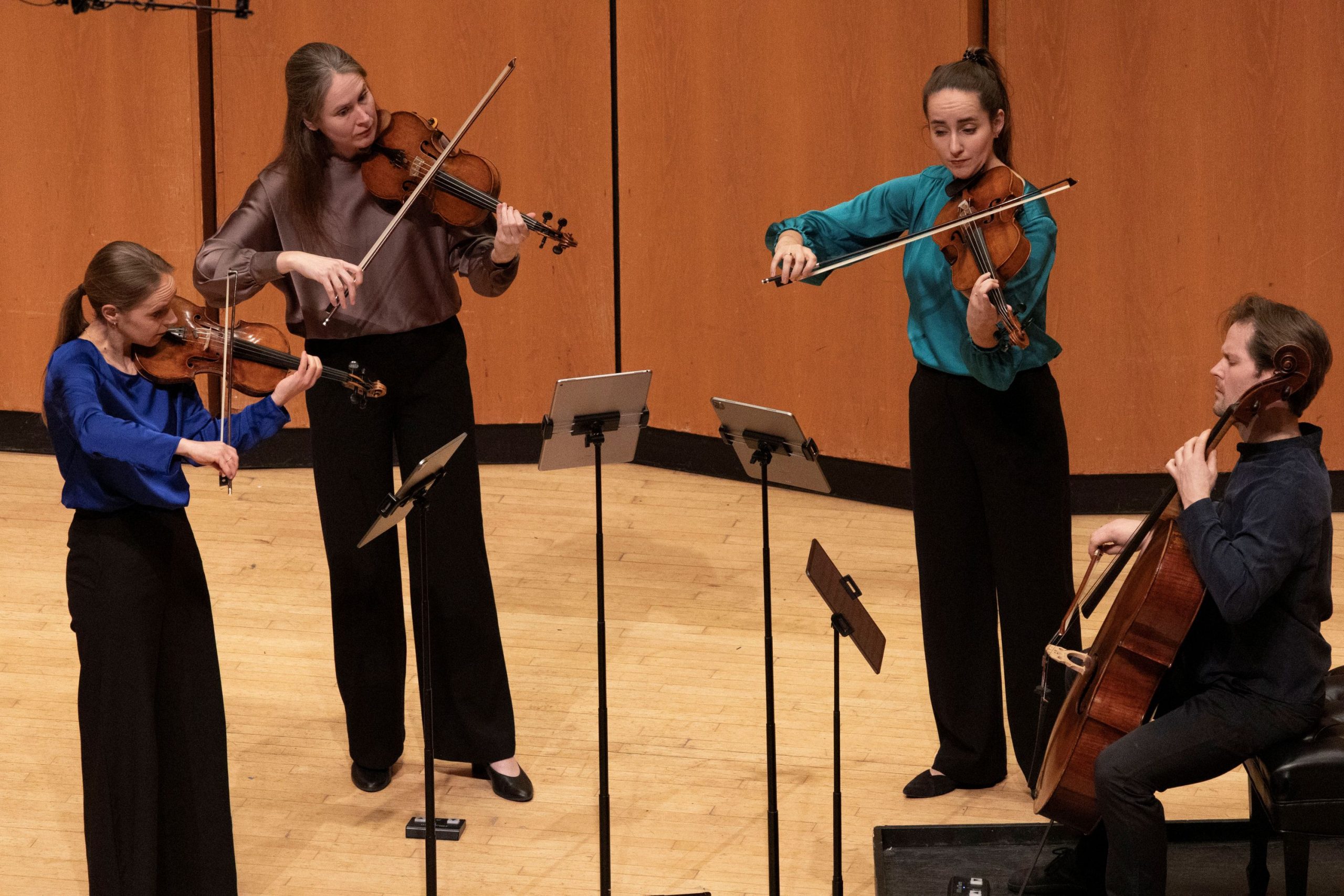

Making its fourth appearance at the Northwestern Winter Chamber Music Festival, Dudok Quartet Amsterdam gave an enjoyable performance of two string quartets of high repute: Dmitri Shostakovich’s String Quartet No. 3 in F-major, and Franz Schubert’s String Quartet No. 15 in G-Major. For this year’s opening concert, the Pick-Staiger Concert Hall was nearly full.
Active since 2009, this young quartet from the Netherlands has a very compelling stage presence. Violinists Judith van Driel and Marleen Wester and violist Marie-Louise de Jong stand, while cellist David Faber sits on a platform to their left. They also offer a fresh approach to the repertoire, commissioning new and transcribing old music.
One composer they have focused on is the Russian Dmitri Shostakovich, whose large output of string quartets reflects the challenges of composing under the political demands of Joseph Stalin and other Soviet leaders during the time surrounding World War II. One of Dudok’s recent projects is transcribing to string quartet Shostakovich’s 24 preludes for solo piano.
Cellist Faber discussed how Dudok Quartet approaches Shostakovich’s five-movement String Quartet No. 3. It was written right at the end of WWII it and plays with the mixed emotions caused by the war and its immediate aftermath. The opening movement Allegretto starts with a deceptively jolly tune, which soon morphs into tension and reflection.
Throughout this performance, Dudok Quartet showed the ability to move seamlessly between contrasting moods and feelings. As their bows danced across the strings, they created a very compelling sound. The opening movement is in sonata form, and the development opens with a fugal passage, where they showed off excellent interplay.
The second and third movements are Scherzos at different tempos. In the second movement, Moderato con moto, an instrument would repetitively play a three-note triad while the others would dance overhead with very distant melodies. Contrast occurs as it ends super quietly and the second, faster Scherzo, an Allegro non troppo, comes in with loud, rapid chords underpinning the melodies. The middle section offered a gentle respite.
In the Finale, Dudok Quartet showed their mettle, starting with Faber’s careful transition from the duo he’d been playing with violist Marie-Louise de Jong to end the slow movement into the finale’s lilting, dotted melody. It ends super softly, with the ensemble magically producing the quietest sounds possible with perfect bowing.
After intermission, Dudok Quartet Amsterdam performed Franz Schubert’s 15th and final String Quartet, in G-major. As is typical of the music Schubert wrote toward the end of his short life, this quartet has a large footprint with elaborate melodic invention and harmonic interplay.
First violinist Judith van Driel explained some of these intricacies. She observed that it frequently moves between major and minor keys and expressed particular fondness for the soulful melody of the middle part of the third movement, Scherzo.
One feature is a lot of rapidly repeated notes, giving it a symphonic feel, especially when all four instruments are doing it at the same time. This requires that each note be played identically, which Dudok Quartet handled very nicely.
After the opening G-major chord starts quietly, it builds in intensity and eventually shifts into a series of dark and foreboding minor chords. Dudok Quartet captured this shifting intensity. One thing I always listen for is the first violin playing a lovely melody followed by the cello. As the cello concludes, it seems as if the melody should end on a note well below cello’s lowest range, when the others join in to finish the phrase with a fanfare.
Their ensemble interaction was usually good, with each player handling their moments in the limelight very well. However, there were a couple of moments in the opening movement when second violinist Marleen Wester seemed a bit overshadowed in the mix.
The slow second movement, Andante un poco moto, is a bit brusque, a feeling the Dudok Quartet effectively captured. But they weren’t quite as tight as they had been. Also, intonation was a bit off during a flourish between the first violin and viola.
After a resounding ovation, Dudok Quartet Amsterdam returned to Shostakovich for an encore: cellist David Faber’s arrangement of the Prelude No. 6 in b-minor. Lovely.
There has been a program change for next Friday’s concert. Members of the Vertavo String Quartet from Norway were unable to get visas to travel to the United States. Taking their place will be the Ariel String Quartet to perform quartets by Haydn, Berg, and Beethoven. Friday, January 16, 7:30pm. For more information click here.
Next Sunday, Trio Seoul will be performing piano trios by Haydn, Seo, Liszt, and Ravel. January 18, 3pm. All performances are at the Pick-Staiger Concert Hall, Evanston. For more info, click here.
If you enjoyed this post, please consider supporting Third Coast Review’s arts and culture coverage by making a donation. Choose the amount that works best for you, and know it goes directly to support our writers and contributors.
