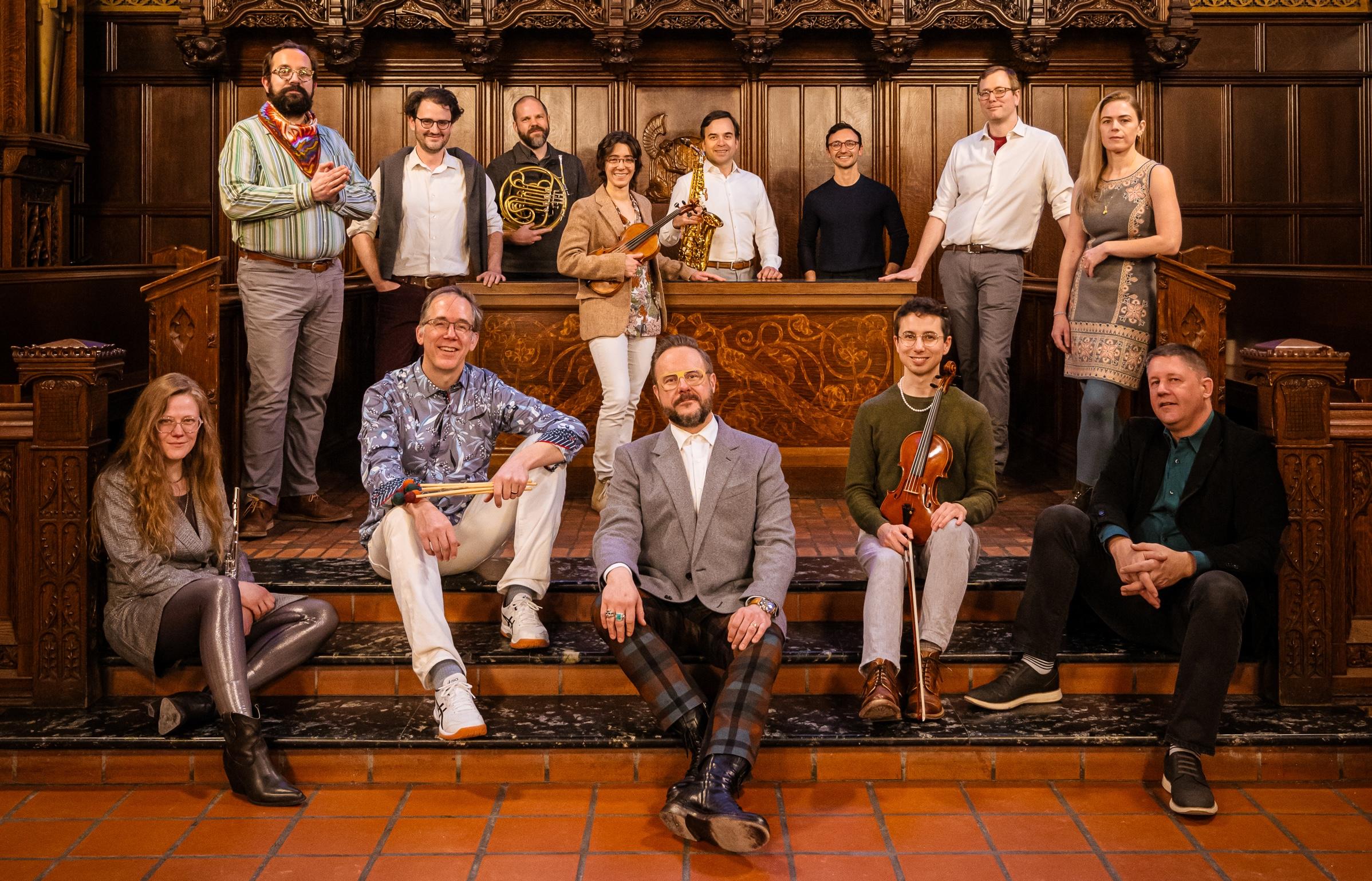

Under the direction of David Bloom, the Grossman Ensemble gave an enjoyable performance at the Logan Center Performing Hall in Hyde Park on Friday. This 13-member ensemble commissions and performs four world premieres at every concert. They also use different conductors, and the composers collaborate with the conductors and ensemble to create a variety of new music.
The Grossman Ensemble is the Ensemble in Residence at the Chicago Center for Contemporary Composition, which is housed at the University of Chicago. Friday’s concert was called Woven Light, and all four composers were present to explain their works.
First was Coronation Riot by Theo Chandler, who expressed concern about the political situation around the world and the trend toward autocracy. The ceremony and pompousness of last January’s inauguration of the current president reminded him of a royal coronation of an autocrat trying to relive some era of the past that never really existed.
To model that, the six movements of Coronation Riot draw from musical styles from many centuries back, and misrepresents them with harmonies and melodies that are askew. The first movement “Fanfares” opens with a jarring and rapid burst of percussion and brass. “Low Dance” is waltz with everything a bit akilter. “Troubadour Song” starts on the harp, which pairs with the oboe and the remaining instruments and string quartet as the work progresses. After a couple more movements, it ends hopefully, with quieter “Undying Song.” Coronation Riot left a very strong impression.
Up next was a fascinating piece by Kyong Mei Choi, (be)yond. She described how the piece is focused on the concept of “being” and transitioning over five sections from “to be” to “beyond.” It starts with two quick notes on the piano with sliding glissandos on the strings. Eventually the clarinet jumps in for a rising melody. Two climaxes occurred with each instrument ascending their range and playing as loud as possible. It reminded me of “Day in the Life” by the Beatles, and the impacts were similar.
This was followed by Talisman by Phil Pierick. As he explained, he has managed the Grossman Ensemble since its founding in 2018. Over Talisman’s six movements, Pierick gave each of the 13 members distinct roles. He also required a variety of instruments, shifting during the performance from piccolo to flute and clarinet to the lower basset horn.
The diversity of sounds that emerged from this work were remarkable. the first two movements, “Incantation” and “Ritual,” flow into one another. They offered intense percussion and rhythms, but not much melody. But the following movement, “Chasse” offered great contrast with rapid melodies all over the place. Talisman ends in quieter reflection with “Adieu.” Very enjoyable.
Concluding the concert was Sita by composer and jazz bandleader David Sanford. It opens with the rhythms on the string quartet, while the piano provides a melody. The sounds reminded me of Ravel’s orchestration of Mussorgsky’s Picures at an Exhibition. Especially remarkable was a fugue-like interlude starting on piano and harp. The percussionists joined sequentially on vibraphones, followed by the string quartet. Then came the oboe and flute, followed by the clarinet, saxophone, and horn. The resulting crescendo created an exciting climax. It was a great end to an enjoyable performance.
Following the concert, the audience was able to interact with the composers and performers at a reception. It is always a nice touch that permits greater interaction.
The Grossman Ensemble will be touring the United States, starting at the Library of Congress in Washington, DC, on May 9. Afterwards, they will be returning to Hyde Park for a performance of four new works at the Logan Center Performance Hall on May 22, 7:30 pm. For more information, click here.
Support arts and culture journalism today. This work doesn't happen without your support. Contribute today and ensure we can continue to share the latest reviews, essays, and previews of the most anticipated arts and culture events across the city.
