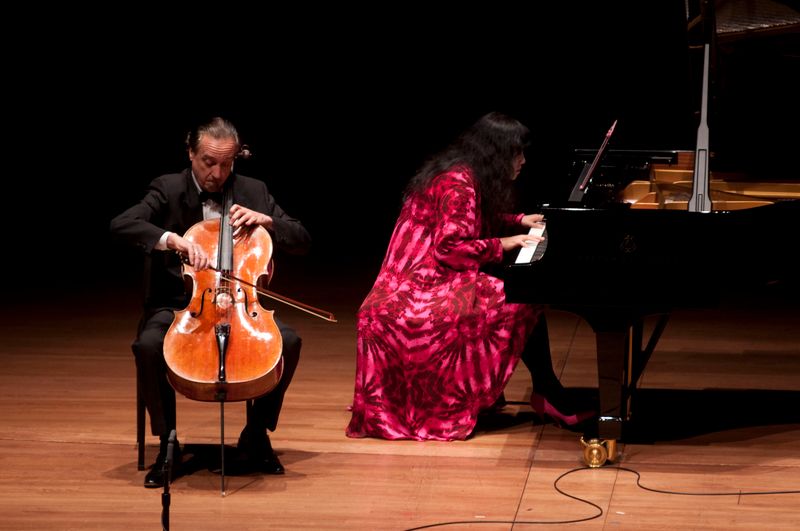

Following last weekend’s excellent performances at the Sun Valley Music Festival, violinist Benjamin Beilman joined pianist Wu Han and cellist David Finckel at Harris Theater on Thursday evening. This was part of the series of concerts by the Chamber Music Society of Lincoln Center, a collection of musicians from New York who perform and tour with various ensemble arrangements.
Han and Finckel are the artistic directors of CMS Lincoln Center. In an interview last weekend, Beilman referred to them as “titans” in the world of classical music, which they certainly are. They are also married, and their relationship comes through in their performances.
Dressed in a colorful, flowing gown, Han introduced the program from the stage. She noted that the first half was rather dark, with one of Wolfgang Amadeus Mozart’s few pieces in a minor key, Violin Sonata in E-minor, K.304. This was followed by another work in E-minor, Piano Trio No. 2 Op. 64, by Soviet composer Dmitri Shostakovich. She promised that the second half was a lot lighter, though equally powerful: Franz Schubert’s Piano Trio No. 2 in E-flat Major, Op. 100.
In keeping with her flowing attire, Han’s playing was fluid throughout the evening. She exhibited charm, subtlety, and, in the concert’s second half, majesty. Her runs were great, with each note being identically struck on the keyboard.
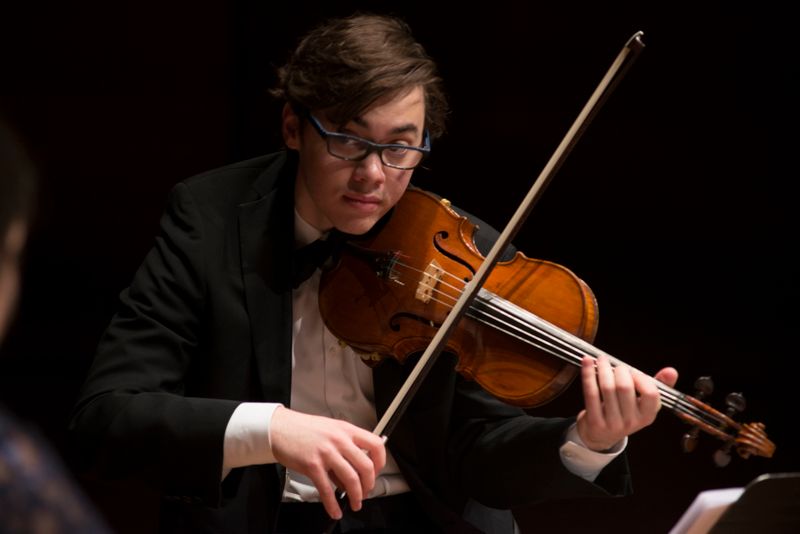
As was the case in Sun Valley, Beilman had several opportunities to sound his deep, rich tone. A big part of this comes from the violin that he plays, a Guarneri instrument from 1740. This violin has an extraordinary provenance that includes Belgian violinist and composer Eugène-Auguste Ysaÿe and Isaac Stern, who played it for 35 years.
In the two piano trios, David Finckel added his masterful cello playing. As a founding member of the Emerson String Quartet, with whom he played for 34 years, he showed exquisite passion and interpretation time and again. It is always great to hear him, whatever the ensemble.
The concert started with Mozart, who wrote this and several other violin sonatas during an unsuccessful job search through western European musical centers. He was traveling with his mother, who died in Paris during the trip. This sonata in two movements was also written in Paris, although, as the program notes indicated, it is unknown whether the gloomy work was written before or after his mother died.
In performance, Han and Beilman’s aural balance was a bit off on Thursday. Especially in the opening movement, Han’s piano was overpowering, and Beilman’s violin hard to hear. Part of the challenge is that this sonata was written for, in the words of H.C. Robbins Landon, "amateur domestic fare." As such, it lacks a flashy violin part. Things were better in the second movement. Even so, there were occasional missed notes on the piano.
In describing Shostakovich’s Trio No. 2, Han noted that it was written toward the end of World War II. As the Soviet Army pushed the Germans back across Eastern Europe, the scale of Germany’s genocide against the Jews and other groups was becoming revealed. She noted how this affected Shostakovich in composing the work.
Finckel started the Andante-Moderato opening movement with quiet overtones on his muted instrument, resulting in notes that were often higher what Beilman, joining soon after, played on his violin. Han added suspense and intrigue with quiet chords. The pace quickened to a trot with rhythmic chords on the strings, and melodies on the piano.
Fun and frolic took over with the second movement, Allegro con brio. They showed excellent interaction as the strings, whether playing with bows or plucked fingers, paired off with the piano. The third movement, Largo, is a slow passacaglia. This form from the Baroque era 200 years earlier is based on a repeated series of chords played on the piano on which the violin and cello overlaid melodies and rhythms. It was a very nice interpretation, as was the upbeat Allegretto finale.
As Han promised, the concert’s second half was very different with Schubert’s second piano trio. This Viennese composer wrote several pieces of chamber music toward the end of his short life. These rather lengthy pieces were of symphonic proportions and highlighted Schubert’s penchant for beautiful melodies and intriguing harmonic progressions.
The first movement Allegro is more notable for harmonic inventions than the melodies. It requires careful playing, and Han, Beilman, and Finckel were very much up for it. After the opening flourish, Finckel took up the melody, as Han and Beilman backed him up, roles that each instrument played throughout.
The slow second movement, Andante con moto, is a soulful march where the performers traded the melody amongst themselves. In contrast, the faster third movement, Scherzo: Allegro moderato, is like a canon, where the players imitated one another in quick succession. Whether trading tunes or imitating one another, the ensemble interacted perfectly.
The finale is where Schubert’s sublime melody comes out. Han started it more majestically than what I usually hear. It worked very well. Schubert demonstrates uncanny ability to shift themes and passages into different harmonies. Even with excellent playing, it seemed, as always, a bit long. It was still a very enjoyable performance.
The Chamber Music Society of Lincoln Center concludes their season at the Harris Theater on May 20 with a program of French composers Saint-Saëns, Vieuxtemps, and Fauré. The ensemble will include Chicago native, violist Mathew Lipman, playing a sonata for that instrument by Vieuxtemps. Wednesday, May 20, 7:30. For more information, click here.
Support arts and culture journalism today. This work doesn't happen without your support. Contribute today and ensure we can continue to share the latest reviews, essays, and previews of the most anticipated arts and culture events across the city.
