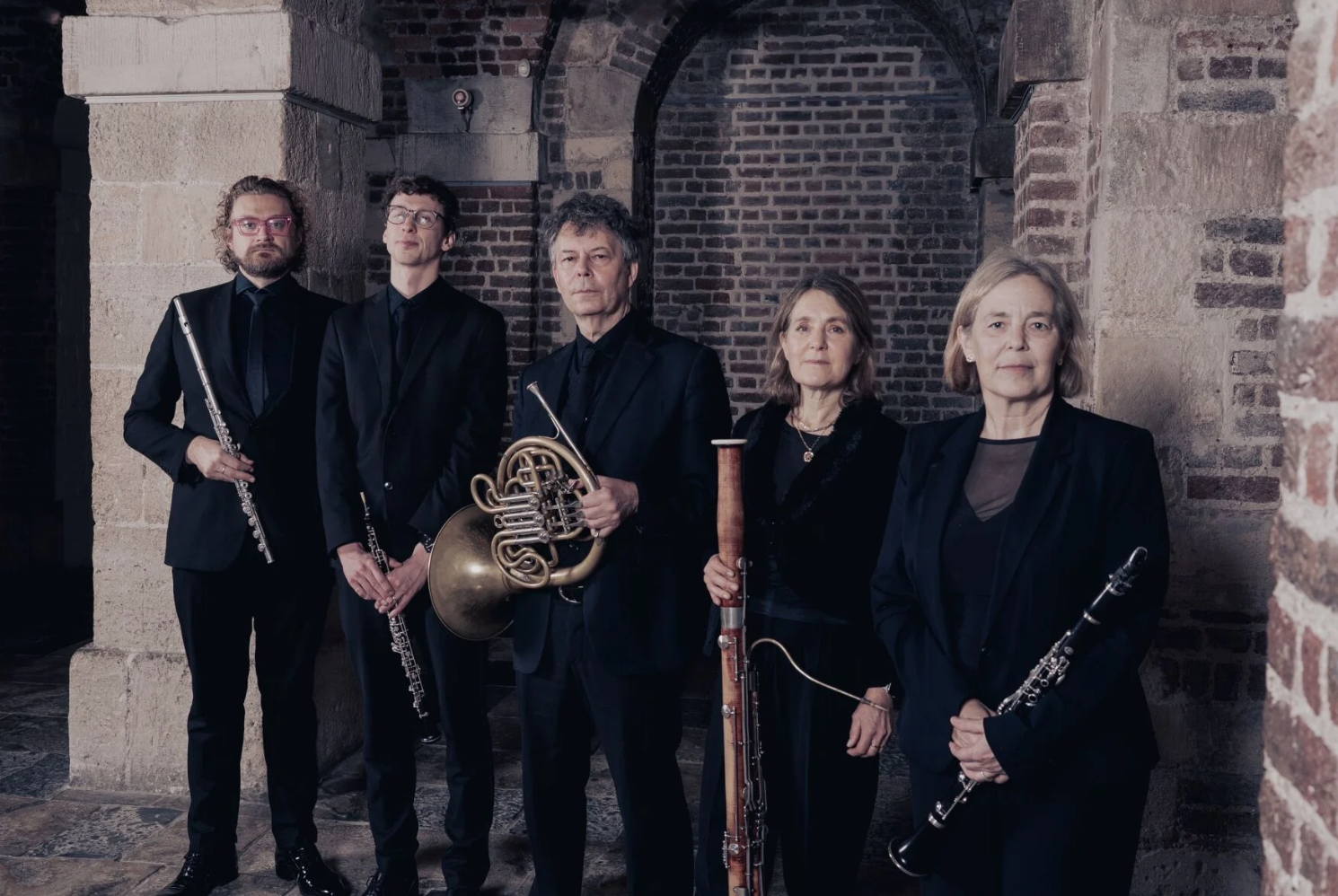

London-based chamber orchestra the Academy of St. Martin in the Fields performed at the University of Chicago’s stiflingly hot Mandel Hall rcently. The group was founded in 1958 by Sir Neville Marriner and was named after Trafalgar Square’s famous church.
The program started with a replacement announcement for oboist John Roberts, who had to fly back to the UK that morning for a family emergency. Young New York musician Lucian Avalon was flown in hours before the concert to learn the program and mesh with the rest of the quartet. He did so with aplomb, seamlessly blending with Harry Winstanley (flute), Fiona Cross (clarinet), Julie Price (bassoon) and Stephen Stirling (French horn), on a somewhat augmented program, which was mostly inspired by mechanical devices like clocks and automata. Each piece was introduced in turn by the different ensemble members to the sweltering but appreciative audience.
The first piece was Mozart’s Adagio & Allegro in F-Minor for musical clock, K. 594 (arranged for wind quintet), offering lively, playful woven threads, punctuated by staccato moments. The second piece, “Small Plinths,” was commissioned by this group in 2026 from composer Freya Waley-Cohen, making Avalon’s last-minute replacement even more heroic. Price noted that the composer had attended some rehearsals to help bring character to each instrument in layers, unconcerned if the players offer different interpretations to her intent. In the liner notes, Cohen describes her inspiration from a New Mexico sculptor’s collections of pebbles, shells and ephemera strewn about the house. She enjoyed that reverence for small and unnoticed details, textures that she incorporated into this composition to curve, jostle and bend, creating little bursts of light, wafting and swirling eddies of sound.
The third offering by Gyorgy Ligeti was 1953’s Six Bagatelles, introduced by Stirling. The first section only uses four out of 12 notes, featuring Winstanley on the piccolo chasing the other instruments. Part two evokes a Hungarian lament with a mysterious, blaring horn. Section three uses seven notes to make a floating melody by implementing a muffled bassoon. Part four is an energetic Hungarian dance, playful, energetic and brief. Hungarian composer and pianist Bela Bartok inspired part five’s melancholy adagio, which offers some quavering and mocking musical conversations. The final, sixth section is “completely bonkers,” according to Stirling, conveying a spirited, joking interplay. The scheduled Haydn piece was removed before intermission.
After the break, Winstanley introduced Carl Nielsen’s chillier Quintet, Op. 43. A violinist himself, Danish Nielsen (1865-1931) wrote for his wind instrument-playing friends. The first Allegro ben moderato section was bassoon-forward, questioning then cheeky, a sassy back-and-forth with neoclassical-inspired mood changes. Next was a Menuet, slower French social dance music in ¾ time, featuring spritely pairings between flute and oboe, then bassoon and clarinet. The more somber and slower chorale Praeludium became a recurring theme of melancholy, with more call-and-response by each instrument, with multilayered changes and turns where each player gets a moment to shine.
For the final piece, the originally scheduled Mozart’s Fantasia in F Minor, K. 608 for mechanical clock was replaced by Israeli bassoonist Mordechai Rechtman's arrangement of Johann Sebastian Bach's Concerto No. 2 in D-minor "after Vivaldi," and was indeed very Vivaldi-esque. In the intro, Cross confessed that clarinetists mostly play baroque music (since the instrument was introduced around 1700), so she was excited for this piece since she “never gets to play ‘scrunchy’ chords.” The first movement featured Avalon’s wafting oboe phrases, wafting like a hawk riding thermals. The second section was more subdued, and the third and final moments had runs most evocative of Vivaldi’s Four Seasons. Despite the heat from an unseasonably warm day, and the last-minute change in personnel, the Academy of St. Martin in the Fields Wind Ensemble delivered a delightful program.
The University of Chicago’s 2025/26 season is winding down in the next few weeks, and it includes Isaiah Collier: In Tribute to the Classics of John Coltrane on May 1, and Grossman Ensemble: Illuminations on May 22.
Did you enjoy this post? Please consider supporting Third Coast Review’s arts and culture coverage by making a donation. Choose the amount that works best for you, and know how much we appreciate your support!
