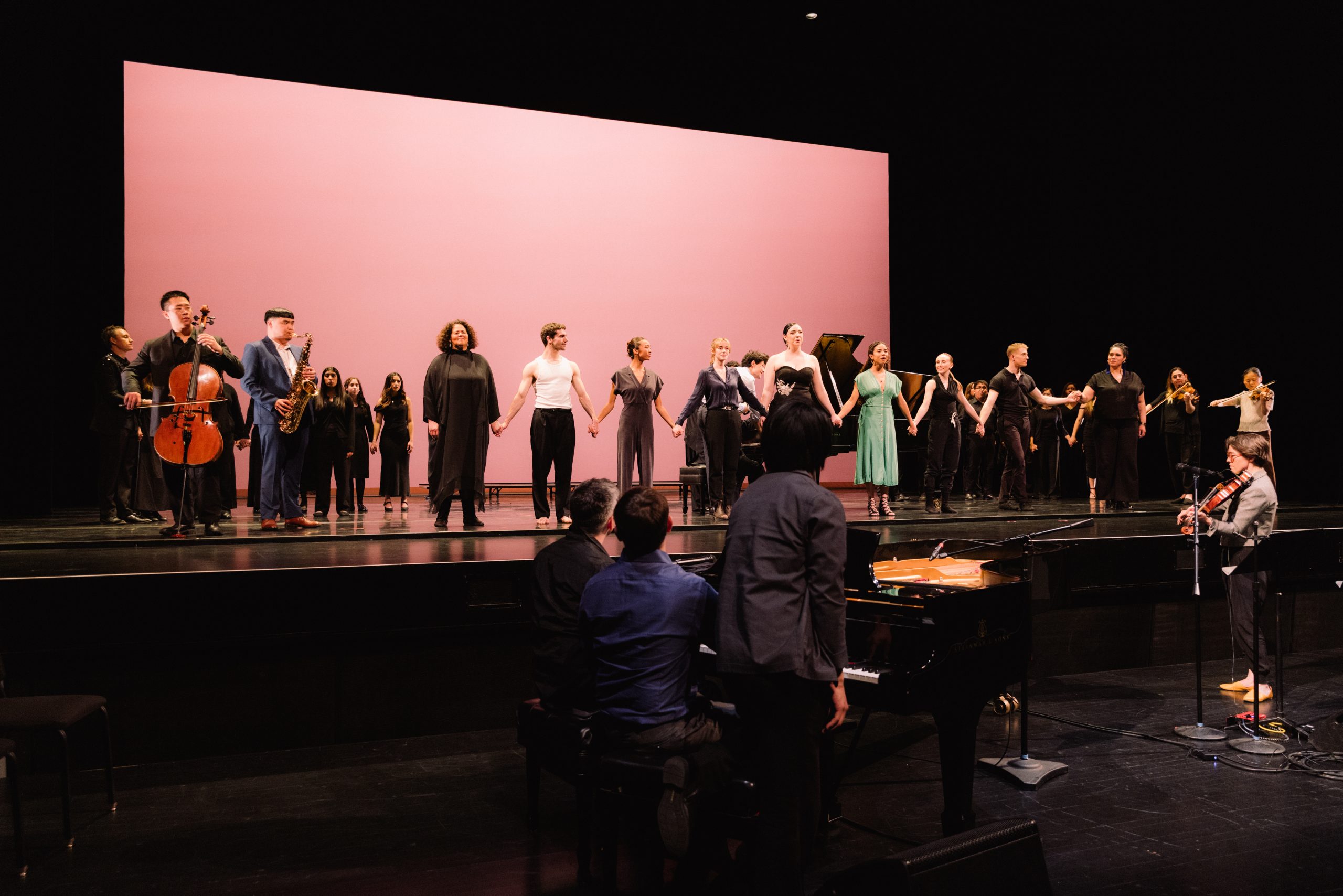

The house lights at the Harris Theater rarely dimmed on an occasion as self-assured as "Icons and Innovators." This program, held on May 2, was ostensibly a tribute to Joan Harris, the philanthropist whose fingerprints are all over the Chicago cultural map and the Juilliard School. It was a night of high ceremony, featuring video testimonials from the likes of Barack Obama and J.B. Pritzker. Yet, beneath the formal tributes lay an argument about the state of American music.
The Harris Theater opened in 2003, filling a specific void in the city. It was designed as a home for mid-sized performing arts groups that were too large for intimate lofts but would be swallowed whole by the city’s larger venues. By championing this middle ground, Joan Harris created a space where the experimental could meet the established. Saturday’s concert felt like a natural unfolding of that mission.
The evening was anchored by three pillars of music: J.S. Bach, Duke Ellington, and Philip Glass. It began with the violinist Midori, who performed movements from Bach’s Partita No. 3 and Sonata No. 3. Midori plays with a lean, unsentimental precision, reminding everyone that whatever innovations would follow, they were built on foundations laid centuries ago.
Ellington’s "Prelude to a Kiss" followed Bach immediately, a pairing that highlighted both composers as master musical architects. They each developed such robust musical languages that their works remain resilient through countless reinterpretations. Jessie Montgomery added to this lineage with Peace, a work she composed during the isolation of the pandemic. A vital and unclassifiable presence in contemporary music, Montgomery creates scores defined by an inviting tonal warmth supported by textural complexity. At this performance, cellist Noah Chen and pianist Joshua Mhoon brought her vision to life.
Philip Glass served as the evening’s third pillar. One of Minimalism’s founding figures, he replaced post-war serialist angst and experimentation with a mechanical, repetitive pulse. His influence was felt everywhere. We heard Nico Muhly’s arrangement of “Like This” from the Glass opera Monsters of Grace, with Caroline Shaw delivering fragile, captivating vocals. Muhly and Derek Wang on piano, violist Nadia Sirota, and cellist Noah Chen provided the instrumental accompaniment. Later, an excerpt from Glassworks accompanied a dance performance by Kayla Mak, choreographed by Juliano Nunes.
The younger composers on the bill showed how far the "minimalist" tree has branched. Muhly, a former Glass protégé, offered his own compositions: Ways of Listening and Twitchy Organs. In his hands, the taut, motorized repetition of the older generation becomes something more relaxed and atmospheric. It feels less like a machine and more like a nervous system.
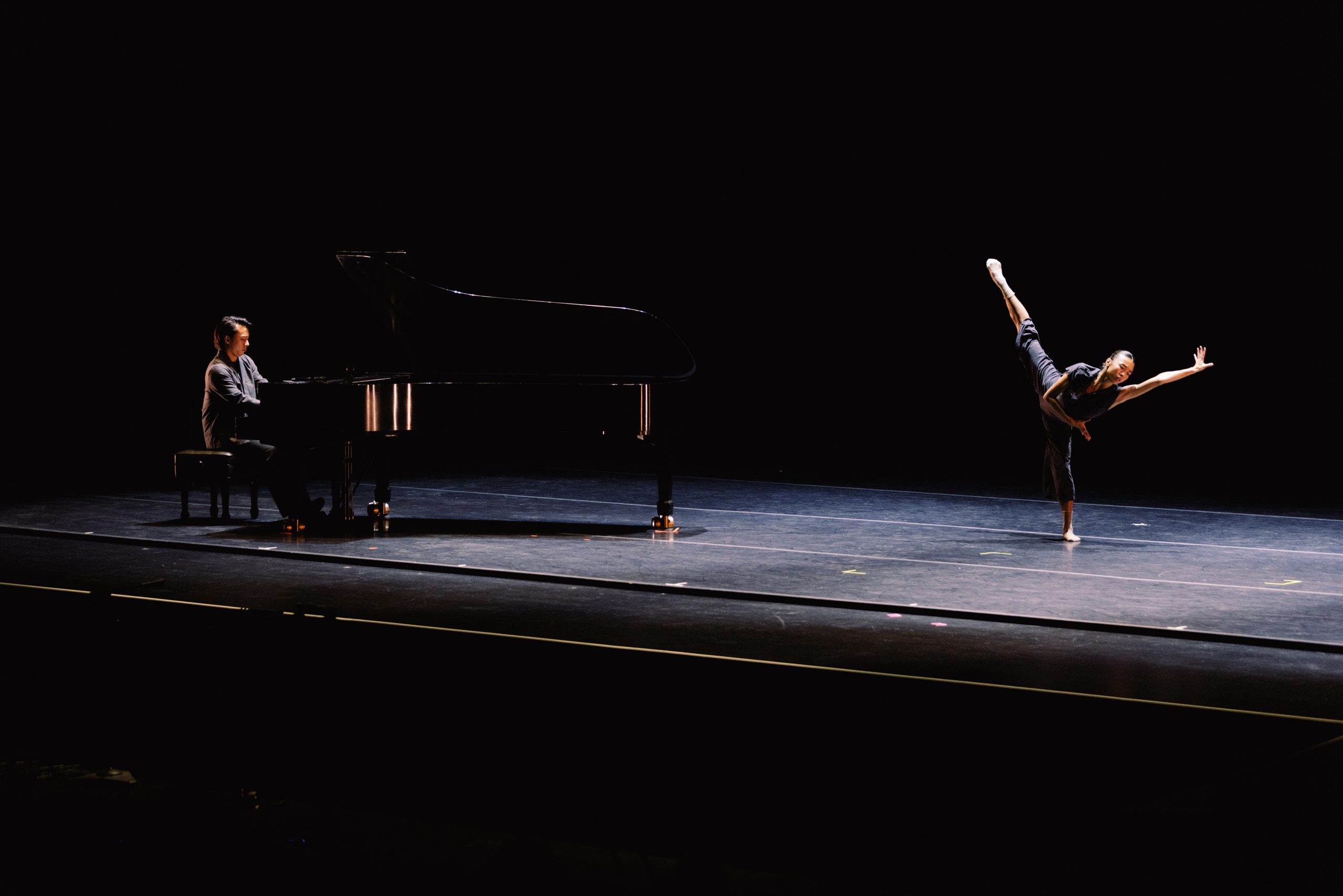
The youngest composer to ever receive the Pulitzer Prize for Music, Caroline Shaw pushed this stylistic progression even further. Her composition Unstudy No. 1, which pianist Tony Siqi Yun performed at the event, stands as a testament to human intimacy. Shaw possesses a unique ability to strip away mechanical layers to reveal a more "earthy" essence. In Unstudy, the melodic line functions much like a conversational voice—interrupting itself, fading, and then resurfacing. Ultimately, it is a piece of music that feels alive and breathing.
If one through line traced lineage and influence, another traced the vanishing boundaries between musical genres and art forms. Shaw shifted between her own roles with unselfconscious fluidity. Muhly and Glass’s works became accompaniment for dance. The vocal contributions of Lauren Randolph and Laëtitia Hollard underscored this genre-blurring spirit, as Camille Saint-Saëns’s aria “Mon cœur s'ouvre à ta voix” from Samson et Dalila was paired seamlessly with the theatricality of Marvin Hamlisch’s “Disneyland.”
An excerpt from Anna Deavere Smith’s Let Me Down Easy, delivered with poignant clarity by Emma Pfitzer Price, showed how naturally a different art form could mesh with the evening’s musical concerns. Even late in the program, when Emanuel Ax performed Chopin’s Nocturne in D-flat major followed by a piano reduction of John Williams’s theme from Sabrina, the point was clear: the boundary between classical and popular isn’t so strict. The “Sabrina theme” carries the same serious elegance as Chopin.
The evening was marred by one flaw. Originally scheduled for 90 minutes with no intermission, regrettably the program stretched and spilled past the two-hour mark. By the time the clock neared 10:00 pm, the audience had begun to thin out. It was a shame. Those who left early missed the finale, where Shaw brought the disparate threads of the night together. Setting music to an excerpt from Shakespeare’s A Midsummer Night’s Dream, she gathered the performers for a final, collaborative statement.
In the end, the concert was a snapshot of a musical ecosystem that is becoming increasingly porous. The "Icons" provided the foundation, but the "Innovators" proved that the foundation is still shifting. Joan Harris’s theater was built to house this exact kind of creative future. On Saturday night, that energy was in abundance, even if it took a little longer than expected to take its final bow.
A full listing of the Harris Theater’s programming for the remainder of the 2025-2026 season can be found here.
Support arts and culture journalism today. This work doesn't happen without your support. Contribute today and ensure we can continue to share the latest reviews, essays, and previews of the most anticipated arts and culture events across the city.
