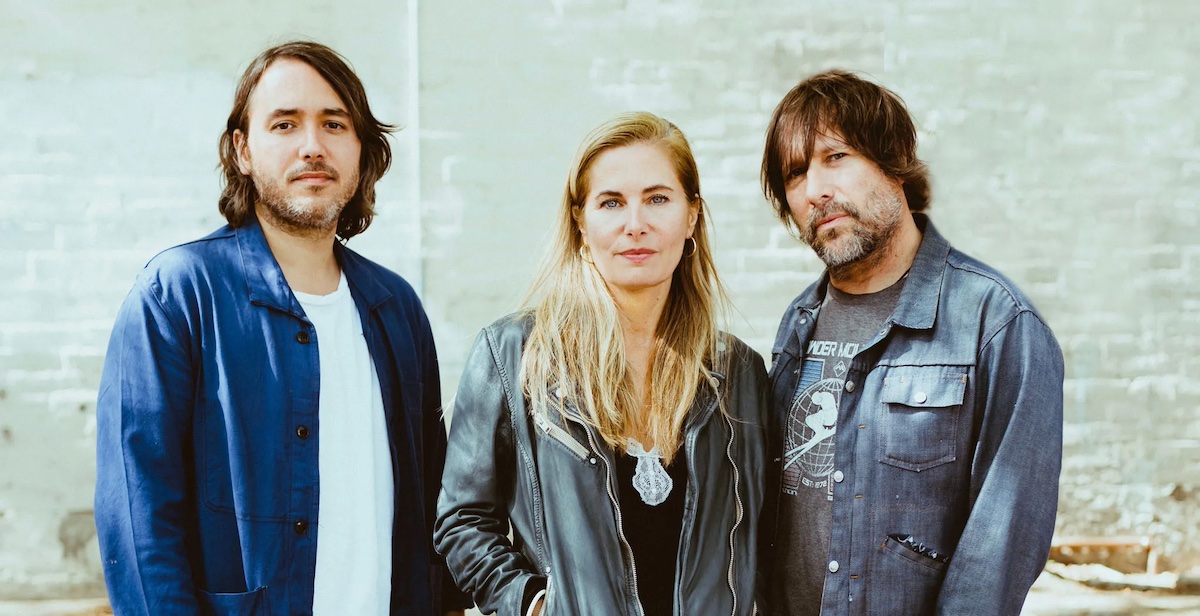
In 1991, Andy Chase placed an ad in New York’s renowned Village Voice seeking musicians who shared his eclectic tastes. One response stood out from the rest: Adam Schlesinger, a fellow multi-instrumentalist and songwriter who would later emerge as the bassist of power pop favorites Fountains of Wayne (best known for their 2003 hit “Stacy’s Mom”). Teaming up with Chase’s then-girlfriend Dominique Durand on lead vocals, they formed the band Ivy and signed with Seed Records in 1994.
The band released six albums between 1995 and 2011, after which tension between Chase and Schlesinger led to an indefinite hiatus. The pair eventually reconciled, but Schlesinger’s death in 2020 halted any plans for an Ivy revival. But when Chase and Dunne sorted through their archives, they discovered promising demos that formed the basis of a new record, Traces of You. Those tapes allowed them to include contributions from Schlesinger on every track. Longtime Ivy collaborator and touring member Bruce Driscoll rounds up the current lineup.
We talked with the band about discovering Dunne’s talents, how Traces of You came together, and the unique way they’re paying tribute to Schlesinger on their upcoming brief tour, which comes to Chicago’s Park West on May 14.
Andy, when you placed the ad that attracted Adam Schlesinger's attention 35 years ago, what were your wildest hopes for what might materialize from that?
ANDY CHASE: You have to sort of go back to that context. Dominique and I were dating, so from my perspective, she was just my girlfriend. I had no idea that she could sing, nor did she. So she was just my girlfriend who was wanting to be a photographer, maybe a music journalist, and I was a singer, or an aspiring singer, and I was looking to start a band in New York. So I put an ad in The Village Voice, and Dominique and I both agreed to mention only a few bands, because whoever liked those bands—we'd be kindred spirits. So I was looking to be the lead singer, songwriter, and find a collaborator, a guitar player, a bass player.
The Village Voice (is) an old New York magazine that was the only place to find each other, in the ad section, the wanted section. We put a couple of random bands like Prefab Sprouts, Go-Betweens, I think Everything But The Girl, that would weed out pretty much everyone. Adam answered and came to my and Dominique's apartment for my big business meeting to see if we could form a band together. And I forced Dominique in the bedroom because we had this tiny living room. So I'm like, this is an important business meeting. My girlfriend can't be sitting around here.
So she goes in the bedroom and I hang out in the living room talking to Adam. And it became clear that he was looking for someone to just play guitar, but not be the lead singer. And so it didn't really work out. And after he left, I opened the door of the bedroom and Dominique almost spilled out because her ear had been to the door the whole time. And she's like, ‘Oh, that guy Adam sounds really cool. We should try to stay friends with him, even though it didn't work out.’ So that was the very first time that I met Adam. And I'm not sure, Dominique, did you even meet him or were you relegated to the bedroom before he even knocked on the door?
DOMINIQUE DURAND: Yeah, I actually came very quickly, and I think he came with Chris Collingwood.
AC: He did. Yeah, from Fountains of Wayne.
DD: They were both in a band called Pinwheel. I mean, they were in a band trying also to get a record deal, so they both came. They didn't see me, but I was listening through the door. I remember really liking Adam, like what he was saying. I thought he was really smart and cool. I think at the end I came out just to see their faces. And I remember Adam being like, ‘Wait, there was a girl here? You mean you locked your girlfriend in the closet?’ So I think Adam was really puzzled to meet me.
AC: He was also impressed with me that I had captive girls in my apartment (laughs).
DD: But I think Adam being a Francophile, actually, I think he liked the idea that I was French (and) from Paris. He was curious about me, I know that. That was the first meeting. Then later, Andy and I were starting to write songs together, just as a fun project, and then we needed a bass player.
AC: We needed a bass player to play bass on these little demos.
DD: So I suggested, well, why don't you get in touch with this guy? Do you remember Adam? He's a bass player, you should ask. So Andy reached out to him. He sent him these little songs that ended up being on our first EP, actually.
AC: I called him and I'm like, ‘Remember that weird girl who was stalking in the bedroom? I'm actually doing something and she's singing. Do you want to come and play bass? Because I don't know how to play bass.’
DD: So Adam listened to our songs (and) got very excited. He was like, ‘Oh, I really like that. Yes, I'll be super happy to do some stuff.’ Adam was really way more into it than Andy and I were into it, because we were just like, whatever, having fun. But Adam got really excited. He was like, ‘No, this is what you should do.’ And then he started rearranging the songs a little bit. And he got so, so interested. And then he wanted to do more with us. So that's how it started, basically.
How did you discover that Dominique was such a great singer?
AC: I didn’t.
DD: He never did (laughs).
AC: I got her drunk enough for her to agree to sing on these little ditties that we did. I had just learned how to play guitar so it was Adam, when he came into the studio to play the bass, and he pulled me aside. He’s like, ‘You know, she’s really got something to her voice.’ And I was like, ‘Come on, you know she’s not a singer. Come on. But it’s cute, right?’
He’s like, ‘I don’t know, it’s more than cute. I think there’s something here.’ And I kind of like stepped back and I looked at her sitting, smoking a cigarette on the couch. I'm like, really? Then I sort of had this epiphany, like I was too close to it. It took Adam to—one of his many gifts was that he really was a great purveyor of talent. And as soon as he really locked on to Dominique, (he realized) there was something special, which is true, about her vocals or delivery, the whole vibe.
It was almost like taking these rose-colored glasses off. I mean, I was seeing clearly for the first time. And I looked at her, I was like, ‘Holy shit, he's actually right.’ And that really was the beginnings of Ivy. That was it. But it was really thanks to Adam kind of seeing things the way they really were.
Dominique, had you always been a singer or was that something you discovered around that time too?
DD: No, no, no, no. I mean, I always loved to sing and I used to sing when I was a kid, but no, that was not my dream at all. Music was definitely one of my biggest passions in my life, and I was surrounded by a lot of musicians in my family. I was born in Paris and it's very different in France. You can go see shows by yourself when you're 10, 12 years old, especially back in the 80s.
I would go see bands all the time on the weekend. I would hang out at rehearsal studios with bands, but not as a musician, just as a pure music lover. I was surrounded my whole life with music. I was breathing music every single day. So when I met Andy, who was a struggling musician…
AC: Whoa, whoa, whoa! (Laughs)
DD: (Laughs) You know what I mean. Very talented, but struggling.
AC: Ok, that’s better.
DD: I started trying to push him into a different direction. He was a keyboard player, and I thought, I know it’s very 80s, but now it's more (about) guitar. So I played the Smiths for him and Johnny Marr, and I was like, ‘He's the best guitar player out there. Listen to what he's doing.’ And then, just because Andy and I were so passionate about music, that became a relationship where that's all we talked about. That's all we did.
AC: I’m still into the Smiths.
DD: So Andy would start writing songs that sounded way more interesting to me. And then naturally he sort of was like, ‘Well, why don't you help me on this one? Why don't you try to sing it?’ And I was like, ‘Well, how can I sing? I don't know.’ And he's like, ‘Oh, you can do it.’ So I did, but I never took myself seriously as a singer, but it was really fun to sing on these songs that I loved and that’s just the way it happened.
I think we're all very grateful that Adam recognized your gift. Bruce, your Ivy journey started in 2005 as a touring member. What was your familiarity with the band before that?
BRUCE DRISCOLL: I was a huge fan and I actually worked with Andy in 2003-ish. A band I had with my sister called Astaire had sent demos to his studio, Stratosphere. And thankfully, he and Dominique listened to them. I think (Andy) called our manager at the time saying, ‘We keep listening to these. I'd love to work with you guys.’ So I had worked with Andy and I'd met Adam and I think maybe even Dominique briefly, but then relocated to New York.
I don't even know how it popped up that I got asked to do that first tour, but I was a big fan. So I was just happy to tag along, and my band was opening up and then I was on double duty. So I would play keyboards and a little bit of guitar. It was awesome. It was my first tour, in a huge bus with these guys. It was insane.
AC: When I met Bruce, when I produced that EP of his band Astaire, you were 18-ish?
BD: 18-ish, yeah.
AC: And circling back to the Smiths, who at that point I loved, and Johnny Marr was one of my huge guitar heroes. I remember the first day I met Bruce, I went home and told Dominique, ‘I swear to God, I just met the next Johnny Marr.’
BD: High praise. That is high praise.
DD: Absolutely. That is absolutely true.
AC: Yeah. And then she's like, ‘No, get the fuck out of here.’ So I'm like, ‘Come, come.’ So you came the next day just to meet, just to see what was going on.
DD: And so that's the reason. So you were wondering why we got you for the tour. That's why.
BD: You need a Johnny Marr guitar? It's the second-best thing, here I am (laughs).
DD: That's why we're like, well, we're getting Johnny Marr too.
AC: All our shows were 21 and over. So Adam, of course, before he met Bruce, he was coming up with all these reasons (not to bring him on). He's like, ‘Well, didn't you say he's like 19? I mean, he can't get into these shows. He's not going to play keyboards.’ But we were like, ‘Trust us, Dominique and I, trust us. Let him just audition one rehearsal for this tour.’ And that was it.
DD: And Adam was blown away. Adam is very tough. He really did not respect a lot of musicians.
AC: So we said, ‘Ok, screw it. He's in. He's got the gig and we'll just figure it out.’ Did you have a fake ID? It became a non-issue.
BD: I've had various fake IDs throughout my life. I can't remember if I had one on that tour. But yeah, I had a bass player who made me one and it was great. My name was Bruce Mendez.
Do you still have those fake IDs? That’s part of Ivy history.
BD: I have, I have the remnant of this fake ID. At one point someone spit on it and smeared it. They knew it was bogus. So I have the remnants of it.
AC: You're like the cousin of McLovin.
BD: Yeah, I'm Mendez. McLovin and Mendez. Attorneys at law.
AC: Bruce, me, Dominique, we've all been in each other's lives since then, which is why we're the three of us here now.
The Traces of You tour will be the first time that you're performing in over a decade, and the first time since the passing of Adam Schlesinger. What does it mean to continue the band's legacy in such a meaningful way?
DD: I think when Andy and I decided to take these pieces of ideas and actually start working on a record, our first thought was, we need someone else. It just cannot be just the two of us, because we need objectivity. And so, of course, our first thought was, Bruce is the closest to us in terms of being part of Ivy, knowing Adam so well and just understanding the sensibility and everything. So we reached out to him and he was excited and he wanted to be part of these projects.
Now, touring was not at all something we were even envisioning. And so we always thought, well, we're just going to make a record, and if we're lucky, we can release it. But that's it. We're not going to tour. There's no way we can tour, because these songs that we're doing, there's a piece of Adam in it, in every song. But live, how do you honor Adam? Because he's no longer there. And frankly, we know Adam very well. He would be pissed. He would be pissed, yes, yes, yes, he would be pissed.
AC: I’m laughing (because) I agree with you.
DD: He would be pissed that we are touring under the name Ivy and he's not there. He was very possessive that way. And so that was not even a question for us. And then after we released the record, our fans reached out to us, and the demand and the wishes for us to perform again were so tremendous that we started to think about it a little more. Still not thinking we could pull it off, but just thinking.
The other thing is, forget Adam for a second, but just us as a band. I mean, we haven't performed and I haven't sung on stage in, what, 14 years? I mean, I just can't. So I was just not even wanting to. I was not ready.
But anyway, we started to have this idea in our head, and then when we finally realized that we could do it and still have Adam there in a strange way…
AC: Bruce was the tipping point, because he said, ‘Look, we can do some limited shows and just see what the demand is. And we can have Adam still there. We won't have a bass player replacing him. We'll have Adam's bass parts on the backing tracks.’ So that's kind of weird, but it also solves the issue of playing for the first time without Adam and having a stranger playing Adam's part.
So we're like, ‘Bruce, you're on to something.’ So we kind of came around to the idea that it’s ok, we'll have backing tracks and every song we play, we'll have Adam playing. It's kind of an interesting homage to him, and it resolves the issue of whether it's appropriate or not to have somebody playing Adam's parts.
DD: It's very unorthodox. I can see you raising your eyebrow like, what the fuck? But you know what? It's very strange. And some of our fans might not like the idea that this part is on tape. But at the same time, honestly, for me to be on stage and performing, I always had Andy on my right and then Adam on my left. Performing and not having Adam on my left would be just too weird. It'd be like, what is this? So in a way, not having another bass player that has a different phase than Adam, who's not Adam, and then I have Bruce on my left playing guitar. And then we will have hopefully the sound and hopefully it will work out musically, we'll see. But at least on an ethical, moral level, we have Adam here and somewhere in the room, if you know what I mean, with his instrument.
Honestly, I got a lump in my throat when you brought that up. I think that’s beautiful. I think that’s such an awesome way to pay tribute and keep him in the band. That’s incredible.
AC: It's also a double positive because I don't have to learn the songs now. My core parts can also be on tape. It's great for me.
You can do the ABBA hologram tour at some point. Just make it easy for all of you. Adam, of course, was such a talented writer and performer. He had a trademark melodic sensibility. Obviously, his fingerprints are present on the album and the tour, too. When you think about him as a songwriter within Ivy or his other bands, what are the distinctly Adam elements that come to mind?
AC: He had two sides to him. And I think without describing it in subjective terms, I can just say, he had two main bands, Ivy and Fountains of Wayne, and he was the co-songwriter in both bands, and both bands couldn't be more dissimilar. So that points to Adam having two very distinctively different sides to his songwriting. I think in Ivy, he was freed up to do things that were more emotional and more vibey. And Fountains of Wayne tapped into his world-class pop prowess.
I think he wouldn't have been happy if he didn't have Fountains of Wayne and he wouldn't have been happy if he didn't have Ivy, because he needed to express both of these spectrums in him.
DD: But it's even much more than just these two bands. He also was writing musicals and Broadway shows and TV stuff. Adam needed to do all these different things. He was a very restless character and always needed to put his energy into a lot of different things because otherwise he would be bored. And because he had so many talents, he never really had that sense of, ‘Oh, I need to be credible.’ He didn't give a fuck about that. He just wanted to have fun and just do as much as he could.
It's funny because now that he passed away so young, I'm thinking it's almost like I've never met anyone who was so hungry for producing, for just constantly working and working and doing more. And it was never satisfying enough. He needed to do more. That was his personality.
AC: He was a creative workaholic.
Do you have a favorite song of his?
BD: I think out of Fountains, there are a couple. I think they're Adam songs. I don't know—maybe Chris (Collingswood) wrote them. But “Prom Theme” is a really beautiful Fountains of Wayne song, or “I-95.” Those are just really, really nice melodies.
AC: What I can say and to answer that is in the context of Ivy, I have some favorite Adam songs. I mean, we never really advertised who wrote what. The truth was, we—me, Adam and Dominique—wrote about a third of the songs together, and the other third was Adam's songs, and the other third was my songs. And if I point to an Adam song that he wrote, clear and simple, my favorite is probably “Worry About You.”
DD: Yeah, me too.
AC: If you only know Adam through everything but Ivy, from “That Thing You Do!” and Fountains of Wayne and his Broadway stuff, you couldn't believe that he could come up with a song, “Worry About You,” which started on the acoustic guitar with him. I really love that side of him.
Going back to the new album, Traces of You, I think it stands very well with your entire discography. What was the feeling like as you were digging through the old demos? How did you select which songs to work with?
AC: That's a Bruce question because Bruce really masterminded pulling these things out of our archives and turning them, helping flesh them out into what they are now on this album.
BD: So Dominique is kind of the president of Ivy. She kind of vetoes ideas. I would take an old idea and maybe I'd help add some loops to it and see if we could salvage it, and then it would be kind of on Dominique to be like, ‘This is cheesy, we're not doing this one,’ or ‘This one's good.’ And then we would kind of save that batch.
I think we had like 40-some contenders in the end that we thought could be turned into promising songs. But yeah, I think a lot of Ivy is Andy and Dominique's taste. And Dominique, with the Parisian thing, she's got a really strong sense of what she likes and also what she doesn't like. And that's also what I love about Ivy—you don't hear cheesy guitar solos in Ivy. You don't hear certain over-the-top things. It's very atmospheric and melancholy.
And I think that comes from just their taste together, but really hers too. So a lot of it was just going through and adding stuff to the soup and then kind of looking back like, ‘You like that?’ We'd add some stuff and then, would it pass Dominique's veto ability, or would we keep advancing? And then we just started falling in love with what we were making.
DD: It was actually a big challenge because most of these songs, the truth is, they were all rejects except maybe a couple that we didn't have room for (in) the old albums to put more songs into it. So we kept them, but we had forgotten about them. But most of them were just ideas. And then at the end, we just decided not to really finish them or work on them, because for some weird reason, I didn't like it, or Andy or Adam didn't like it.
AC: We had these funny arguments. I remember “Fragile People,” which is one of our—me, Bruce and Dominique's—collective favorite songs on the new album. And at some point when it was really fleshing out into something exciting to us, I'd look at Dominique. I'm like, ‘Why the hell didn't we ever do this?’ Because that song I think was a sketch that me, Dominique and Adam had started in, I want to say 2003. So I'd look at Dominique. I'm like, ‘Why didn't this song get (produced)? Why are we doing this now in 2023? Like what the hell?’ And so we started accusing each other of sabotage. ‘It was you, Andy. You're the one who didn't like it.’ I'm like, ‘No, absolutely not. That was Adam. Adam railroaded that song.’
It's really interesting. We have no memory of why these little kernels didn't get fleshed out and finished and released pre-2023. But credit to Bruce for having this vision to pull out the ones that had the potential. I guess at the time, 2003 with “Fragile People,” we didn't see it.
DD: So the three of us, when we took all these old ideas and started to make songs out of them and just record them, at the end, Bruce was saying we had something like close to 40 ideas. At the end, we recorded around 22 songs. And then we were going to release it as a double record. And then I thought, it's too much. We were away for so long and then we're coming back and we're just throwing 22 songs at people. So we decided to just make one record, and then we'll release hopefully in the fall the second record.
The difference is Traces of You is, in a way, much more mellow and a little more melancholic and a little maybe sadder than the second one. The second one will be much more upbeat and a little more…rocking is a big word, but you know what I mean, not as moody.
I know you'd mentioned that second album in a Rolling Stone interview. I'm really excited for that. A few years ago, you also released the Apartment Life demos album. Is there anything else besides that new album in the fall? Any chance of some of the old demos or archive material coming out?
DD: Well, maybe. I mean, right now we just released some acoustic version of Traces of You. So every month, I think every four weeks, we put out one song. Actually, it's not just Traces of You. It's a lot of Ivy songs.
AC: 17 songs, many from Traces of You, but also the others spanning our entire career. We did acoustic versions of them, but we're starting to release only the Traces of You acoustic versions.
DD: But to come back to your first question, during this whole process of going back to our old master tapes and everything, we discovered even more stuff. So I think just maybe as a b-side or maybe one thing, we might at some point. Right now we're focusing on the tour, but when we have more time, we might just release some fun stuff.
AC: We have enough with me and Dominique and Adam from our career that, after me and Dominique pass, Bruce can keep releasing stuff (laughs).
BD: I'll get your kids involved (laughs).
Bruce is the only one standing on stage; everything else is recorded.
AC: Well, he is also younger than us, so he's going to carry the torch when we're gone.
What's been the biggest Spinal Tap moment in your career?
AC: I think the closest we came to a Spinal Tap moment—it's not exactly Spinal Tap, but I remember we did a tour and Adam announced that he wasn't going to bring a second bass.
He's like, ‘Look, we keep touring, and why do I have a backup bass? I never break a string.’ So we're like, ‘Ok, fine, just bring one bass. But if you break a string, we're going to be freaking pissed, because what are we going to do? We have to stop the show.’ He's like, ‘I'm not going to break a string.’
So we start this tour, the first tour, first show of maybe 35 shows around the U.S., and the lights go up. Everybody's like, “Woo, Ivy!” and we're like, “One, two, three, four,” and I hear this thunk! And I look over, and Adam breaks his bass string on the first note of the first song of the set. And he kind of looks at us like a deer in the headlights, and he just runs off stage to try to deal with finding a bass string.
We're all looking at each other, and Dominique's looking at me, and she's like, ‘Talk, talk!’ And I'm like, ‘You talk, you're the singer!’ She’s like, ‘I don’t talk!’ And the lights go halfway up, and people are looking really confused. And I go over to Dominique, I'm like, ‘Fucking say something, you're the singer!’ And she's like, ‘You!’
And then finally Dominique kind of looks at the audience, she's like, ‘Anybody have any questions?’ And all these hands go up, and so she's like, ‘Okay, you!’ And (the audience member) is like, ‘Yeah, so when you did your…’ And it just became a Q&A session. It was the cutest thing I've ever seen.
So for the next 10 minutes—because it took Adam 10 minutes to find a string, wind it up, stretch it, tune it, and get back on stage—for 10 minutes, Dominique and the audience had this like question-and-answer session. It was so impromptu, but so genuine and charming.
That's so endearing. What are you going to do if there's a Milli Vanilli moment and the recording of Adam's bass drops out?
DD: Oh, god.
AC: Our worst nightmare.
BD: We can always play acoustic.
Ivy performs at Park West (322 W Armitage Ave) Thursday, May 14 (doors 6:30pm, show at 7:30pm). Tickets (starting at $61.24) are on sale now.
