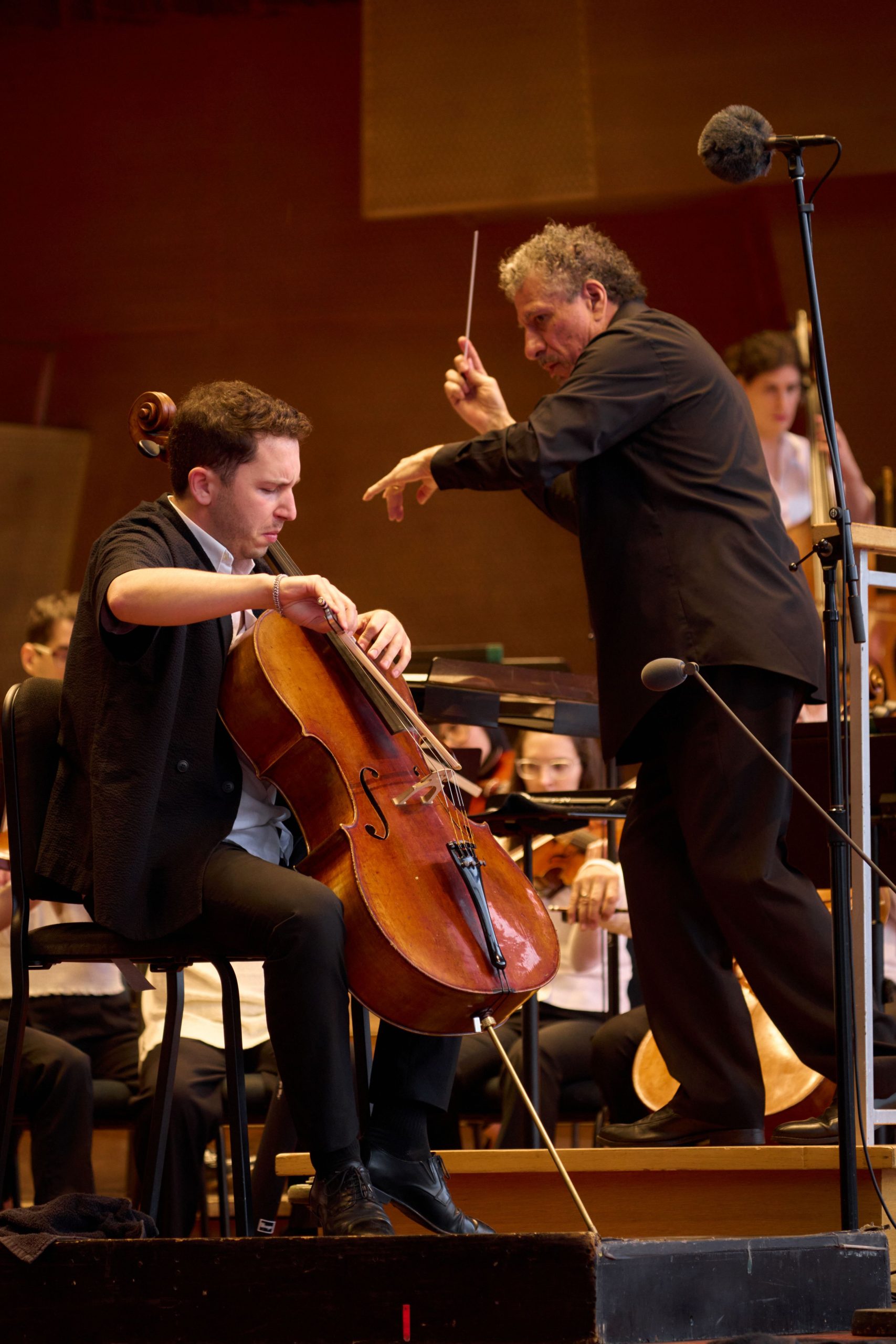

The Grant Park Music Festival’s legendary luck held out as Wednesday’s stormy weather let up just in time for an excellent concert at the Jay Pritzker Pavilion in Millennium Park. Under cloudy skies and occasional light drizzle, Giancarlo Guerrero led the Grant Park Symphony Orchestra through Julia Perry’s Short Piece for Orchestra, Dmitri Shostakovich’s first cello concerto, and Franz Josef Haydn’s Military Symphony. Performing the concerto was cellist Oliver Herbert. The crowd was rather small, but they were in for a treat.
As an entertainer, Guerrero is clearly having fun. Whether he’s explaining the music to the audience or managing the sounds from the podium, his presence is warm, joyful, and engaging. During a quieter moment in the finale of the Haydn symphony, he scanned the orchestra, slowly moving his head from right to left. He didn’t stop at the first violins on the far end, but continued scanning into the audience, which chuckled.
Before starting, he described Jullia Perry’s struggles as an African American woman composer in the middle of the 20th century. While she had some success in Europe, she was ignored in the United States and died in complete obscurity in 1979 at the age of 55. She wrote Short Piece for Orchestra while studying in Italy in 1952. As the notes point out, it was performed and recorded by the New York Philharmonic in 1965.
In this piece, Perry shows great command of the orchestra’s tonal color, combining winds, muted brass, and solo strings, and Guerrero gave it a lively interpretation. The Grant Park Symphony Orchestra showed off excellent dynamic control in the lengthy quiet section, just before a final flourish. It is always a pleasure to hear a robust performance of undeservedly obscure music.
Following a quick set change, Oliver Herbert entered the stage for Shostakovich’s Cello Concerto No. 1 in E-minor. From the opening of the Allegretto, he played the repeated, four-note motif with a very raspy sound, but tones smoothed out as the movement progressed. Under Guerrero’s direction, Herbert’s interactions with clarinets, horn, and strings were precise.
Being completely immersed in the music, Herbert’s expression was rather intense. His talent on the finger board and bow strokes came out brilliantly in the Cadenza, which is its own, stand-alone movement. The slow second movement Moderato sounded lovely, until the sirens came in. It was the evening’s only time when the nearby traffic sounds were jarring. After a great ovation, Herbert's encore was the opening of Bach’s Cello Suite No. 1 in G-major.
With a quick set change but no intermission, the concert continued with a Haydn favorite, Symphony No. 100 in G-major, Military. Guerrero gave another enjoyable explanation describing Haydn’s sojourns in London in the early 1790s. At that time, ensembles of Turkish Janissaries were traveling around Europe with their military marching bands. Haydn scored into this symphony a bass drum, triangle, cymbals, trumpet, and clarinet heard in their performances. The symphony earned the name Military from their use in the second movement, which is the closest Haydn’s instrumental music ever came to being programmatic. From a quiet, bucolic opening, a skirmish breaks out, and trumpets sound the charge. Haydn did not name the symphony Military, but his intent was clear.
After an introduction found in nearly all of his late symphonies, Haydn assigned the main theme to two oboes and a flute, which sounded lovely on Wednesday evening. Given the lack of intermission, I was concerned that Guerrero would skip the repeats in the opening movement and finale, but he honored them.
One sign of a great performance is a new appreciation it gives me for a familiar work. This occurred with the playful approach Guerrero gave the minuet and trio, where melodies scampered back and forth between the winds and strings. The Presto finale was a delightful way to end an enjoyable performance. And the rain stayed away.
Tonight and tomorrow night, pianist Stewart Goodyear and Guerrero perform Prokofiev’s Piano Concerto No. 3, Esmail’s Black Iris, and Copland’s Symphony No. 3. Friday, June 19, 6:30 pm; Saturday, June 20, 7:30 pm. For more info, click here.
This Wednesday, Kolina Bovell takes the baton and is joined by violinist William Hagen and the Lookingglass Theatre Company for Jessie Montgomery’s Starburst, Samuel Barber’s Violin Concerto, and Peter Boyer’s Ellis Island: The Dream of America. Wednesday, June 24, 6:30 pm.
Support arts and culture journalism today. This his work doesn't happen without your support. Contribute today and ensure we can continue to share the latest reviews, essays, and previews of the most anticipated arts and culture events across the city.
