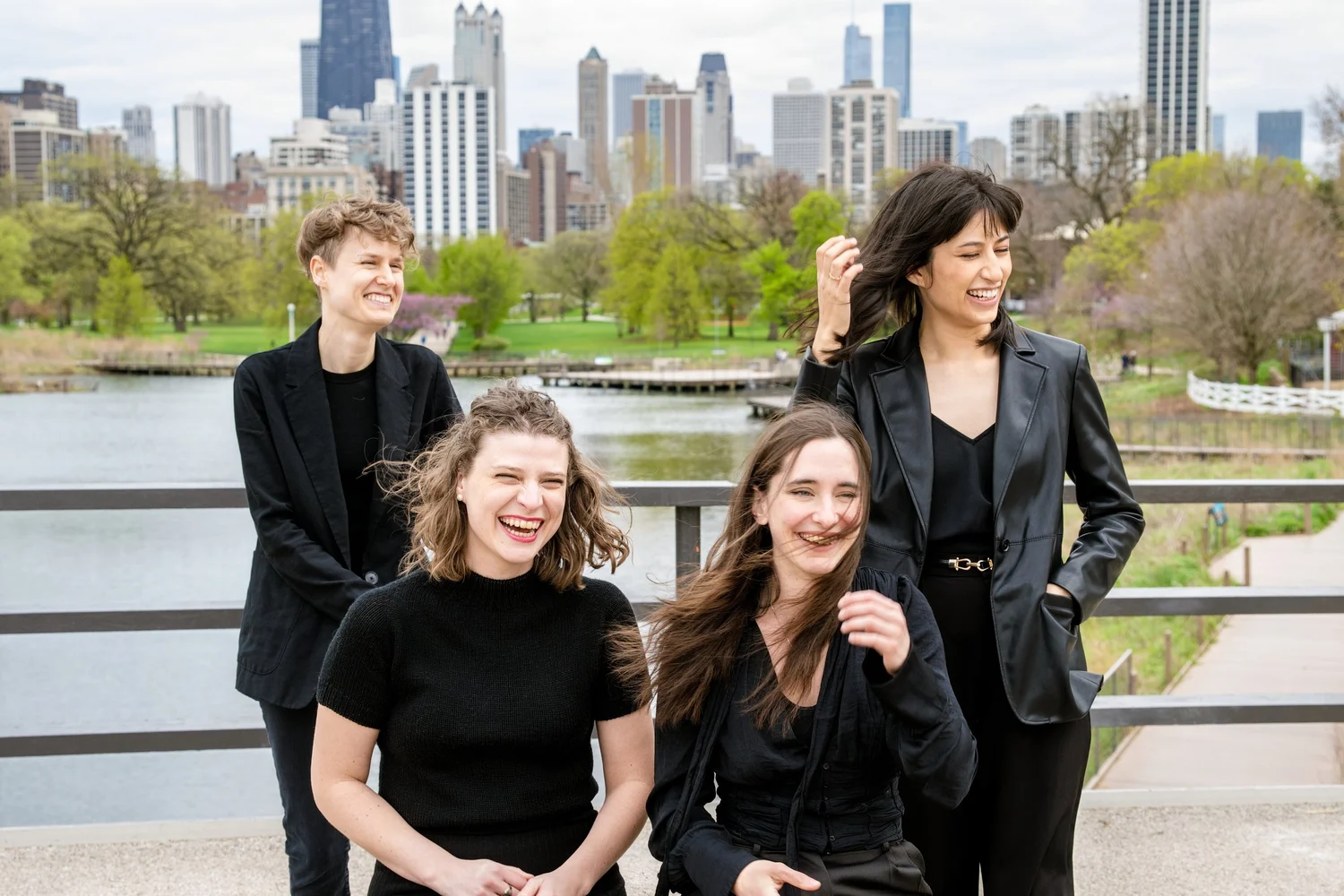

What draws a critic to one performance over another is entirely subjective. For me, it is sometimes the chance to hear a specific performer; other times, it is the opportunity to encounter a piece that is new, recently composed, or uniquely relevant to a city's cultural life. When a concert promises both a compelling ensemble and a thoughtful program, live performance approaches its best alchemy.
That was certainly the case earlier this week at Holy Name Cathedral, during the latest installment of Classical Music Chicago’s Rush Hour Concerts. Throughout the summer, chamber groups present 45-minute, bite-sized recitals in the cathedral nave. It is a brief, accessible format that works surprisingly well. The July 7 program featured the ascendant Varo String Quartet performing two works: Grażyna Bacewicz’s String Quartet No. 4 and Joseph Haydn’s String Quartet in C major, Op. 20, No. 2, from his celebrated "Sun" quartets.
The Varo musicians—violinists Carmen Abelson and Hannah Christiansen, violist Lena Vidulich, and cellist Isidora Nojkovic—are now concluding their third season as an established, Chicago-based ensemble. Their recent calendar reflects an admirable range, including a residency at Western Michigan University, a Halloween-themed program at Rosehill Cemetery, and a double-header at the North Side venue The CheckOut with the Quince Ensemble. What genuinely distinguishes the group, however, is the breadth of its repertoire, a quality that was on full display Tuesday evening.
Bacewicz’s seven string quartets are not as widely known as other major 20th-century cycles, yet they deserve a permanent place in the repertoire. Her voice bridges styles and eras with remarkable assurance. The music is never lightweight, but it lacks the severe, bracing quality of Shostakovich or the deliberate brusqueness of Bartók. Instead, Bacewicz’s writing is forceful, rhythmically taut, and remarkably clear—qualities especially well suited to a genre that can sound dense or overburdened in less-skilled hands.
The Varo's performance brought those qualities vividly to life. One might have expected a more overtly aggressive reading of the Bacewicz, but the musicians instead found a satisfying balance, tempering the work's inherent force through careful interplay among the four voices. Even in the final movement, where the bustling energy threatened to spill over, the quartet maintained a sharp, transparent sound. This was no small feat given the overly resonant acoustics of Holy Name Cathedral, which regrettably tended to blur detail. Rather than allowing any single player to dominate, the ensemble distributed the expressive weight evenly, producing a performance defined as much by its collective discipline as by individual virtuosity.
That same sense of shared purpose carried naturally into the Haydn, making the pairing with Bacewicz feel especially perceptive. The quartet features an unusually prominent role for the cello and several of the formal surprises that only Haydn could execute with such ease. It includes an austere second movement of unexpected drama, followed by a deceptively tricky minuet. The work concludes with its famous four-theme fugue, which the musicians affectionately described as a "fugue for friends" because of its democratic distribution of material. Throughout, the Varo's success lay in the small gestures—a collective attention to detail and a shared sense of purpose that made the performance feel both disciplined and alive.
A full listing of Classical Music Chicago's remaining Rush Hour Concerts in 2026 can be found here. More information about the Varo String Quartet, including a list of their upcoming performances and activities can be found here.
Did you enjoy this post? Please consider supporting Third Coast Review’s arts and culture coverage by making a donation. Choose the amount that works best for you, and know how much we appreciate your support!
