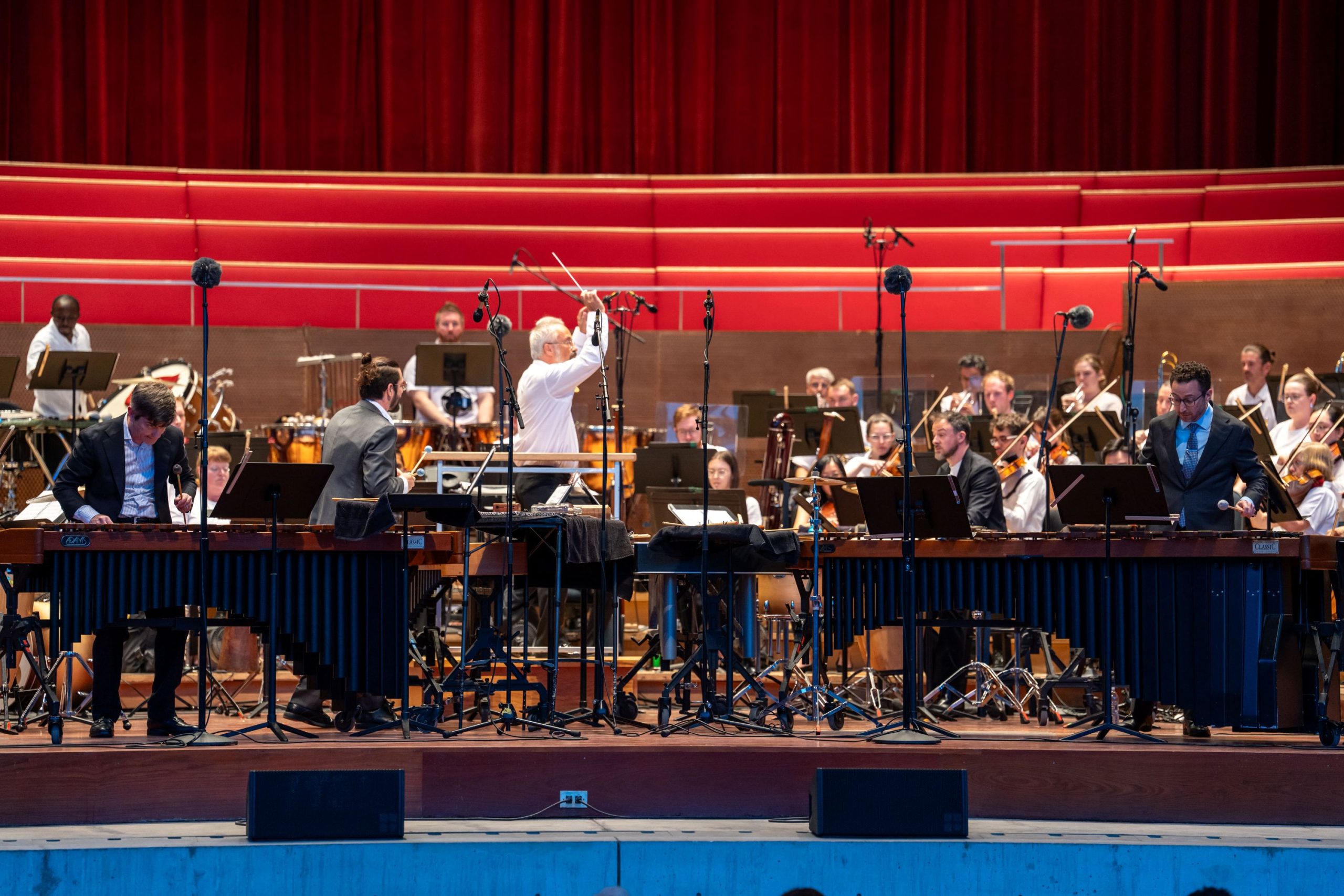

Carlos Kalmar returned to the helm of the Grant Park Festival Orchestra at Jay Pritzker Pavilion on Wednesday night. He and the orchestra were joined by Chicago’s own Third Coast Percussion to perform Drum Circles by Christopher Theofanidis, an astonishing percussion concerto in five movements. Following a lengthy set change the concert closed with Jean Sibelius’ Symphony No.2 in D-Major, a piece bursting with tuneful melodies.
To avoid interference from the amplified music at Taste of Chicago next door, the concert began later than usual, at 8:15. Unfortunately that time frame coincided with the booming fireworks at Navy Pier. Other distractions were caused by a larger the usual number of sirens from emergency vehicles. On one occasion, they wailed at the worst possible time.
An opportunity to hear Third Coast Percussion fronting an orchestra was not to be missed. David Skidmore, Robert Dillon, Peter Martin, and Sean Connors combine the beating of mallets, drum sticks, and brushes on marimbas, crotales, cymbals, bells, and drums with the choreography of movement between instruments. Their performances are quite a spectacle.
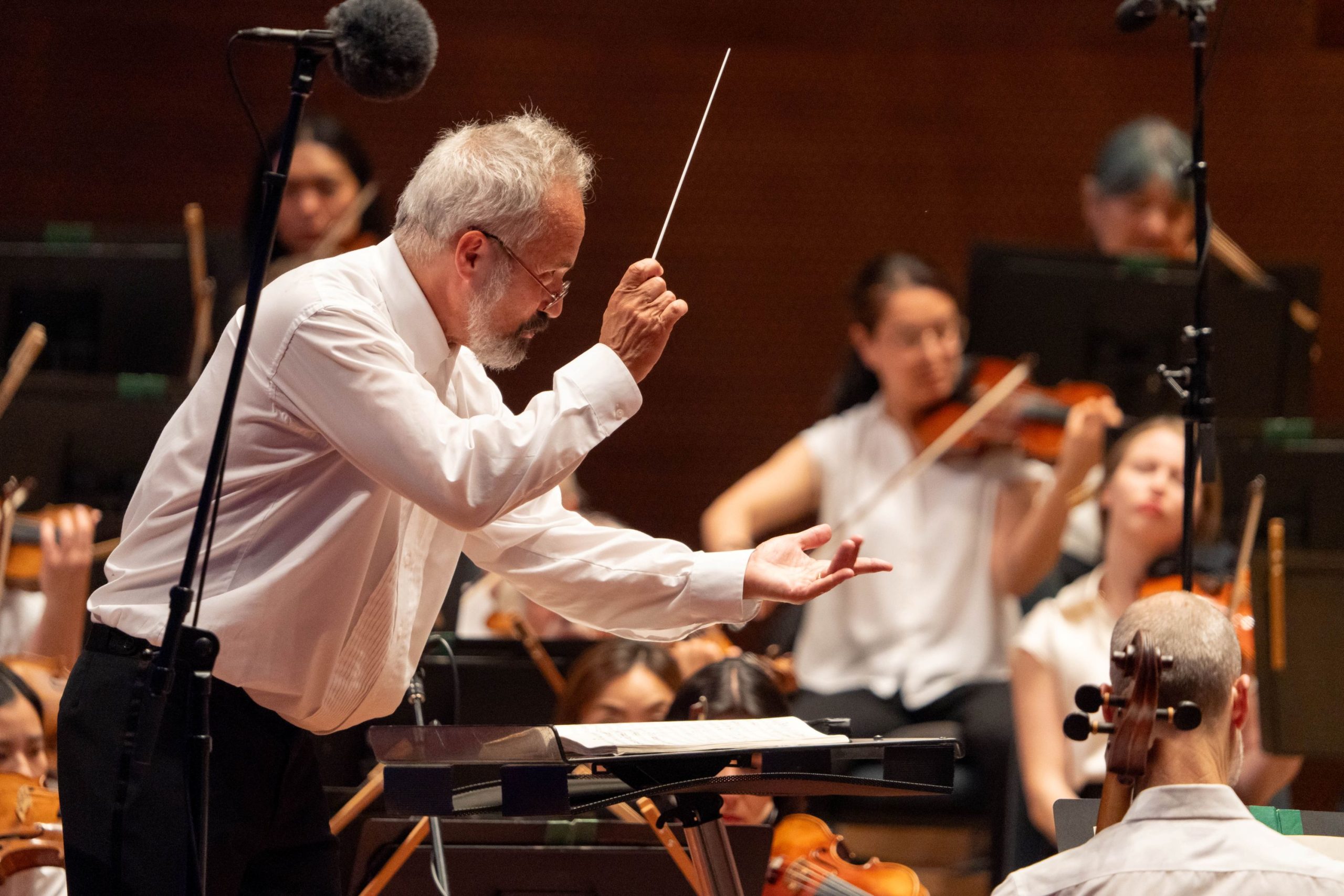
As is typical, TCP required a large footprint of instruments at the front of the stage. Hemmed in by TCP and the orchestra, Kalmar was leading from a podium nearly at center stage. He had to be very animated to make eye contact with everyone onstage, practically turning full circles.
Drum Circles by Theofanidis gave TCP the opportunity to interact with all the instruments in the Grant Park Festival Orchestra, most notably the orchestra’s own percussion section. In the opening passages of “Rivers and Anthems,” the percussion section played drums and timpani, while TCP offered melodies from marimbas, chimes, and vibraphones. Adding the sounds of woodwinds and brass created a wonderful aural cocktail. Halfway through the movement, the sound got mystical when TCP dialogued with the violins.
Theofanidis created an interesting aural panoply throughout the work. During the fourth movement “Spirits and Drums,” TCP and the orchestra percussions were trading drum passages when the basses and cellos joined in. The brass and woodwinds also got into the mix.
The only bummer was the opening of the finale, “Three Chords and Truth (or, Learning to Breathe Again).” Here, TCP played quietly on marimbas and vibraphones, but that’s when the sirens started blaring around Grant Park. They didn’t stop for several minutes. It was the worst possible time for sirenitis to show up.
Third Coast Percussion received several ovations. Although quite a bit of time was required to remove their instruments and reset the stage, there was no intermission. Instead, Kalmar offered a great explanation of Sibelius’ Symphony No. 2. Kalmar talked about this Finnish composer’s unusual career in music. After writing seven symphonies, a violin concerto, incidental music for theatrical works, songs, overtures, and many other things, he just stopped composing thirty years before he died. Even with a shortened compositional career, he has deservedly been regarded as a national treasure of Finland.
Sibelius was active at the turn of the 20th Century when Finland, under Russian suzerainty until after World War I, was struggling to deal with attempts at Russification by the Tsar. The program noted that he had composed overtly political songs, but Sibelius insisted that that this symphony was not political.
What it has is some of the most hauntingly beautiful melodies, especially in the opening movement Allegretto and the Finale: Allegro Moderato. In the opening, the melody is built with several seemingly disparate tunes, first on strings, then on winds, then in the horns. Kalmar carefully massaged the various parts, and the result was blessed.
One common feature in Sibelius symphonies is a heavy emphasis on the brass, but in the first movement, they’re a bit restrained until the climax in the development. The strings carried much of the sound, and Grant Park Orchestra gave Kalmar all the ingredients he needed.
The second movement, Andante; ma rubato is where much of this symphony’s suspense arises. Unfortunately the booming fireworks definitely got in the way. The quick Vivacissimo blends into the stunning melody of the finale. Under Kalmar’s direction, the excellent playing by the Grant Park Symphony Orchestra made it a delight.
Tonight and tomorrow night, Grant Park Music Festival’s former Principal Conductor Leonard Slatkin will take the podium for Tchaikovsky’s Symphony No. 5 in E-minor. The program also includes violinist Yevgeny Kutik performing Joseph Schwantner’s Violin Concerto. Jay Pritzker Pavilion, Millennium Park. Both concerts will start later than usual, 8:15 pm. For more information, click here.
Next Wednesday Jeri Lynne Johnson will be conducting a program that includes Maurice Ravel’s Piano Concerto with Michelle Cann at the keyboard. Also on the program is Florence Price’s Symphony No. 3 and William Grant Still’s Festive Overture. Jay Pritzker Pavilion, Millennium Park, Wednesday, July 15, 6:30 pm.
Support arts and culture journalism today. This his work doesn't happen without your support. Contribute today and ensure we can continue to share the latest reviews, essays, and previews of the most anticipated arts and culture events across the city.
