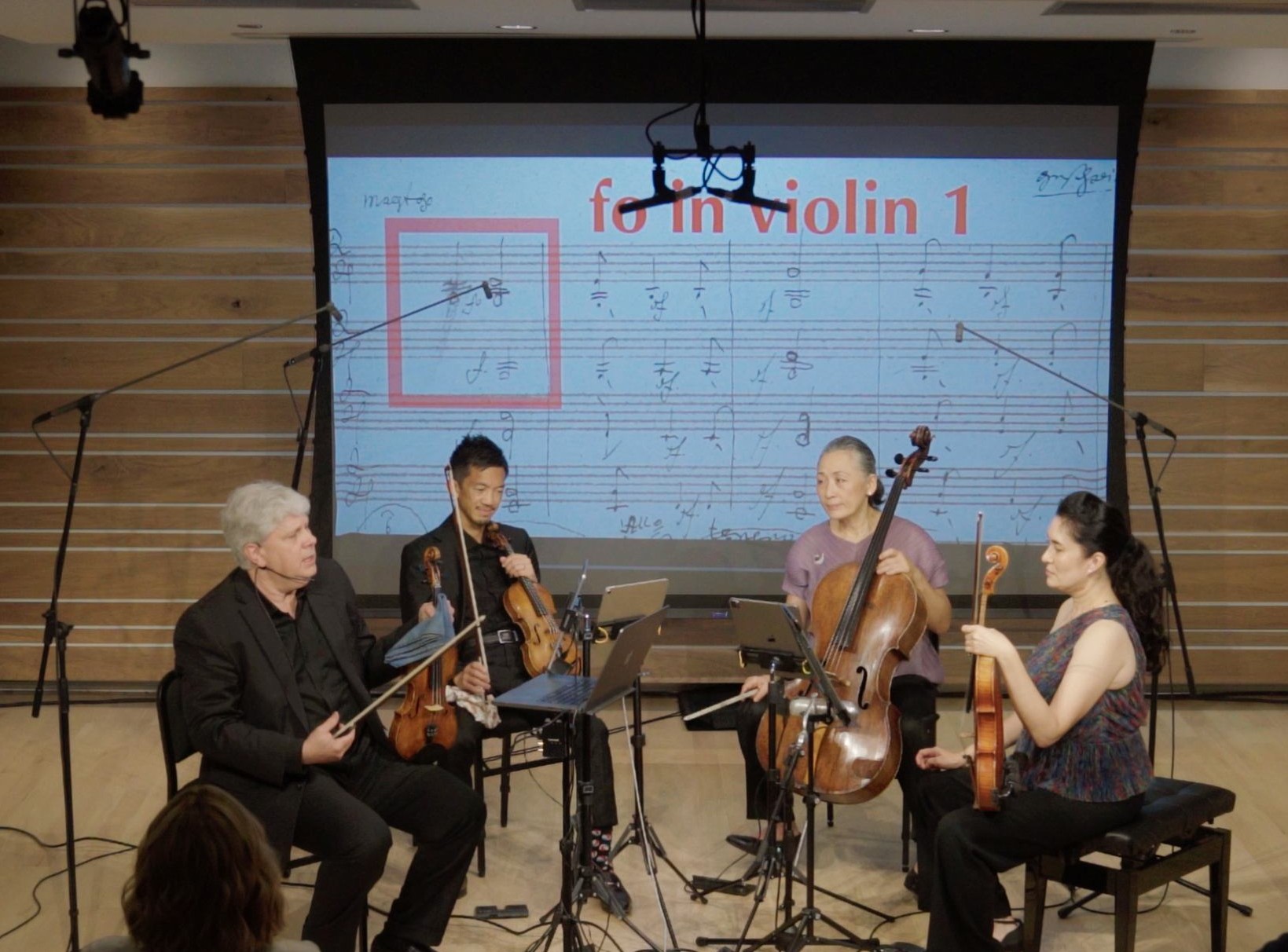

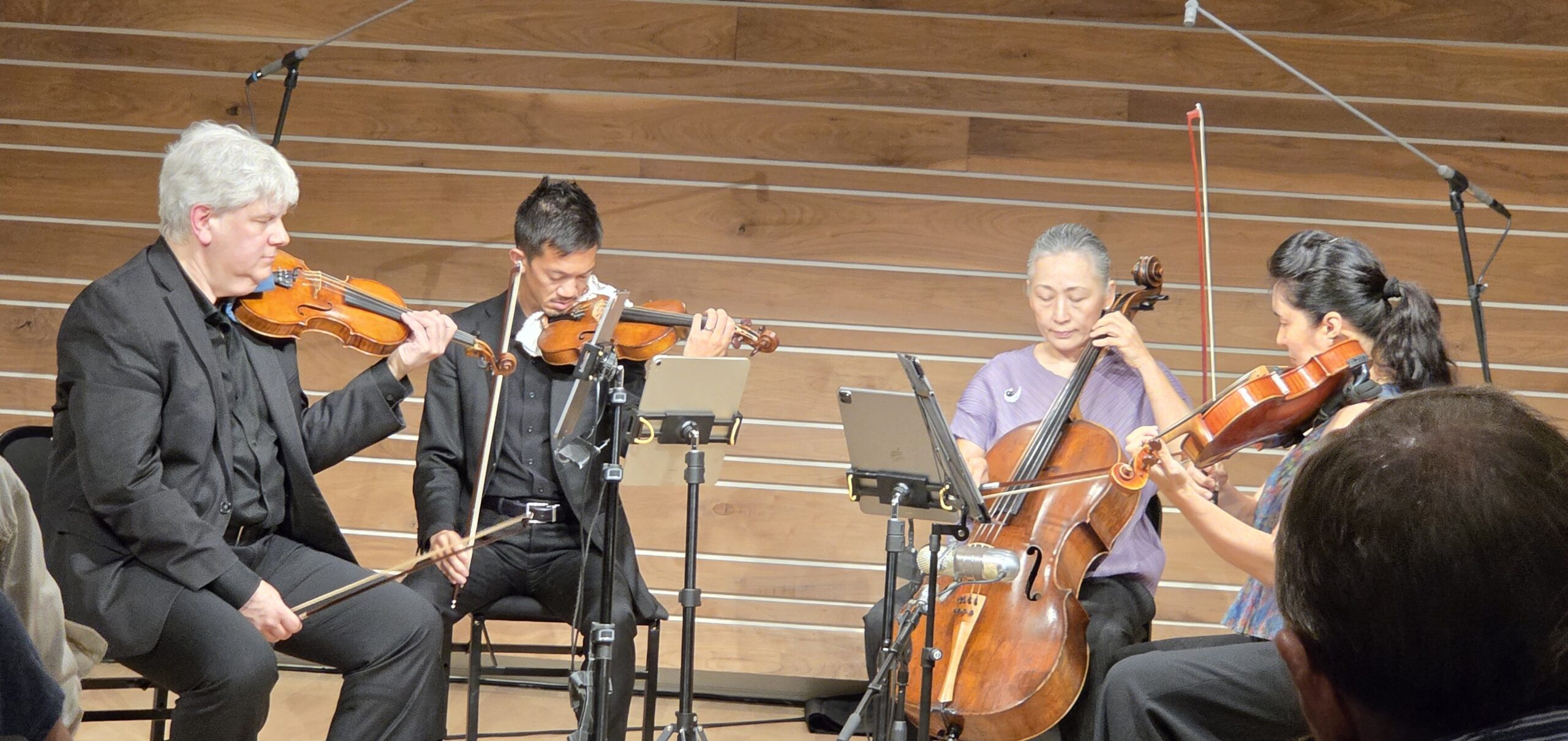
On Thursday and Friday evenings, the Boromeo Quartet brought to Guarneri Hall an innovative performance of the music that, in my humble opinion, is the greatest ever written: the late string quartets by Ludwig van Beethoven. In two performances dubbed Beethoven Immortal, they performed this incredible music in a way I had never previously heard. Instead of playing from the familiar published scores, the Boromeo Quartet played from Beethoven’s original manuscripts written in his own hand.
Of course, this was only made possible with the modern technology of computers and tablets displaying the manuscripts in full score. The individual parts were not laid out separately.
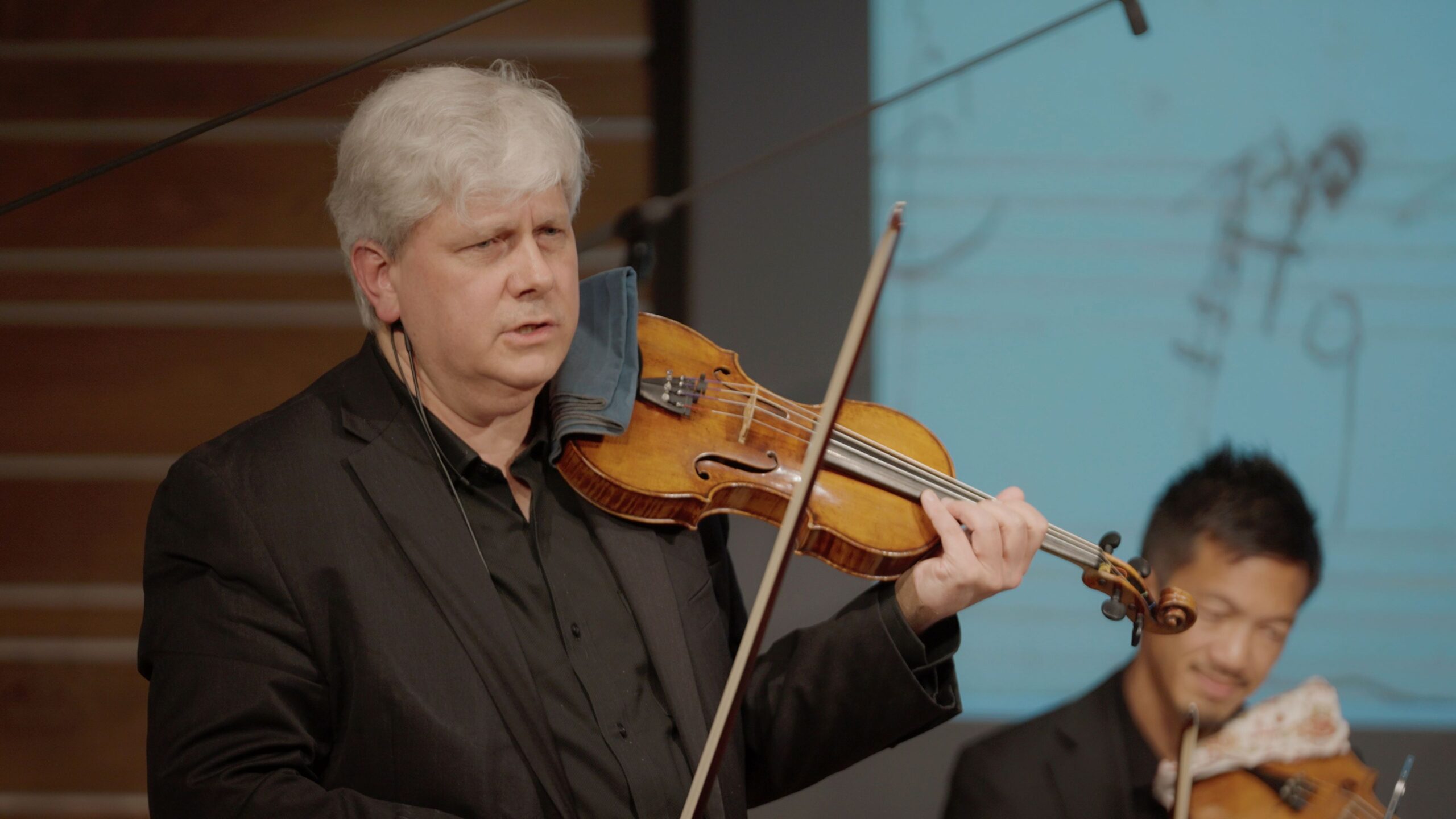
First violinist Nicholas Kitchen is a faculty member of the New England Conservatory who has researched Beethoven’s music and scores. In a fascinating talk, he explained how Beethoven’s manuscripts show variants of the usual “loud” dynamic markings of f, ff, and fff and “soft” markings of p, pp, and ppp. With each variant, Beethoven intended the players to play and sound differently.
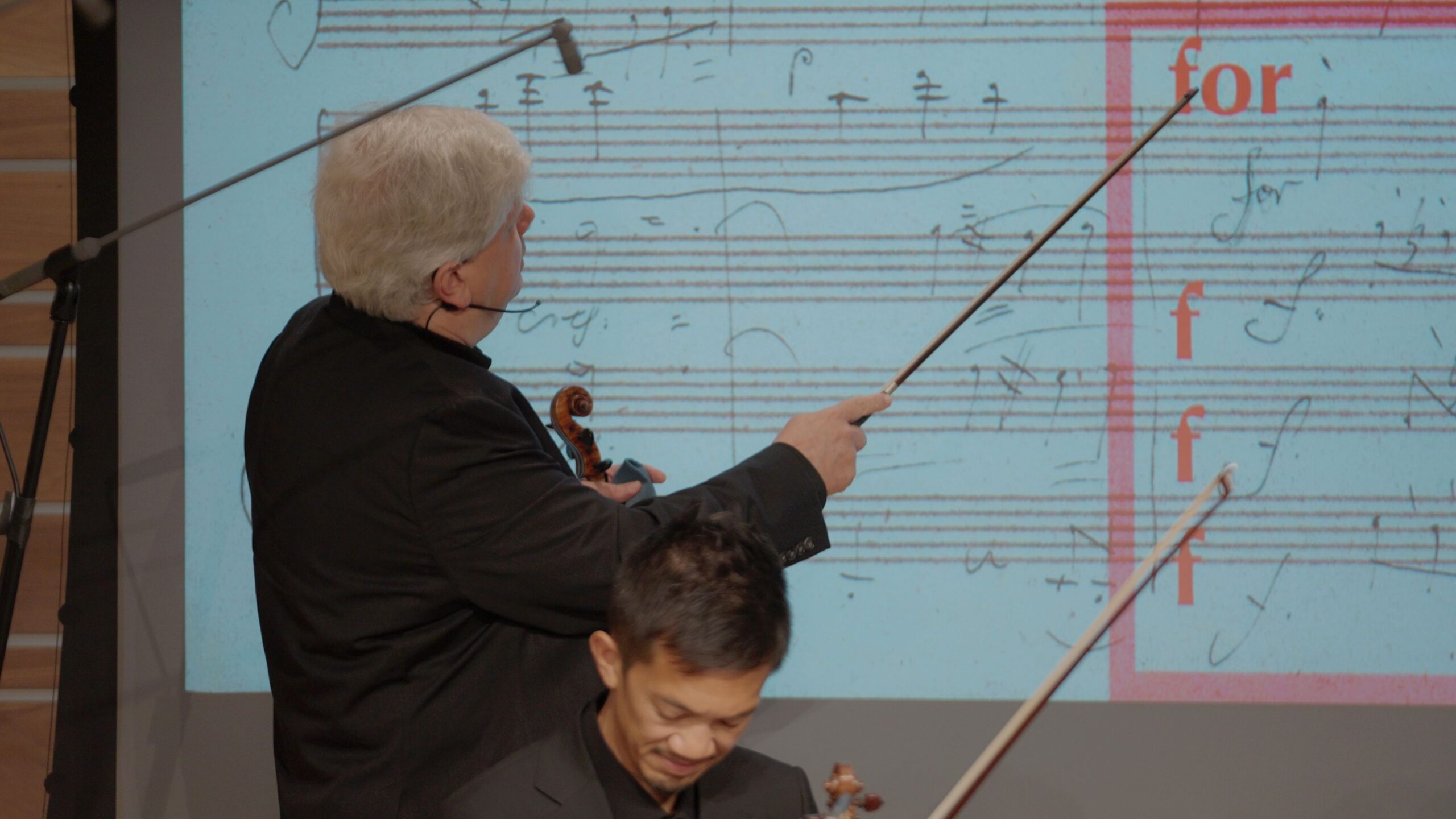
Professor Kitchen noted that, in printing Beethoven’s scores, music publishers did not reproduce Beethoven’s varieties of f and p. The same went for the staccato markings. Beethoven wrote four different marks for staccato, but the published scores only used the simple staccato dot. He also used different kinds of wedges for crescendo and decrescendo, some of which he actually connected and combined by hand. The printed scores do not reflect these subtleties.
As an illustration, Professor Kitchen displayed many passages in the manuscript for the first movement of Beethoven’s String Quartet No, 12 in E-flat Major, Op 127. He pointed to all of the different signs Beethoven used for fortissimo, such as ffo, ffmo, and ff with one or two slashes underneath. He noted that the different instruments sometimes had different f markings at the same time. He also showed the four different staccato markings and the variety of handwritten wedges Beethoven used for crescendo and decrescendo.
The Boromeo Quartet of violinists Kitchen and Kristopher Tong, violist Melissa Reardon, and cellist Yeesun Kim performed the opening movements of E-flat quartet with the manuscript project on the wall behind. It did, indeed, produce a different sound than what I normally experience hearing a piece of music I know inside out. While there were a few instances when the ensemble could have blended better, it was lovely.
Before taking a short break, the quartet turned its attention to the Fugue in b-minor from Book I of Johann Sebastian Bach’s Well Tempered Clavier. Professor Kitchen explained that Beethoven wrote out that fugue, which is based on the last four notes of the harmonic minor scale. Beethoven used that same 4-note motto in the String Quartets Op. 130, 131, 132, and the Grosse Fugue Op. 133. The Boromeo Quartet then performed a string quartet transcription of Bach’s Fugue in b-minor.
One thing Professor Kitchen did not talk about is the reason why so many of us consider these late string quartets to be so profound. They are an amazing culmination of a lifelong career that revolutionized music. Beethoven took the classical forms he inherited from Haydn and Mozart, expanded their dimensions, changed their make-up, and created levels of emotion and expression that had previously never been heard.
Building upon changes he had already unveiled, these quartets expanded the four-movement structure to five, six, even seven movements. They also represent a look back to the forms Bach was using 100 years previously and tonalities that had not been prevalent since the Renaissance.
Following a quick break the Boromeo Quartet turned their attention to Beethoven’s String Quartet No. 15 in a-minor. This time, there was no projection of the manuscript. As Professor Kitchen mentioned before the break, it opens with the four-note motif in the cello, which was soon joined by the other instruments in a slow, ominous opening. It soon breaks into a very passionate melody.
While generally good, the performance of this five-movement work was not smooth, and in the first two movements, intonation was a big issue. In such times, the overtones do not match and gel. This was especially evident in the middle of the second movement, where there is a bagpipe-like drone effect in A. It wasn’t quite right.
Fortunately, they all tuned up before this quartet’s most amazing feature, the Heiliger Dankesang …, a song of thanks that Beethoven wrote after recovering from a major illness. Very unusually, Beethoven used the Lydian mode, a seven-note scale starting in F that has a B-natural, instead of the B-flat that is normally in the F-Major scale. The ultimate effect produced the greatest piece of meditation music I have ever encountered, one of many “greatest” things to be found in Beethoven’s music. The Boromeo’s performance was every bit worthy, especially the contrasts they showed in the joyful section in D-Major. It is always nice to enjoy a period of meditation during a concert.
On the following evening, Nicholas Kitchen explained the joke that underpinned the finale of Beethoven’s final String Quartet, No. 16, in F-Major. Op. 135. It starts with the question and answer written above the score in German, "Must it Be? It Must be!" The movement beautifully combines deep intensity with fun and frolic. The Boromeo Quartet interpreted this well.
This was quickly followed by what I and many other afficionados consider to be the greatest piece of music ever written, Beethoven’s String Quartet No. 14 in c-sharp minor, Op, 131. This work in seven movements represents the pinnacle of Beethoven reimagining the classical models he inherited from Haydn and Mozart.
Given the Boromeo’s use of the hand-written manuscripts instead of published scores, I was looking for subtle differences from a typical performance. Those differences were evident in the varied sharpness of staccatos and variety of volume when they all played at once, when the instrument with the melody was noticeably playing with slightly greater intensity than the others.
There are several things I look for in every performance of this work, and they were all on display on Friday night. First is the inquisitive nature of the opening fugue in c-sharp minor, which is the only slow fugue Beethoven ever wrote. It is formed by the last four notes of the harmonic minor scale, as discussed the previous night. As this fugue unfolds, I look for a growing sense of awareness as it progresses, ending in a very satisfying discovery that moves from c-sharp minor to C-sharp Major. This is what I heard on Friday night.
Moving up a half tone to D, it leads without pause to a joyful, sunny movement, and the Boromeo Quartet captured its lively feel very well. Following a quick transition movement, the central fourth movement is a lengthy set of variations. Here the Boromeo displayed excellent ensemble interaction, starting with the opening theme, when the two violins Kitchen and Tong effortlessly passed the melody back and forth. Later, violist Reardon and cellist Kim had a similar exchange. The ensemble faithfully captured the many interesting sounds that come out of this movement.
One big test is the very rapid, Presto fifth movement, and the Boromeo gave it all of the required exuberance. There are passages where the instruments will play one or two syncopated notes immediately followed by another instrument doing the same. I once saw a performance break down through such a passage, but Boromeo held it together.
The final thing I listen for is whether players clearly capture every note in the main theme of the finale. Sometimes performers rush through it, but not Friday night. Every note sounded very clearly. I know it’s great performance when I say “Wow” after it finishes, and that happened Friday night.
Following intermission, Boromeo Quartet returned to the stage for String Quartet No. 13 in B-flat Major, Op. 130/133, the second time I’ve had the pleasure of reviewing this gem in a few months. The opening movement of this six-movement work has lots of disparate sections, where slow and moody passages are following by outbursts of rapid melodies. This performance really highlighted these contrasts. They were performing from Beethoven’s manuscript. One thing the published score has is a repeat of the exposition, which they did not do.
Following the opening, Beethoven added four charming movements. The last of which, Cavatina, is, in my humble opinion, the most beautiful melody Beethoven ever composed. The Boromeo Quartet gave it all of the reflection and passion possible. Delightful.
This quartet originally had a mammoth finale comprised of a fugue that is so jarring and confusing, it is the closest thing Beethoven ever wrote to an aural cacophony. Audiences hated it, and, in a very rare nod to public pressure, Beethoven wrote a substitute finale, the last music he ever wrote. The original finale was parceled off to a separate published piece, the Grosse Fugue Op. 133.
In the intervening 200 years, perceptions of the Grosse Fugue have softened dramatically, and most performances now conclude with it. I actually like both. When I previously reviewed this quartet, the substitute finale was played. Consistent with their desire to interpret music as Beethoven himself expressed in the actual manuscripts, the Boromeo Quartet concluded with the Grosse Fugue on Friday night. It worked just fine.
Guarneri Hall is a charming performance space in the heart of the Loop at 11 E. Adams St. It hosts its own Guarneri Hall Presents concert series, the next of which is on “Hydrogen Day,” October 8. In Sun/Moon, Soprano Kristina Bachrach will be offering a wide-ranging program inspired by the celestial lights that hydrogen fuels. Wednesday, October 8, 6:30pm.
The Nova Linea Musica Festival 2025-26 will present the Owls Quartet, which will be performing a program entitled Rare Birds. Wednesday, October 29, 6:30pm. For more information, click here.
