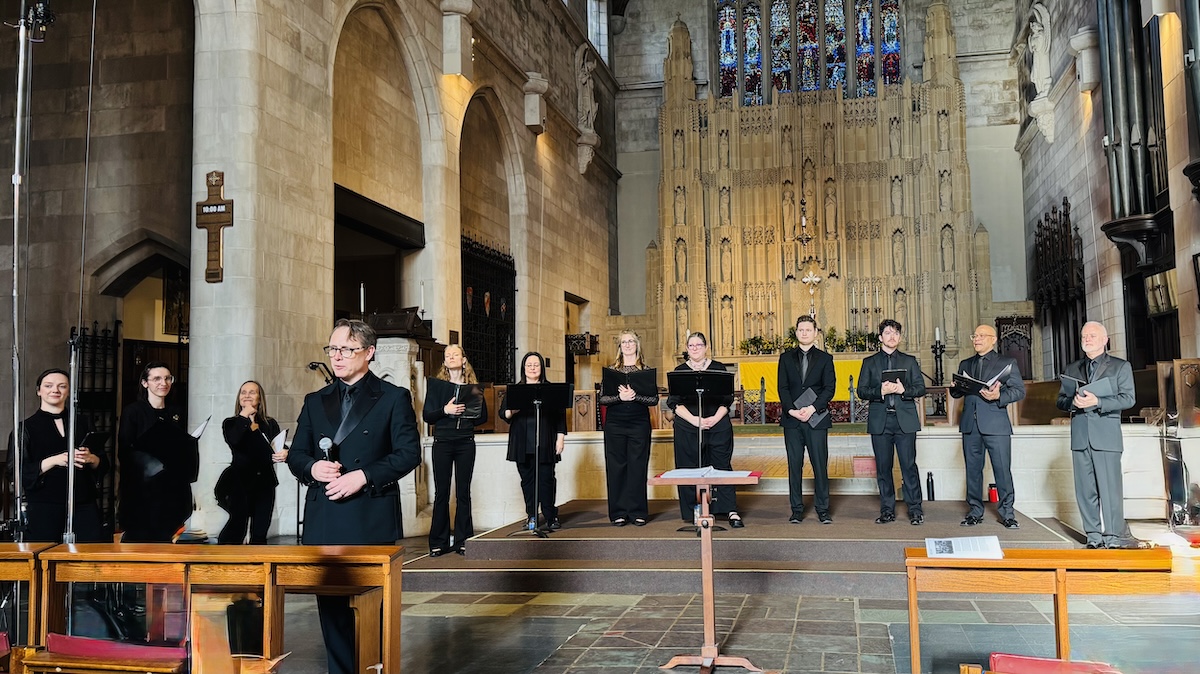

Bella Voce returned to St. Luke's Episcopal in Evanston for Star of the Sea: Music for Mary from Colonial Guatemala on Sunday. This excellent program featured a Renaissance Mass by composer Tomás Luis de Victoria and Marian motets by other Spanish composers. In addition, several songs from Villancicos, aka the local peasants or campesinos, are listed as anonymous.
As a Catholic baptized before Vatican II, I grew up with the Latin Mass, and this music had a familiar appeal. This performance was done a capella, vocal music without instrumental backing, which requires a great deal of skill and musical talent. Bella Voce sang under the direction of artistic director/conductor Andrew Lewis, who has led the group since 2005.
Lewis introduced the concert by discussing discoveries in choir books from the 1560s. He said, "The level of artistry is mindblowing." The concert that followed was precise in its artistry and ethereal in its beauty. The members of Bella Voce are musicians with years of performance and training. They are in prime voice with flowing melodies, seamless counterpoint, and precision harmonies. Star of the Sea is from the Spanish Renaissance, which was more religiously fervent than that in the rest of Europe. The colonization of South America introduced Catholicism, which remains woven into the various cultures today. This music reflects the drama and mystery of the Catholic Mass.
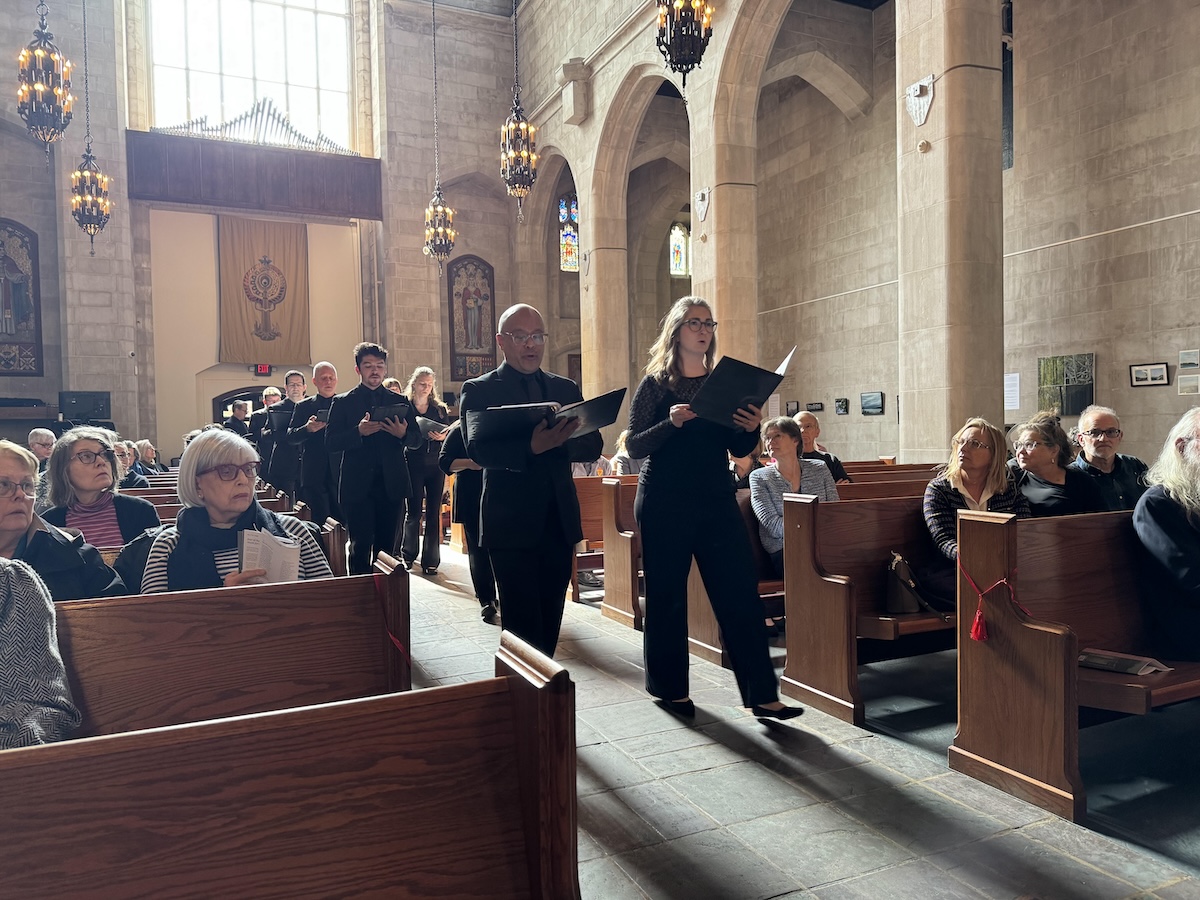
The Mass opened with "Hoy nace la nueva estrella," translated as "Today is born a new star," by Anonymous. In keeping with authenticity, the ensemble did a processional into the sanctuary. The cantor for this was Bella Voce bass, Eric Miranda. It was beautifully sung and sounded gorgeous in St. Luke's sanctuary. The motets written by Villancicos are comparable to Christmas carols or folk songs that evolve from lore passed down through generations. "Hoy nace la nueva estrella" would be considered the processional to the Mass. It continues into the prayers and supplications: "Kyrie" and "Gloria" written by Tomas Luis de Victoria.
The first part ends with "Salve Regina," written by composer and priest Francisco Guerrero. This song is a motet that is comparable to the Hail Mary. After the intermission, there was another version of "Salve Maria," written by a third composer, Hernando Franco, who was born in Spain but spent more of his life in Guatemala. Conductor Lewis spoke about the differences between the two. Guerrero's version was sung in a noticeably lower register. Franco's version was significantly higher, with the soprano voices sounding heavenly in the upper registers.
The concert put the spotlight on several singers, showcasing the beauty of their individual voices. There was a duet by tenor Oliver Camacho, a presenter and producer on WFMT, and Eric Miranda. Soprano Kirsten Hedegaard was also featured with Miranda. Other featured singers included soprano Lydia Walsh-Rock, alto Nora Engonopoulos, tenor Michael Hudetz, and bass Ed Frazier.
Sacred music is challenging to sing, and Bella Voce meets and surpasses expectations. My experience with this music is that it can be sibilant due to its repetitiveness. One of the motets has "Sanctus, Sanctus, Sanctus, Dominus Deus Sabaoth." The singing was crisp and in perfect pitch. One a capella is a challenge in itself, an entire Mass is a triumph. Star of the Sea: Music for Mary from Colonial Guatemala is the third installment of Bella Voce's Expanding the Canon series. This series explores music composed in Guatemala and Mexico, and by indigenous composers influenced by Iberian Peninsula music and Catholicism.
I highly recommend attending a Bella Voce concert. I previously attended Bella Voce and the Madison Bach Musicians in December 2025 for Christmas with the Baroque Masters. That concert featured authentic Baroque instruments accompanying the ensemble. The upcoming 2026-2027 season brings more rarely heard music from Handel and the Baltic region, as well as more sacred music from the Latin Mass and the Anglican tradition. Click here for concert information and to order recordings.
Did you enjoy this post? Please consider supporting Third Coast Review’s arts and culture coverage by making a donation. Choose the amount that works best for you, and know how much we appreciate your support!
