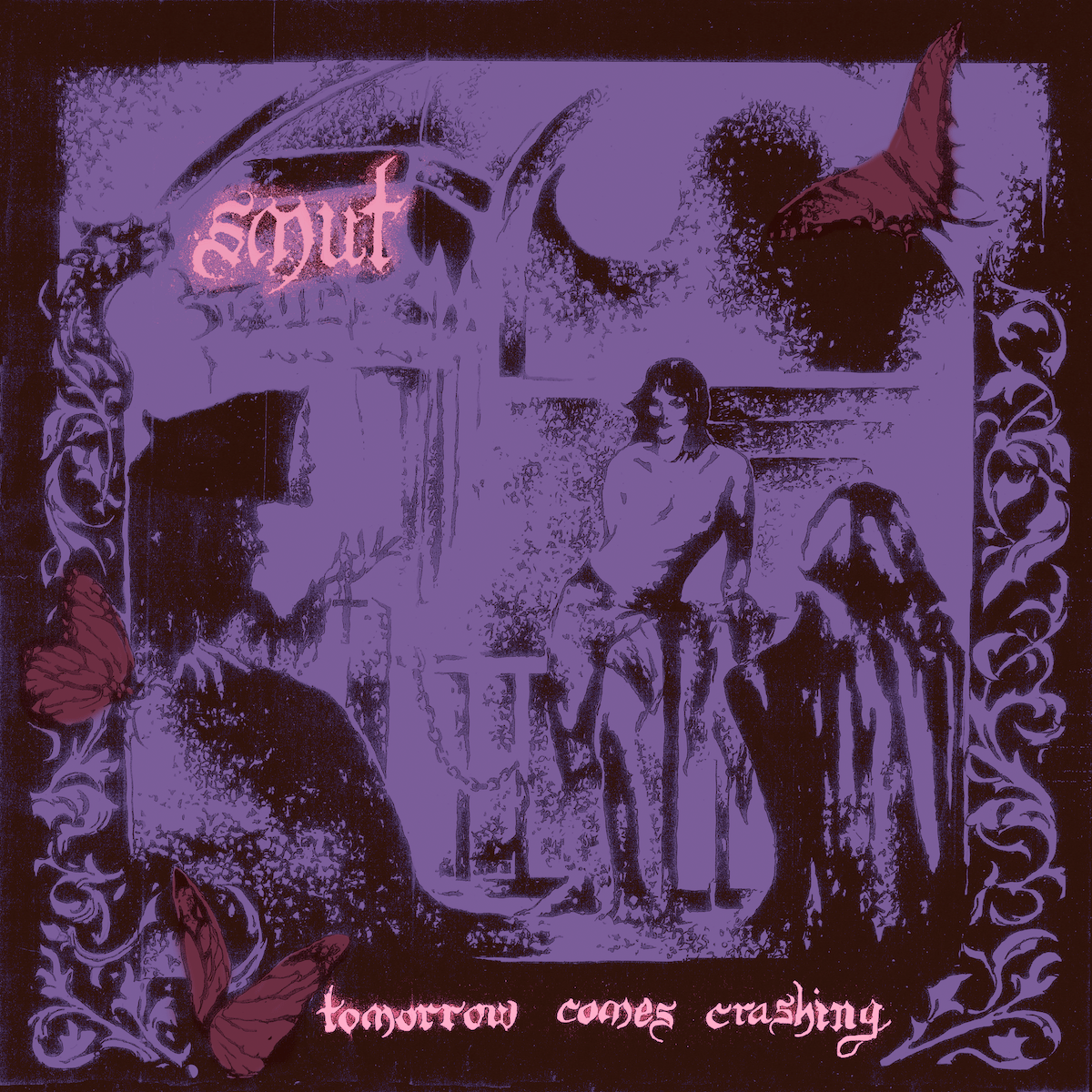
Although originally hailing from Cleveland’s vivacious DIY indie scene, Smut set up shop in our little town of Chicago, earning their keep by releasing one of the greatest Chicago indie rock records of, at the very least, the last 10 years with their 2022 Bayonet Records debut, How The Light Felt. Even though I’d categorize most of their music as indie punk, How The Light Felt captured the poignant emotional stirrings and dreamy, ethereal instrumentation of seminal 90s bands like Lush and The Cranberries in such a beautiful and inspired fashion that really set the band apart within the Chicago indie space. You don’t hear too many newer bands doing The Cranberries justice while remaining true to themselves as original and impassioned artists, but Smut figured out the secret recipe and prevailed atop all doubts.
I first came to know Smut after seeing them open for legendary NoCal hardcore outfit Ceremony at Lincoln Hall last year. I was already completely enamored with How The Light Felt by the time the show came about, feeling so utterly lucky that such an entrancing, versatile band could be residing in my favorite city, but I was absolutely not expecting them to put on one of the best performances I’ve ever seen from a local indie band. At the time of the show, I had not heard their first release from 2017 entitled End of Sam-Soon, so I wasn’t aware of their more distorted, punky roots; about halfway through their set, it suddenly made a lot more sense why they were opening for Ceremony of all bands! They played with a shockingly feral and wonderfully reckless rage that surprised the heck out of me, considering how warm, delicate, and effortlessly dreamy How The Light Felt is.
Needless to say, after that show, I was firmly seated in the Smut fan club, waiting patiently for their follow-up album. Well, the day finally came all the way back in June (yes, I’m incredibly late on this review, but this new album is very nuanced and I had to take my time!) when Smut finally released their second album off Bayonet Records, Tomorrow Comes Crashing. The album was recorded in New York as live as the band could muster, and it could not be more apparent with the stunning end product they have bestowed upon us. Tomorrow Comes Crashing sees the band as lively and ferocious as ever, reinvigorated by their old punk spirit that may have taken some holiday with How The Light Felt but has fully returned in ways you’d never expect. There are no trade-offs with this record and no compromises. The band isn’t any less catchy, any less dreamy, any less DIY, and especially not any less true to themselves as evocative, impassioned musicians.

“Godhead” opens the album as the shortest and one of the more aggressive offerings the band has up its sleeve with Tomorrow Comes Crashing. The first thing I immediately noticed as soon as the song started and the vocals kicked in was how professionally produced it sounded. How The Light Felt is a masterful album, but it does sound like a band still in the throes of finding themselves sonically, at least at times. The production on Tomorrow Comes Crashing is much more mature and confident and it really succeeds in making every song reach its fullest sonic potential. What was even more impressive was just how far lead singer Tay Roebuck’s vocals have come since End of Sam-Soon. Their vocals improved by leaps and bounds for How The Light Felt, but Roebuck has never sounded more confident and self-assured as a vocalist than on Tomorrow Comes Crashing, and it gives way to some truly impressive stand-out vocal performances on a number of the songs on this record. Roebuck has so much swagger, confidence, and personality on these new songs, displaying way more range and aggression than we heard on the last album, but can still be as sweet and tender as you’d need them to be when the album calls for it. “Godhead” is a perfect album opener as it does everything a first song should do: it sets the tone for the rest of the record perfectly, it highlights every band member (especially drummer Aidan O’Connor), and it leaves you anxiously anticipating the tracks to come.
“Syd Sweeney” has been quoted by the band as being the centerpiece to Tomorrow Comes Crashing, and boy, if that ain’t the understatement of the year. This song is truly without hyperbole, one of the strongest and exciting songs I’ve heard in recent years. As the longest song on the record, clocking in just under five minutes, “Syd Sweeney” has everything I could ever want in an indie rock song and more. The song features an irresistibly driving rhythm with drums that will have your inner air drummer doing cartwheels, distorted guitars that harken back to the early years of The Smashing Pumpkins with lovely natural harmonics prancing around in the foreground of any given riff, vocals and lyrics that are impossibly catchy but with actual themes and messaging behind them about what it means to be a woman with impossible expectations thrust upon you from persons who don’t even know you, one of the best guitar solos I’ve heard in ages, and a brutally climactic and bombastic ending that would knock you on your ass if you weren’t already sitting down trying to collect your bearings from hearing the rest of the song. Smut’s fondness for bands such as My Chemical Romance, Paramore, and At the Drive-In shines through on this song, leading to truly breathtaking moments of punk catharsis that you probably aren’t getting from most other indie bands. There are elements of power pop, punk, 90s indie rock, and even hardcore with the ferocious, ravenous breakdown at the end of the song, and it somehow all works, bundled up in one of the catchiest packages you’ll hear all year; just try and name me another band that could do that better than Smut.
Much like “Syd Sweeney”, “Dead Air” has that single-esque quality to it where you know it was destined to represent the album as a shining star as soon as the song was finished. Featuring one of the album’s best choruses and another face-melting guitar solo that just makes you audibly laugh out loud at how stupidly fun and brilliant it is, “Dead Air” sees the band harkening back to a sound established on their last album, rooted in more of a 90s dream pop sound. Even when the band slows things down and opens a song up to more melody and atmosphere, the raw and vibrant production pulls in that punk DIY ethos, giving each song a lump sum of teeth and grit to balance out its underlying pop sensibilities.
“Waste Me”, the runaway non-single hit of the album (judging purely by streaming numbers), gives the album some breathing room following the one-two-three punch the album opens with. The verses on this song feel so carefree in their simplicity with sparsely strummed guitar chords and a dancey 90s-inspired rhythm section of groove-ridden drums and chugging bass. Admittedly, this is one of my least favorite songs on the record only because it has some of the fewest memorable moments for me compared to the rest of the album, but that’s not to say the song hasn’t been growing on me at a very fast pace. In the last minute of the song, the band picks up the energy and singer Tay Roebuck sings the lyrics in an almost talking fashion with a sort of dry, sarcastic attitude that just oozes fun. More so than anything, the vocals and Roebuck’s incredibly expressive and rhythmically enunciated lyrics bring me back to this song. It may be one of my lesser favorites, but when your album’s bottom tier songs are songs like “Waste Me”, you’re really doing something right.
The next three songs on the album I tend to think of as being, at the very least, musically related to one another. “Ghosts (Cataclysm, Cover Me)”, “Burn Like Violet”, and “Touch & Go” all have these rich, warm, and vibrantly swirling colors that appear in my head when I’m listening to them that mirror the album artwork so well. They are far from the most aggressive or punky songs on the album, almost the exact opposite; these three songs are incredibly rich with tantalizing melodies that offer up as many feelings of happiness and impassioned rage (”Burn Like Violet”) as they do bittersweet acceptance and melancholy (”Ghosts (Cataclysm, Cover Me)” and “Touch & Go”). “Ghosts”, an immediate favorite of mine, might have the most beautifully haunting chorus on the album while “Burn Like Violet” offers up a slab of kick-ass yet very melodic rock and/or roll that doesn’t just make you bang around the thoughts in your head but actually ponder them as well.
“Touch & Go”, the last of the album’s three singles, is the most evocative and melodically rich. The song has this lush and moody pop punk feel to it, almost post-grunge in parts, sounding like it came straight out of the early 2000s. Although the song lacks a chorus in the general sense, Roebuck’s repetitive callouts of the song’s title read more like the ethos of the song and band at large than some catchy chorus you’d hear two or three times in a song. To me, “Touch & Go”, next to “Syd Sweeney”, has the best lyrics across the whole album. Just take the opening lines of the song: “You’re hanging off the balcony // A cigarette glued to your lip // I don’t like you well enough to hold your life in a hand like this // Touch and go”. It’s brooding, pissed off, sardonic, tired, and so illustrative that they’ve got me hanging on every word. Towards the end of the song, Roebuck sings, “The basement flooded // The coffee burned // The van is broken down // We all take turns // Touch and go”, and it really reads like an artist being brutally honest with themselves, coming to terms with the fact that the realities of the rockstar life weren’t what they expected them to be, but they do it not only because they love it, but because they don’t know any other kind of life; it’s a really beautiful and introspective set of lyrics that makes me love the band even more for their love and dedication to their craft.
I don’t have much to say on “Crashing in the Coil” as it’s my least favorite song on the record. It’s not a bad song by any stretch of the imagination, and it’s far better than the lowest low of How The Light Felt (it’s “Morningstar”, sorry), but I just never end up remembering much of the song when it’s over. What helps this song out is that there is still a crushing 90s alt-rock energy to it in a way that I can see Billy Corgan singing this song in 1993, but there’s just nothing that hooks me, and with the competition being as fierce as it is, the song often falls by the wayside.
Speaking of fierce competition, there’s no song so fierce on Tomorrow Comes Crashing as “Spit”. The song is messy, saucy, and all too royally steamed at something or someone I can’t quite figure out. The song almost reads as a manifesto on the state of the music industry, or the state of the world at large as seen through the eyes of someone who is just a cog in some soon-to-be-outdated piece of machinery. This song makes “Godhead” sound like a ballad, and I just love the undisputed attitude this song brings to the table; it’s absolutely addictive to listen to and one of my favorite songs of the year. A slight side tangent, but I’m in love with the way Tay Roebuck sings “So lucky to be here // To feed off the waste of wealth” in such a wild and haphazard tone; it makes me happy. That’s it, that’s all I wanted to say.
Ending the album on a catastrophic high note, Smut gives it their all and makes the full-court shot with “Sunset Hymnal”. Cut from the same heavenly cloth as “Ghosts (Cataclysm, Cover Me)”, “Sunset Hymnal” reigns with its reverb-soaked main riff towering above you like a thunderous raincloud and verses that build such intensity that when the chorus hits, you’re left with some overwhelming and unshakeable sense of wonder and amazement at the sonic grandness the band was able to achieve with not only this song but with the whole album at large. It’s truly a masterclass in songwriting and how to end an album the right way! The first and last song of any album should always perform the same function: leaving you wanting more. Well… I do, in fact, want more, so I guess we can write off “Sunset Hymnal” as a total success!
I didn’t think Smut had it in them to write an album better than How The Light Felt, but in the heavenly words of Father John Misty: “I guess time just makes fools of us all”. I will say that this album was definitely a grower and not a shower for me. It took a lot of time for the beauty of this album to reveal itself to me. Even some of my immediate favorites like “Syd Sweeney”, “Ghosts”, and “Spit”, I couldn’t put above any of my favorite songs from their last album, but I truly do think the best albums grow on you and don’t show off their full potential to you right away. This album necessitates your attention like a plant requires light; you won’t get anything out of this album with just a kind smile and a wave, you have to take it out to a dinner and a show at the very least before the album can start to reveal itself to you in ways you never thought possible from only one or two listens. Smut remain experts in their field and masters at their craft, and all other bands in town better watch out because Smut has come to crash.
