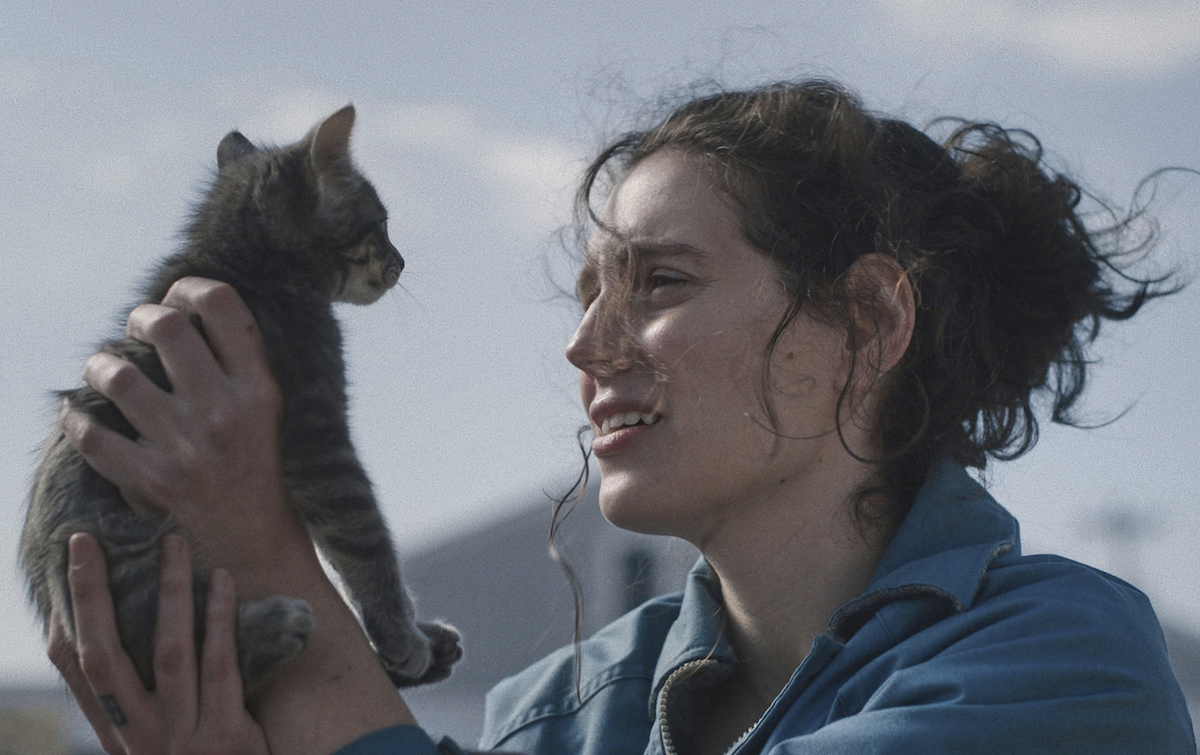
Eva Victor (they/them) has made a career—and a helluva feature film debut with Sorry, Baby—by never doing what’s expected. After working for the feminist satire website Reductress and MTV’s Decoded for a time, Victor first gained viral traction with a series of funny videos made for both their own Twitter account and later for Comedy Central. As an actor, Victor appeared as Rian beginning in the fifth season of Billions and the first season of Super Pumped, both for Showtime. They have also appeared in a handful of indie films, including Shithouse, Dating & New York, and Boys Go to Jupiter.
But it’s their writing-directing debut (in which Victor also stars), Sorry, Baby, that has thrown them into the spotlight, winning the Screenwriting Award-U.S. Dramatic at this year’s Sundance Film Festival. In it, Victor plays Agnes (she/her), whom we see at two different times in her life: as a student, and later, as a professor at the same college, where an event occurred that altered her even as she refuses to let it break or define her. The film is about how Agnes, along with her best friend Lydie (Naomi Ackie) work to bring Agnes back to the funny, optimistic person she was before this event, a tone that may bother people who believe a film about trauma also has to be heavy or upsetting. Victor respectfully disagrees, and Sorry, Baby is proof that stories like this can tackle heavy material without becoming trauma porn.
I spoke with Victor when they were in Chicago in May for the Chicago Critics Film Festival, and they reveal how much of the story of Sorry, Baby was based on events in their own life and their response to those events. There’s a thin line between Eva and Agnes, and it’s fascinating to watch how both deal with difficult subjects and episodes on their lives. The film is easily one of the best, most emotionally honest works of the year. Please enjoy our conversation.
I saw this the film at Sundance and again recently. Jane Schoenbrun was a guest at our festival last year, and I understand you shadowed Jane while you were prepping this. What did you learn from that?
I think the differences between our films allowed me to see how a director moves so clearly. is such a different genre and scope; it was a bigger film. The thing about Jane is that they are such a visual filmmaker and everything is about eliciting a guttural feeling from an audience. Their script has dialogue, but it’s also quiet. So much of how they’re telling that story is visual, and with my film, I was aware that it was very dialogue-heavy, so watching them work was about the confidence to find the emotionality of a shot visually. I think that was a huge lesson for me, and one I continue to learn from.
Jane is a close friend, and I continually use them as this lighthouse of how to tell a story really confidently and visually in a way that’s very stirring. It was an amazing experience, and they had all of these really beautifully crafted long shots, and I didn’t know what it would look like to create that—so much planning, so much care. Also, to be close to someone who has such a genius mind and is so wry, so funny, it was a really positive experience to find community, and they really saw me as a director before I had made anything, so that was a huge vote of confidence for me.
Speaking of that, you also got some sort of guidance from Barry Jenkins, including just the idea of becoming a director. I love that you’re seeking advice from these wonderfully creative people.
Yes, it’s very very cool. The Barry thing, he was someone I met with to talk about filmmaking. When Barry Jenkins says to you, “You might be able to do this job,” that’s something you have to consider. It’s very special; it meant a lot; and I don’t know if I would have directed this movie if I hadn’t heard someone say I could do it before I’d done it.
You did go from these short funny videos right into this. Other than shadowing Jane, what did you do to prepare to become a director?
I did a lot, a lot of secret stuff . I reverse shot-listed films; I storyboarded the whole film, drawing every shot—it was my first attempt at making a shot list, but through image. I did a two-day workshop weekend where I shot two scenes from my script to practice shooting with a DP , who ended up being the DP on the film, and I watched a lot of movies. And then I shadowed Jane.
I also got a GH5 camera and was in France for about a month, and I made this pretty weird…what I actually did was I shot a bunch of stuff and made it into this 90-minute thing, just to see what it felt like to put something together. So there was a lot of private experimenting and lessons learned in the year and a half between Pastel coming onboard the project and us deciding, "Eva is ready to direct it."
You mentioned you watched some movies. What were some of the movies you watched to find a tone for your film?
Yeah, there were different reasons to watch movies. Some were to understand how people were covering things, and then how that informs tone and humor. There’s also stuff to just understand how someone makes a shot list, and do guesswork about how a shot list becomes a film. Kelly Reichardt’s Certain Women was one of the movies, 45 Years, I tried to analyze Moonlight a bunch.
The thing that I connected to in all the films for this project was a real intimacy and simplicity to how it’s shot. Also, looking at comedies, there’s a reason there’s more coverage in comedies, and it’s usually something you can manipulate in post to make something land in a different way. You can create time or take away time in post to make a joke land, so it was this balance of “I want this film to land in this dramatic space sometimes and to breathe and be slow, but also I want the comedy to land and have enough coverage to make things funny and manipulate and calibrate things later pacing wise.” It’s a balancing act.
The whole film is a balancing act. The humor is front and center; this is mostly a comedy.
Thank you!
Especially in places where you least expect it. The film feels like it’s about Agnes pushing back on bullies and mean people, and not just the obvious person, but the doctor character or the people at the university you meet with, and Kelly McCormack’s character.
That’s interesting. There’s definitely some fantasy fulfillment in the film. Agnes is very blunt and says things sometimes that we want to say and don’t. Same with Lydie . They both act as this sort of gauge with each other and ask, “This is weird, right?” which is really helpful. A real intention in writing the film was “How do I make clowns out of people who are cruel?” and then also, through the creating of it, sometimes the most effective way to make clowns is to find the ways in which we empathize with them. Obviously, the doctor is horrible but also it feels like he doesn’t know that he’s horrible. Most people aren’t trying to do evil things, but there is a mundanity to the evilness that I wanted to get across.
A lot of times, it comes across as being careless with somebody else’s feelings.
Yes, careless. Perfect. Totally.
Is this the story you wanted to tell first as a film? Did you go with the old adage of writing what you know? Did you have other ideas?
Your first film is just the first film they let you make. You have a lot of ideas and attempts before that. I don’t know if that’s true for everyone, but it’s true for me. I had stories that never found their way, but this was the one that made. Looking back, I think I’m happy and grateful and relieved that this is the one that made it, and it’s the one that made it into the right hands—it made it to my producers, who kept it safe. And that’s the thing I’m most grateful for, that I was able to feel safe making this film and maintain the amount of creative control I needed to to feel safe and trusting of their input. I think the one that makes it through does so for a reason, or that’s what I have to believe. It’s a long road before this, years of rejection in different ways. I was an auditioning actor from the age of 20 until now, until last year. It’s a business of rejection sometimes.
There’s also a really beautiful theme in your film about not letting a single event in your life define you and how you see yourself and how other people see you. Was that something you wanted to push to the forefront of this story?
Yes, I wanted the film to support the idea that the violence isn’t the center of this story; it’s really about an attempt at healing. I wanted the film to have us meet Agnes without having that information about how she got to where she is, because I do think we as a society define people like that, when we don’t understand the nuance of it. So I wanted the film to be able to show a person, and then you understand how she got there. I definitely think Agnes is someone who is fighting as hard as they can but very much in survival mode to move through this, but the moving is slow and nonlinear.
I wasn’t sure which love story I was rooting for the most, the one with Lydie or the one with Gavin…
I thought you were going to say the cat .
Hey, as an unapologetic cat person, cat videos have gotten me through some tough times.
Me too, me too.
But I think it’s the friendship with Lydie that pulled me through this story. The friendship is possibly in danger of falling apart because of the geographical distance, but we get to watch them find a way to hold it together, and it’s really inspiring.
Thank you. I do think that’s the love story of the film. The Gavin-Agnes relationship is about Agnes’ journey back to her body, and he’s an amazing instrument to that, but the real intimacy in romance exists for Lydie and Agnes. I agree.
I was going to ask you about the healing power of laughter, but I think the real healing power comes from cats.
Yes. The thing about cats, I found out because I saw an online video about it, is that the decibel that their purr is heals the bones. That might not be real, but it feels real, and that’s what someone posted, so it feels real. So that’s what I’ll go with.
John Carroll Lynch, also a previous guest of the festival as a director, seeing him in this movie made me feel so good. When you’re around someone who’s such a legend, what do you glean from just being around him for a couple of days.
Well, he infused the set with a ton of professionalism and energy, and everyone wanted to show up for him, which is an amazing thing to bring to set. And he asked a long of questions really bluntly to me, and I remember, it’s written in the script that they both eat sandwiches, and he was like “I don’t understand why I’m eating a sandwich. I think he makes her a sandwich, and just let’s her eat the sandwich.” And I was like “Great!” He came in with a lot of opinions, and when a legend comes in with opinions about whether he should make one sandwich or two, you listen to him. He’s wonderful. I was so happy he said yes and was very excited to surprise people by bringing him in 75 percent of the way through the film. The Zodiac pops in and is the kindest stranger you could ever meet. I’m so grateful he did it. I think that was one of the first casting moments where I was like “Shit, people get this,” and it meant a lot.
Do you wish there had been a film like this a few years ago for you? Was there anything even close when you were going through your version of this?
Of course I do. Looking back, some of the films I watched that aren’t necessarily traceably connected to this got me through hard times. The films that are popping into my head are really interesting, like Kiki’s Delivery Service is one of them. Phoenix is another, about a woman who has a complete face reconstruction. Films with a lot of love in them that are about transformation. The reason you write a film is really because you needed that film, or at least it is for this one; I don’t know what the future will hold.
I’ll see you later. Thanks for doing this.
Thank you so much.
If you enjoyed this post, please consider supporting Third Coast Review’s arts and culture coverage by making a donation. Choose the amount that works best for you, and know it goes directly to support our writers and contributors.
