
Filmmaker Nia DaCosta is not one to shy away from taking risks. She broke into the mainstream in 2021 with her updated take on the horror classic Candyman, before quickly being elevated to superhero status with 2023’s The Marvels. Serving as writer and director on both of those films, she again takes on dual roles for Hedda, an adaptation of the late-19th century play Hedda Gabler by Henrik Ibsen about a free-spirited woman confronting an isolating future. DaCosta does not just transfer the work from stage to screen; she quite literally reinvents it with inventive casting and gender-swapped roles, creating something fresh and unexpected out of the familiar.
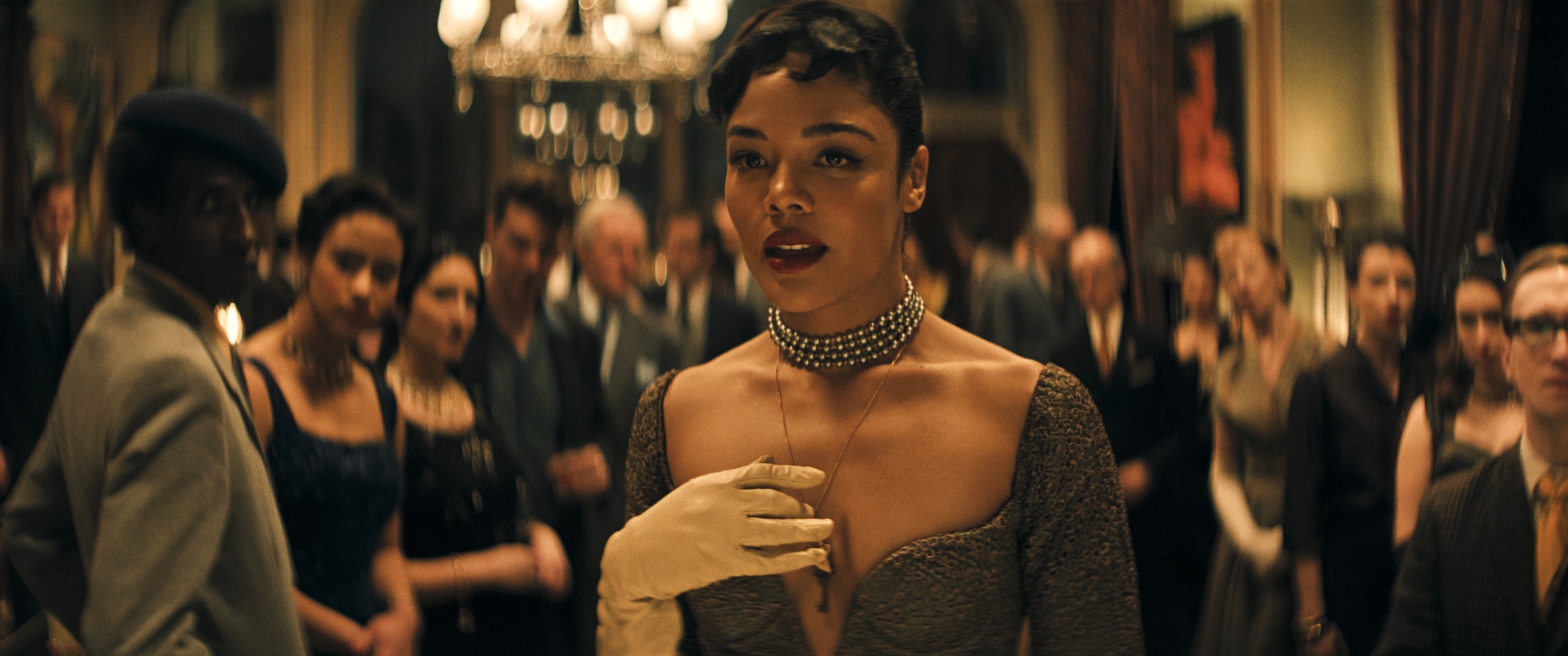
Tessa Thompson stars as Hedda Tesman (née Gabler), the daughter of a respectable general recently married to a man she doesn’t love but who will go to great lengths to make her happy. On the night the film takes place, she and George (Tom Bateman) are hosting a party at their lush country estate, a grand home on expansive grounds, which George called in favors and went into debt to secure for his wife. George is an academic hoping to secure a generous grant that will not only allow him to continue his studies but to provide Hedda with the life to which she’s accustomed. Their party, then, becomes an unlikely mix of the scholarly elite debating their high-minded ideas and the bohemian types Hedda, a rebellious and unpredictable young woman, typically runs with.
Into this mix comes Eileen Lovborg (Nina Hoss), a colleague of George’s who is also up for the academic grant and someone with whom Hedda quite clearly has a history. It’s the biggest update DaCosta makes to Ibsen’s original play where, of course, this role was a man (Eilert), and this change upends many of the original dynamics only to replace them with new, more intriguing ones. Where in the original stage production George and Eilert are two men with clashing egos and shared desires, as Eileen in DaCosta’s version, this role becomes a statement on misogyny, sexuality and the patriarchy.
As the night progresses, secrets are revealed, tempers flare and everyone’s true selves become more and more apparent. Eileen’s current love interest, Thea (Imogen Poots) arrives in a frenzy, desperate to keep Eileen sober and clear-headed for the duration of the evening and, more importantly, to keep her away from Hedda. Hedda still harbors feelings for her former lover, but, unable to be honest about any of this, she acts out by interfering to a shocking and irreparable degree in a project Eileen is counting on to earn her the grant. As the drama increases, DaCosta and cinematographer Sean Bobbitt (The Marvels, 12 Years a Slave) evoke it all through frenetic camera work and moody tableaus in rich, deep colors.
Thompson, always a reliable addition to any cast, loses herself in Hedda’s chaotic emotional state; it’s not entirely clear what she’s doing with her accent, but it’s a small distraction from the overall transformation she makes into a woman in a gilded cage fighting back in the only ways she knows how: with her heart and her body. Ibsen’s play was evocative for its time, offering an imperfect, often unsympathetic heroine at a time when women’s interior lives were hardly a thing for society to care about. In her updated version, DaCosta retains Hedda’s unpredictability, often making it difficult for a modern audience to appreciate her motives.
But it’s in the character’s perceived selfishness and self-assuredness that we find what’s most intriguing about how Hedda interacts with the world around her. Though she’s ultimately motivated by a logic only she can truly understand, these typically negative characteristics are actually what instill in her the sense of ambition and independence often lauded in the modern woman. Despite the main character’s less-than-virtuous motivations, Hedda, at least in DaCosta’s 21st century adaptation, is a story of self-reliance, unrequited love and finding ways to move forward through it all.
Hedda is now playing in select theaters; the film begins streaming on Prime Video on October 29.
If you enjoyed this post, please consider supporting Third Coast Review’s arts and culture coverage by making a donation. Choose the amount that works best for you, and know it goes directly to support our writers and contributors.
