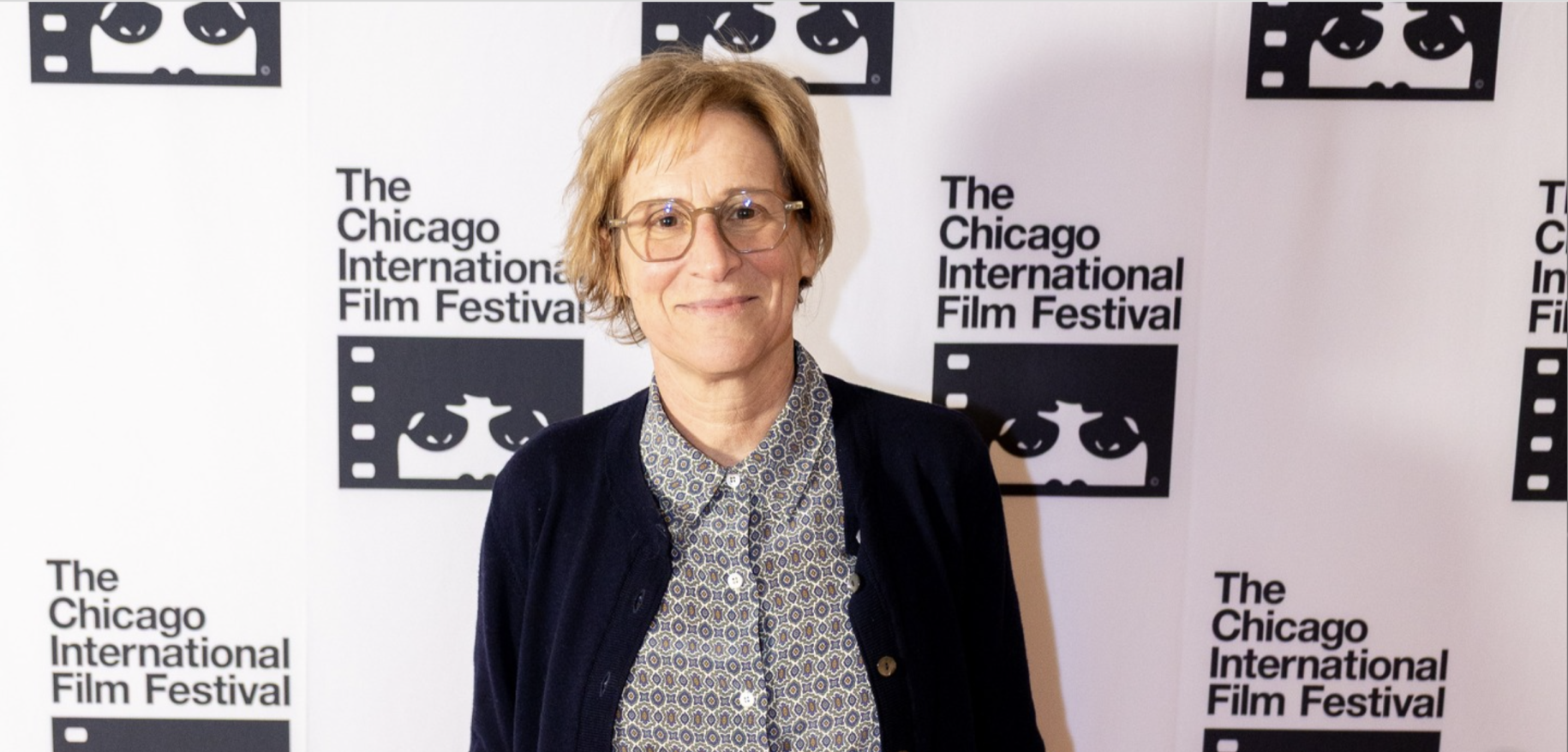
“This film will really put the hustle in you.”
Director Kelly Reichardt said this of her breakout film Old Joy (2006) while introducing its screening at the Gene Siskel Film Center last Thursday. The 35mm presentation was part of the In-Person Retrospective programmed by the Chicago International Film Festival to celebrate the release of her new film, The Mastermind. Running 76 minutes and containing only enough plot to fill a single act in a conventional film, Old Joy is Reichardt at her most unhurried and unassuming. And so her droll prologue to the film, lasting no more than two minutes, offered a droplet of her filmmaking essence: brevity, patience, and not a dash of pretension.
The Retrospective ran three days, from Tuesday, October 21 through Thursday, October 23. In addition to Old Joy and The Mastermind, the series included First Cow (2019) and Showing Up (2022). The Siskel Center split the screenings with Old Town’s AMC Newcity 14.
The festival selected the trio of previous films to represent Reichardt’s “unique take on the ‘buddy film.’” Old Joy and First Cow deal in shades of masculinity, each with a pair of men searching for purpose at a crossroads. The inclusion of Showing Up as a “buddy film” interests me; I can only assume the companion of Michelle Williams’ protagonist is her injured pigeon. After all, Reichardt is a master of mundane concerns.
In September, Chicago Film Fest organizers primed festival-goers for the Retrospective with an installment of Dr. Nick Davis’ “Digging into Movies” series. Davis is a Festival Associate Programmer and a Northwestern professor of film analysis, feminist and gender studies, queer theory, and American literature. Entitled Voices that Carry, the lecture underlined a number of the throughlines in Reichardt’s 10-film career, especially how the writer-director scours the edges of society to bring outsiders’ perspectives to the fore. Davis also highlighted the contrast between Reichardt’s sparse visual compositions and rich soundscapes. Just listen to the hot springs scene in Old Joy to hear how Reichardt pushes and pulls natural sounds from our purview, lifting the ordinary off of Earth.
Reichardt's films magnify simple aspirations, ones that can usually be stated in a single breath. Wendy and Lucy: A woman loses her dog. Meek’s Cutoff: Settlers seek a new home. First Cow: Two drifters start a biscuit business. The filmmaker fashions her stories with enough universality that we relate to her characters’ plights, and she adds such specific details that it feels like saying goodbye to friends when the credits appear.
Along the way, the writer-director (and editor) gathers genre tropes and disperses them in the wind. Her Western has no time for gunfights; her political revolutionary thriller withholds the explosion; her heist film gets stopped up by school girls and a cop eating a sandwich. Reichardt wants us eye level with these people, so she strips away the distractions and makes it feel real.
The Mastermind, for which Reichardt gave a full post-film Q&A on Wednesday, presents another luckless loner in unemployed carpenter JB (Josh O’Connor). This time, however, the filmmaker adds a layer of slickness with a 1970s milieu and a percussive jazz score by Rob Mazurek. The stylishness may seem a departure from her typically demure trappings, but it is necessary to achieve her goal of putting us in the main character’s head. JB thinks he’s a suave criminal, maneuvering his way from the boredom of suburban family life, so we hear the cymbals and vibes clacking as his gears get going. But like the ironic title suggests, his schemes have no shot at success. The early-70s furnishings—all olive, taupe, and rust—illustrate the faded promise of the previous decade, for JB and America.
Kelly Reichardt's films don’t resolve as expected. They rarely send us home on a feel-good wave. But they have a healing quality. To see ordinary people struggle with their meager goals, we feel our innate sense of humanity swell within us. I feel more alive, more in tune with myself and the world when I watch her stories. These movies are medicine.
Tickets to The Mastermind, now playing in theaters, are available through the Siskel Center.
If you enjoyed this post, please consider supporting Third Coast Review’s arts and culture coverage by making a donation. Choose the amount that works best for you, and know it goes directly to support our writers and contributors.
