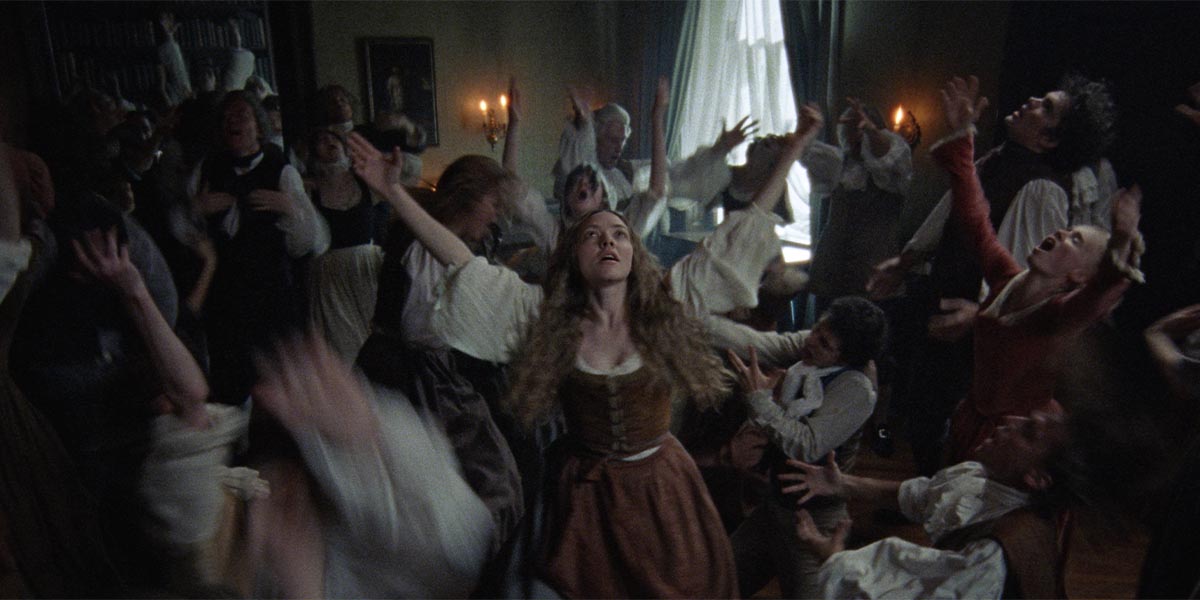

I entered a screening of The Testament of Ann Lee much the way I enter most film screenings: knowing as little as possible. Sure, I knew Amanda Seyfried stars as the titular Ann Lee, the founder of the Shaker religious movement; and yes, I knew it's directed and co-written by Mona Fastvold, who collaborated on last year's The Brutalist with partner Brady Corbet (her co-writer here). But beyond that, I hadn't done a deep-dive into the time period the film explores or investigated exactly what history its premise indicated it would be chronicling. So for much of this magnificent, moving epic thrumming with a vibrancy not often captured on screen, I found myself both enthralled and curious. Is all of this an accurate depiction, or an interpretation?
It turns out, as is the case in most memorable biopics, the answer is a little bit of both, and Fastvold's ability to strike a compelling balance between the two makes for one of the best films of the year, driven in large part by Seyfried's visceral and fully committed performance. Coupled with a score by Daniel Blumberg that, with its meditative tones and choral vocals will find its way into one's very fibers and a supporting cast that successfully meets Seyfried where she is, The Testament of Ann Lee is in that rarefied air of achievement in cinema that justifies the existence of awards and accolades.
Ann Lee was born in Manchester, England, in 1736. Fastvold's film only spends a bit of time with Ann Lee as a child, but they are formative years; it's in this time that the young girl witnesses things and discovers truths about the world that will linger with her for the rest of her life. In her family of Quakers, Ann would've been accustomed to regular prayer services but it's clear as a young woman she is looking for more from her religion. When she meets James and Jane Wardley (Scott Handy and Stacy Martin), she's introduced to a version of Quakerism that intrigues her with its physicality and expressive movements; the Wardleys are part of a small sub-sect known as Shaking Quakers and with Ann's guidance and devout commitment to the practice, the Shaker movement is about to take off.
Ann's life at this time is dark and difficult, and she often finds solace in a faith that she's relying on to help make everything make sense; a series of miscarriages and stillbirths wreak havoc on her body and her spirit, and she swears off sexual relations entirely (much to the consternation of her husband, Abraham, played by Christopher Abbott). This sequence is one of the most powerful and gut-wrenching montages in cinema this year (or perhaps ever), but it does what it's meant to do: it drives home Ann's commitment to her vocation and her God. (It also solidifies Fastfold as one of the most ambitious filmmakers of the year, right up there with Chloe Zhao's deeply powerful Hamnet.)
The challenges continue to stack up against Ann, namely in the form of persecution from a government and a church that are none too amused by her proselytizing and unwavering convictions. Agree or not with Ann's sometimes extreme takes on sex, female-dom and faith, there's an unmistakable feminist thread to The Testament of Ann Lee as she resists those who would silence her and pays the price again and again for her beliefs.
The film, already impossible to look away from in its first two acts, becomes absolutely enveloping when, in 1774, Ann and her followers, now a small but faithful sect of people who join her in her full-body worship, board a ship for passage to the New World just as America is headed for the Revolutionary War. From the harrowing passage where, as she has several times previously, Ann seems to conjure a miracle to save everyone from certain death at sea, to building a gathering space of their own just outside Albany, New York, this final third sees Ann coming to terms with her own mortality and what it will mean for her followers when she's gone.
The Testament of Ann Lee is Seyfried's film, to be sure; it is a career-defining performance and one that proves to any who may still doubt her that the actor who played ditzy Karen Smith in Mean Girls and bubbly but lost Sophie in Mamma Mia! is a force to be reckoned with (real ones always knew). Worth mentioning in the ensemble is Thomasin McKenzie as Mary Partington, an early and devoted follower who acts as a sort of narrator for us through Ann Lee's incredible life. McKenzie's Partington is meek and quiet, but she is also beautifully spiritual, awed by all that she sees in Ann and the lives they are creating for themselves. She's a standout.
A film like The Testament of Ann Lee reminds me of what's possible in this beautiful, expansive and ever-surprising art form; at no moment in the film's two-hour-plus runtime did I have any inkling what might be coming next, not just because I wasn't familiar with Ann Lee's life story but because Fastvold is a filmmaker of bold vision and impressive risks that blessedly pay off. If you go to the movies to be swept up in grandeur, The Testament of Ann Lee is where you'll find it.
The Testament of Ann Lee opens Friday, January 16, screening on 70mm at Music Box Theatre.
If you enjoyed this post, please consider supporting Third Coast Review’s arts and culture coverage by making a donation. Choose the amount that works best for you, and know it goes directly to support our writers and contributors.
