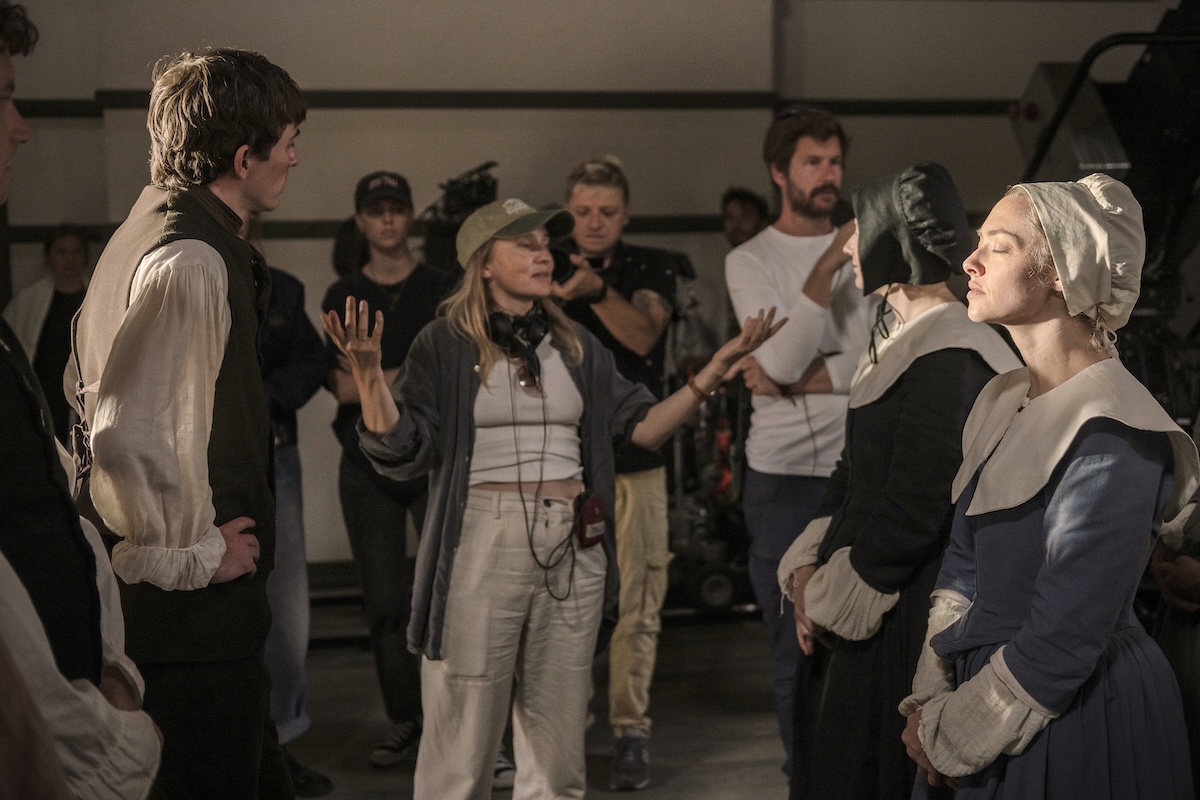
In recent years, Norwegian-born filmmaker Mona Fastvold has divided her time between co-writing her own films (The Sleepwalker) as well as those directed by her partner, Brady Corbet (The Brutalist, Vox Lux). She gained a great deal of notoriety with her 2020 work The World To Come (which she did not write) and has garnered an immense amount of acclaim and awards buzz with her latest, The Testament of Ann Lee, (also co-written with Corbet) about the founding leader of the Shaker Movement, as portrayed by Amanda Seyfried. (Read my colleague's 4-star review here.)
The film is a fully immersive, speculative retelling (based on years of research) of the founding of the Shakers, a religious sect, by Lee, who was seen by her followers as the female incarnation of Christ. Lee was married to a brute of a man, Abraham Standerin (Christopher Abbott), and while he continued to stay married to her for a time, her belief in celibacy among all her followers eventually drove him away in spectacular fashion. With the invaluable assistance of Oscar-winning composer Daniel Blumberg (who also has a role in the film) and choreographer Celia Rowlson-Hall, the movie profiles the Shakers' belief that impassioned singing and ecstatic dancing makes one closer to God, and at times, Testament feels like a spiritually based musical that manages to give us glimpses of the utopian world Lee envisioned for her followers.
Testament also reminds us just how terrified colonial America was of a religion run by a woman in a time when the rest of the country was celebrating newfound religious freedoms, as well as afraid of a religion that genuinely saw all people as equal and wasn’t afraid to practice what they preached. The film is now playing in theaters, including a 70mm presentation at the Music Box Theatre.
I got a chance to sit down with Fastvold last October during the Chicago International Film Festival, and we discussed her research process and how she managed to place her camera in the middle of so much Shaker dancing. Enjoy our conversation…
Why the Shakers? Did you gravitate to them because of Ann Lee’s story?
Obviously, I’ve written a lot about architectural design, and I’m interested in that naturally. I knew about the Shaker design—the chairs, the boxes—and how it informed American design and architecture. But I didn’t know much about them beyond that. When I was doing research on The World to Come, I was reading a lot about the women’s relationship to religion. That script was based on a short story, and that short story was based on some old letters, and I did a lot of research on that period. There was one line that described how these two women didn’t go to church any more, and they were separate from that. My impression of that period—around 1856—was that it was puritanical and you had to be part of some religious community, and I wanted to understand what happened before this, in the generation before. So I started reading about American Utopian society and the people who emigrated to America for religious freedom, and I started reading about this religious-freedom mecca where people were pioneering all of these different ideas, and it was then that I stumbled across the Shakers and Ann Lee.
At the same time, I was doing musical research, looking for a specific hymn, and I came across this beautiful hymn called “Pretty Mother’s Home,” which was from that period earlier on, and I thought “What’s the story of this song?” I was trying to figure out where it originated. It turns out it was written by this woman named Patsy Williams, who was a freed slave and a prominent songwriter and elder in the church, and I wondered what this religion was that had an African-American woman as a songwriter and artist and an elder. It turns out that was the Shakers. It was this culmination of research that led me to them. Then I discovered Ann Lee, who I knew nothing about; I’d never heard of her before. And when I started reading her story, I thought it was incredible. What a journey she had from being an illiterate, poor daughter of a blacksmith to creating the largest Utopian society in American history, with equality between gender and race, at a time when women had no autonomy at all. And that was the story that really called to me.
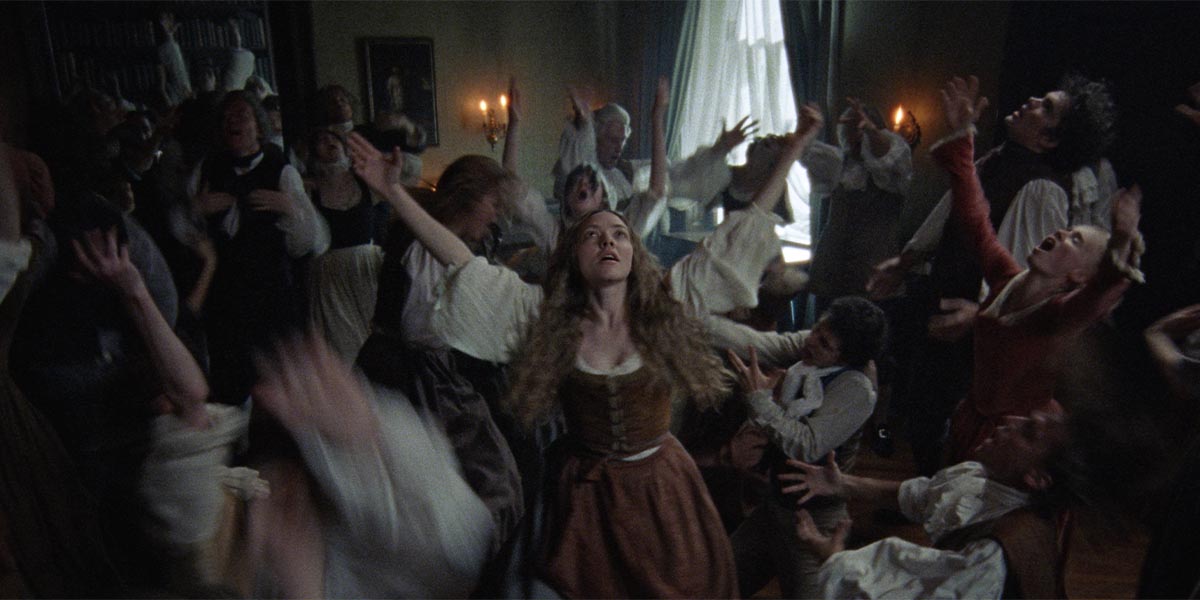
Then, on top of that, it was the musical and movement aspect of them. They worshipped through ecstatic song and dance. At the beginning, they would have great parties, they would dance for four days, collapse, dance more, sing, make noises as a form of worship. That, combined with confessing your sins and purging any bad thought you ever had. To me, I found it so exciting because my background is in movement, and the idea of tracing that journey from the chaotic, ecstatic movement and into these really beautiful hymns they left behind, like 1,000 hymns, and these organized, structural shapes that they would create in movement toward the end. That all speaks to the architecture as well, with everything in symmetry.
And your film traces that. I know that films aren’t made chronologically most of the time, but were you able to film any of this chronologically?
I wish we could have, but no. But we were super specific about that journey, from the wild and free to the structured, organized way they ended up.
You have a Busby Berkeley shot from above at the end of the film.
Yeah, there were some of these pencil drawings of the Shakers that I was so enamored by, where they are all dancing in these circles, with one row bending one way, and another row bending another, into these spiral shapes. And I knew I wanted to re-create that, but we had to work backwards toward that into the chaos. If you’re a dancer or ever done an improvisational movement class that goes on for quite a long time, you will start finding patterns and rhythms with other people, and you’ll start developing something more structured within the chaos. That’s something I played with early on, so even though it’s wild, there are moments of choreography that’s very precise within the movement.
Clearly, you have professional dancers and singers with specific skills, but was your priority to also have actors who could do those things, or to get dancers and singers who could also act to a certain degree?
They’re not supposed to perform. All the movement and singing is an expression of faith, so it wasn’t ever supposed to be showy. I wanted everything to understand the movement, so we had meaning behind each gesture, and that’s something that me and my choreographer, Celia Rowlson-Hall, worked on with every single person, even the extras. If someone came on set for one day to be in the corner, either me or Celia or one of our choreography assistants and Daniel Blumberg, our composer, would be like “This is the meaning of this sound, this is the meaning of the gesture, this is what you’re doing, you might be the lead today because the camera might be right on you at some point, and you have to be fully committed to it.” So everybody got so much direction, and we had 200 dancers and singers.
Some of them, we specifically cast as singers, but they all worked with the professional actors. Ann Lee was supposedly a small-framed, fair, beautiful woman who had an incredible singing voice; we know that about her. So Amanda was not Hollywood casting; she was just right for it. I wanted the person who played Ann to be a strong singer, but the others, I just wanted them to be great performers, and we did so many workshops with them. Lewis Pullman is a great drummer, but he hadn’t sung much before ever, but he has a band and plays drums. He’s musical, and his mother is a wonderful modern dancer and choreographer, so he worked with her a lot in preparation for the part. I did cast some incredible dancers as well so they could do some improvised pieces, but it was a combination of all of it. With the cast, I wanted them to find whatever lived with them and see how far we could push it.
Just hearing you talk about your research path, and how one thing led to another, it’s a very academic approach. I think that’s true of a lot of what you’ve written; you try to make the history as accurate as you can. At what point does your brain take that research and make it cinematic?
The research leads me to those moments. When I saw that drawing of all of those hundreds of Shakers in the circle, I thought “I have to make this.” Or even just their architecture is like porn for me . Those boxes being made with the joints fitting exactly right is amazing.
I was joking with someone last night that this is two films in a row that you’ve made about furniture.
I know, right. We’re obsessed with chairs. But to me, all of that is deeply cinematic. I do all the research for years, and then Brady and I, when we sit down to actually write the script, we know where we’re going with it, we know the story, we’ve done all the research, and then you have to let your intuition guide you. It has to pull you in the direction the story wants to go, and the characters start speaking to you and telling you where they want to go and what they want to be. That’s the magic of creating art, you just have to. It comes to you clearly and has a life of its own, in a way.
I love the way that the camera is always within the dance; it’s rarely filming it at a distance. That seems like it would triple the complication of shooting it. The cinematographer has to have a place to go while still capturing what you’re trying to show us. Did they have to be part of the rehearsals?
Oh, absolutely. It’s a big part of my process, finding the perfect relationship between the performer and the camera—the perfect dance—it follows my background in dance and movement. I strive to find a great oner or long-sequence take, where you can really edit with the camera, and you can find that movement path between the character and the camera, where everyone is moving and no one can anticipate each other, and we’re moving together and finding that dance. That’s really important to me, really exciting. And with this film, we’re pushing it even further, because there’s so much dance and movement in the film, so my cinematographer and one of our camera operators were at our rehearsals, from when we were in the dance studio, and both of us would be shooting with our iPhones, and really getting a sense of how big we were in the group.
We were showing Celia and the dancers how much space we needed, and then trying to find that space together. And we would also find our edit point. And then we would go on location and continue that, again rehearsing all of us, shooting it, and then rehearse with even more of my crew and be part of that, even if you were just holding a wire or adjusting a light. The scene at the town was the first big dance and song moment in the film, and it’s a really good example of what we were doing, because you have 200 dancers in this very small space, and there’s a lot of old-fashioned movie tricks that we were having so much fun with—hidden cuts, camera wipes, we have in-camera changes, we spin around the room and follow a dancer and come around while my cast members are off camera changing costumes and coming back in. I thought that was one of my nods to my love for old musicals, with tricks from another time, even though the movement and music is very modern. Some say it’s more akin to an opera, which I like, because it’s big emotionally.
The passion is certainly more operatic. Speaking of passion, I want to talk about portraying religious fervor on the screen. So often when we see that in movies, it’s a cult or something negative. But so much of that fervor is just on Amanda’s face; that’s what sells it. But how do you capture that fervor in a positive, rational way?
For me and Amanda and all of us making this film together, we wanted to examine this idea they had of creating this Utopian society with respect, because even thought that there are a lot of things I don’t agree with with them and there are things that are flawed about this experiment, there’s something extraordinary about what they did. They were extraordinary artists and inventors, and her conviction is easy to ridicule—and there are moments of levity in the film—but I never wanted to laugh at them. I wanted us to go on a journey with them and laugh with them and be with them and feel with them, because I think there is a lot of value to this experiment she created. I had a lot of love and compassion for her, and so did Amanda.
As artists, we felt a connection to this group. What is this thing that’s guiding us to something and want to spend 17 hours until you’re so tired, you withdraw? You want to make an independent film, and there’s not a lot of glory in that. And I have no idea what the appetite is for a Shaker musical; it’s not something you’re doing for any kind of glory or financial gain. You just feel the call to tell this story, and you can’t stop yourself from doing it. You work so hard on it; we hand-painted the credits and shot them on film. We had worked with a traditional matte painter, who created all of our set extensions on plates, which were then shot. We had the same obsessive nature about craftsmanship.
The sets that you built for these communities, they look fully immersive, like you could shoot them 360 degrees. Is that what you did, just build the community?
I could never afford to build all of that; we had a modest budget, roughly the same as The Brutalist. It’s a combination of many things. We built a lot of it, some facades, some extensions, we shot a lot at the Hancock Shaker village . We also built a few interiors sets as well, and some sets we would just flip and alter and change. The majority of the work was done in Hungary, and we were lucky enough that the Hancock village let us shoot there as well.
I love that you have a working relationship with Christopher Abbott, because I don’t think anybody plays a terrible person as well as he does. What is it about him that makes him so good at playing these dominating men?
I have to write a kind, sweet role for him. I must; he deserves that. I don’t know why I always cast him as an asshole. I know why I do, actually. It’s because he has so much worth and humor in him, so he counters it, and I really love that. It makes the character so complex. He’s beautiful and charming and has a lot of warmth, so when he’s playing someone who’s more negative, he really counters that and brings a wonderful complexity to the character. He has a real way of understanding that complexity; I love that.
Any time a filmmaker makes a period piece, they are usually trying to say something about the modern world as well. What were some of the things you want us to learn from Ann Lee’s journey and what she established?
You never want a film to be a lesson. You spend so many years working on something, and everything you have to say is in that two-and-a-half hours. But I think that talking about leadership in a different way is important to me. Brady and I examine this journey of something who is striving to create something impossible, like László’s impossible building and Ann Lee’s impossible idea of Utopia, a place that is led by this idea and thought of mothering—leadership being a mother who nurtures and allows for freedom of thought and expression and to be artistic.
This woman was part of American history that is being erased, but we do stand on her shoulders. She did create one of the largest Utopian societies in American history—she had over 6000 followers at the height of it, with equality between gender and race. That was a beautiful thing. To me, there’s something quite hopeful about what she did with nothing, and I want to examine this way of leadership right now, while we have these male leaders around the world who are leading with a lot of intimidation and fear. I want to remember this woman who led with so much love and generosity. It’s important to visit that right now, because it’s so easy to feel hopeless right now. We an create safe, beautiful pockets or communities; they don’t have to be celibate .
Are there any modern remnants of this religion?
There are. When I finished the film, there were two Shakers left, both in Maine. And a week or two after we finished the film, a third person joined. It’s been years and years since someone joined, but a third person joined. Maybe more will come.
Thank you so much, Mona. Best of luck with this. I can’t wait to see it in 70mm.
Thank you, very nice to meet you.
If you enjoyed this post, please consider supporting Third Coast Review’s arts and culture coverage by making a donation. Choose the amount that works best for you, and know it goes directly to support our writers and contributors.
