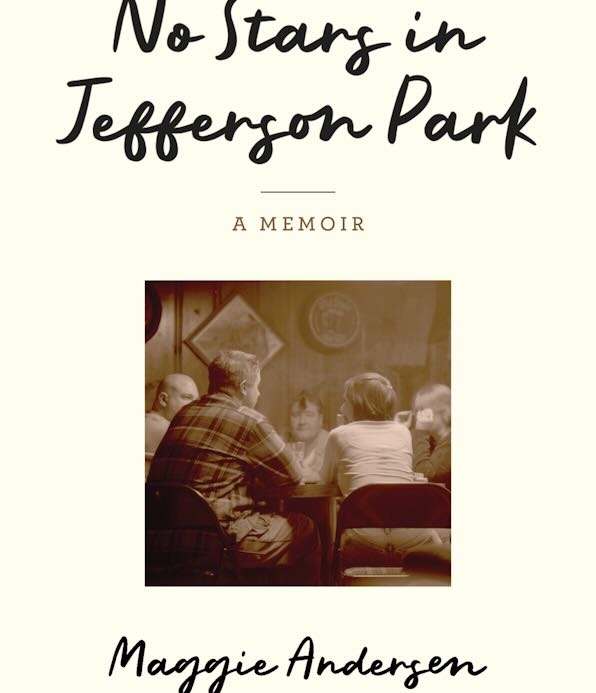

When I open a book to review it, I view it as an assignment. Read it as thoroughly as practical, and perhaps skim over some sections. But by the time I finished reading the prologue of Maggie Andersen’s memoir, No Stars in Jefferson Park, I was hooked, and reading every word. Unfortunately, this highly readable memoir about a theater kid turned writer is burdened with too much detail about the physical rehab of her actor-partner.
The book is a story of theater kids, but not the ones who go to elite theater camps and star in prep school plays. These theater kids grew up in and played in far northwest side Jefferson Park, a working-class neighborhood that also fostered the iconic Imagist painter, Ed Paschke.
Andersen’s story begins with the founding and early years of the Gift Theatre, which she and her friends founded in a storefront with a tiny stage on Milwaukee Avenue. The Gift made theatrical magic in that tiny space; I’ve seen many plays there (especially memorable were Wolf Play and a version of Hamlet cast with mostly Black actors); they were always inventive and well performed. (The Gift Theatre moved out of that space in 2021, and is raising funds to create a new theater home. For the time being, they are a transient theater, like so many other Chicago companies.)
Andersen’s partner in this effort was an actor named Michael Patrick Thornton. The two met in high school where they began their theater journey. The theater partnership became a romantic relationship. But in March 2003, when Thornton was 24, he suffered spinal strokes that left him paralyzed from the neck down. He went through years of therapy to regain strength and movement ability, He still acts but is reliant on a wheelchair. Thornton is a strong and charismatic actor and he recently has performed in Broadway theaters and in TV series, including a small role in the current series Black Rabbit on Netflix. He now is on Broadway in the starry production of Waiting for Godot, with Keanu Reeves and Alex Winter playing Didi and Gogo. Thornton in his wheelchair plays Lucky, the slave of the lordly character, Pozzo.
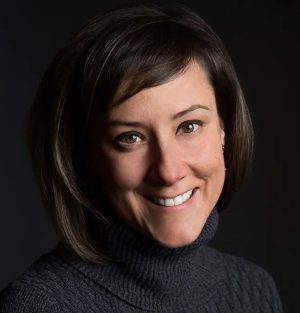
A great deal of Andersen’s book—about two-thirds—concerns her time spent with Thornton as he goes through various stages of rehabilitation. During the latter part of this saga, Andersen found her connection to Thornton crumbling and she finally broke off their relationship a year and a half after his stroke.
To me, the more important part of her story was her realization that she wasn’t cut out to be an actor but really was a writer. it was her recognition that she had to put herself first, as much as the day-after-day rehabilitation trauma with Thornton, that led to her separation from her longtime partner (they talked about marriage, but never took that step).
Andersen broke through to her new life and her new identity as a writer when she left for Kalamazoo to participate in a program at Western Michigan University in Kalamazoo; she stayed on to live in Kalamazoo and work on her MFA. One of her mentors and professors was Chicago author/poet Stuart Dybek. (She had already participated in a writing intensive in Prague in 2004, the first stage of her separation from Thornton and her search for her own identity.)
Andersen earned an MFA at Western Michigan and a PhD in English at the University of Illinois Chicago, where her creative dissertation was the manuscript for this memoir. She now is an associate professor of English at Dominican University in River Forest.
I can recommend No Stars in Jefferson Park as a good read, especially for those who are lovers of Chicago theater. Andersen’s story is a very readable personal memoir (except for too much health trauma).
If I had been an editor assigned to get this book published, however, I would have added some missing pieces:
There’s no table of contents. There’s no index (and that’s important in a nonfiction book). And the chapter titles, while helpful in that they identify the year in which the chapter action takes place, would have been better labeled with month and year. Five or six chapters in a row, for instance, are titled 2004, which is not helpful to the reader.
No Stars in Jefferson Park is available from the publisher or from your favorite bookseller.
Support arts and culture journalism today. This work doesn't happen without your support. Contribute today and ensure we can continue to share the latest reviews, essays, and previews of the most anticipated arts and culture events across the city.
