I like to think of Jill Lepore sitting down at her desk to plan her new book on the US Constitution. We don’t need just another history, she thinks. There are plenty of them that say how grand and special it is and how historic in its thinking. We need a book that shows the flaws in our beautiful Constitution. What’s wrong with it, why we need to fix it, and some ways to do that.
If that was her thinking, she succeeds with We the People: A History of the US Constitution. The title doesn’t give away her purpose, however.
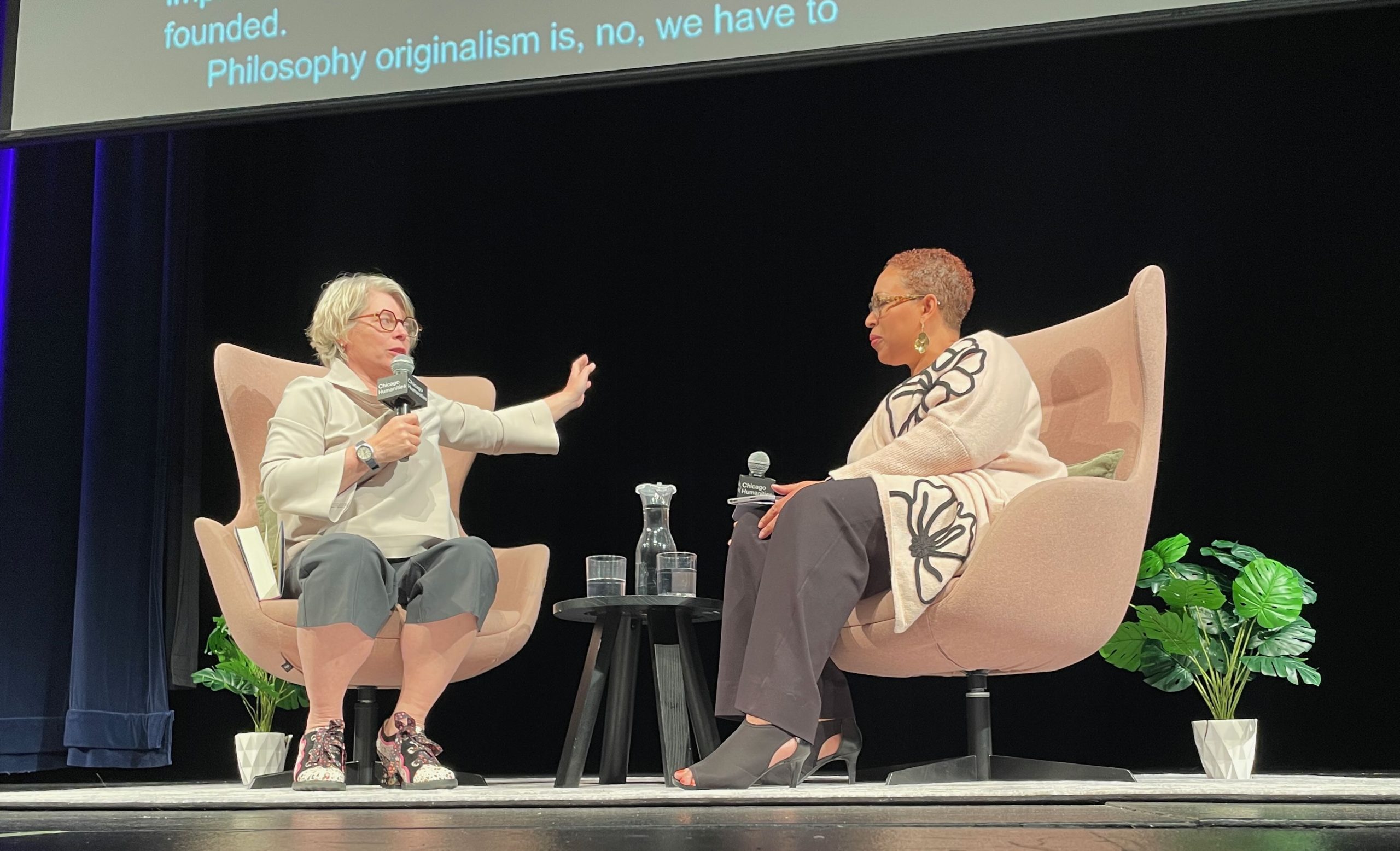
Now, there she is, sitting in an armchair on the stage at Francis Parker School, chatting with her interviewer, Jenn White of NPR. The question of the evening (and the theme of Lepore’s book) is: Can this nation survive with a Constitution set in stone as of 1971, when the last functional amendment was passed? Lepore and White appeared at a fall event of the Chicago Humanities Festival.
Many people believe Constitutional change is still possible; but in fact the process is complex and the country is so polarized (and has been for some time) that the US Constitution has lost its amendability. And therein, dangers lurk.
The framers were men with lofty ideas intent on writing a constitution that would serve the new country for decades to come. They based their ideas, Lepore says, to a great extent on books they read—on Newtonian physics and Aristotelian philosophy. They wanted to solve “ancient problems having to do with the people and their rulers, the structure of government, and the nature of rights, but also with the knowability and endurance of law.”

Lepore pointed out the sad statistics of efforts to amend the Constitution. Twelve thousand amendments have been introduced in Congress since 1789, and thousands more have been proposed and discussed beyond Capitol Hill.
After the Constitution was ratified in 1789, 12 amendments immediately were passed, creating the ten making up the Bill of Rights, which establishes many of the individual rights we value so highly today. But since then, only 15 more have passed. Three of those were after the Civil War, when the 13th, 14th and 15th amendments achieved the American Ideals of equality by abolishing slavery and establishing birthright citizenship and voting rights for Blacks. Historian Eric Foner called this trifecta The Second Founding in his excellent 2019 book of that title.
The 26th Amendment, ratified in 1971, changed the voting age to 18. And the 27th, ratified in 1992, specified how Congressional salaries are to be adjusted. (That is more like a bookkeeping amendment, so we don’t view that as functional.) Nothing has really changed since 1971, Lepore points out.
Thomas Jefferson said that “a constitution with a good amendment provision can long endure,“ Lepore says. The framers wanted to make the Constitution easy to amend, but not too easy, and thus Article V describes the convoluted process of amendment: either by acts of Congress followed by ratification by three-fourths of the states, or by a Constitutional Convention, with the same ratification requirement. In the process, she said, the framers created the two worst compromises of the Constitution.
The Constitution was a “messy, sloppy document,” Lepore said, and some delegates didn’t even sign because of disagreements over Article V and provisions like the relevant clauses in Article I on slavery and equal suffrage in the Senate.
White asked Lepore what the framers were trying to protect against with Article V.
Lepore noted that the constant undercurrents throughout the Constitutional Convention were between slave and free states, and between urban and rural states. Thus embedded in Articles I and V are clauses that are bows to the slave states and equal suffrage in the Senate (in which every state, no matter how small, each has two Senators). The former was changed by the 13th Amendment and the latter remains set in stone. (Consider that as provided in Section 3 of Article 1, California, a state larger than many countries with 40 million people, has the same number of US Senators as each of the Dakotas, with fewer than a million each. (As Bill Maher would snarkily say, “why do we even need two Dakotas?”) James Madison, for one, was known to hate the provision for equal suffrage in the Senate.

Lepore believes that because of the complexity of the amendment process, especially in our now-polarized society, too much Constitutional change comes about by judicial decision, rather than by the votes of the people and their representatives.
Basically, the Constitution is now unamendable and this is not a good situation for an open and sometimes volatile society. Amendments like a full voting rights amendment, the Equal Rights Amendment or abolition of the Electoral College are considered virtually impossible to enact because of Article V’s provisions.
Lepore also talked about how some state constitutions created in the early years of the nation were models for the framers of the federal constitution. She also describes the colorful personalities and styles of some important founders like Benjamin Franklin, and the late Supreme Court Justice Antonin Scalia. Scalia, she says, “was the Ben Franklin of the Court.”
Lepore spent time both in her book and her interview discussing the concept of originalism in the US Constitution and its proponents, who view the document as meaning exactly what the founders understood it to mean and not a word more. The first use of the term originalism was by Judge Robert Bork, who was nominated for the Court in 1987 but not confirmed, after long and controversial debate in the Senate.
One audience member asked Lepore about the National Popular Vote Compact, which would take effect after enough states have approved the compact. The goal is to gain approvals in enough states to total the number of electoral votes required to win the presidency. Then every state that passed the compact would automatically cast all its electoral votes in the next election for the winner of the popular vote. Lepore answered that if the compact was ever enacted by enough states, it would be declared unconstitutional in any court challenge.
When Lepore was asked what she thought about social media as an outlet for civil opinion and unrest, she replied that “social media is an artificial community dominated by bots.”
One final thought was on the current unpopular opinion of SCOTUS. “I wish they were not he focus of so much attention,” she said. “It’s a byproduct of our culture of celebrity.”
The difficulty of amending the US Constitution leaves Americans subject to what political scientists call “the tyranny of the minority.” Danger lurks in those words, she believes.
The New York Times writer who reviewed We the People felt the same. The final paragraph of that review states, “Left hanging in the air at the end of this rewarding book is a dark question: At what cost have we abandoned amendment? Textual change has long been seen as an alternative to political violence. So what happens when a nation rived by polarization, seemingly incapable of addressing its pathological fiscal situation and profoundly unjust legacies of oppression, cannot fix itself by constitutional reform? Does it abide in suffering? Or does it explode?”
You can find all these concepts and predictions in Lepore’s excellent book, which is well-organized and crisply written. We the People: A History of the U.S. Constitution is available from the publisher or your favorite bookseller. The book is 700 pages, including copious helpful notes and index.
If you found this post interesting, please consider supporting Third Coast Review’s arts and culture coverage by making a donation. Choose the amount that works best for you, and know how much we appreciate your support!
