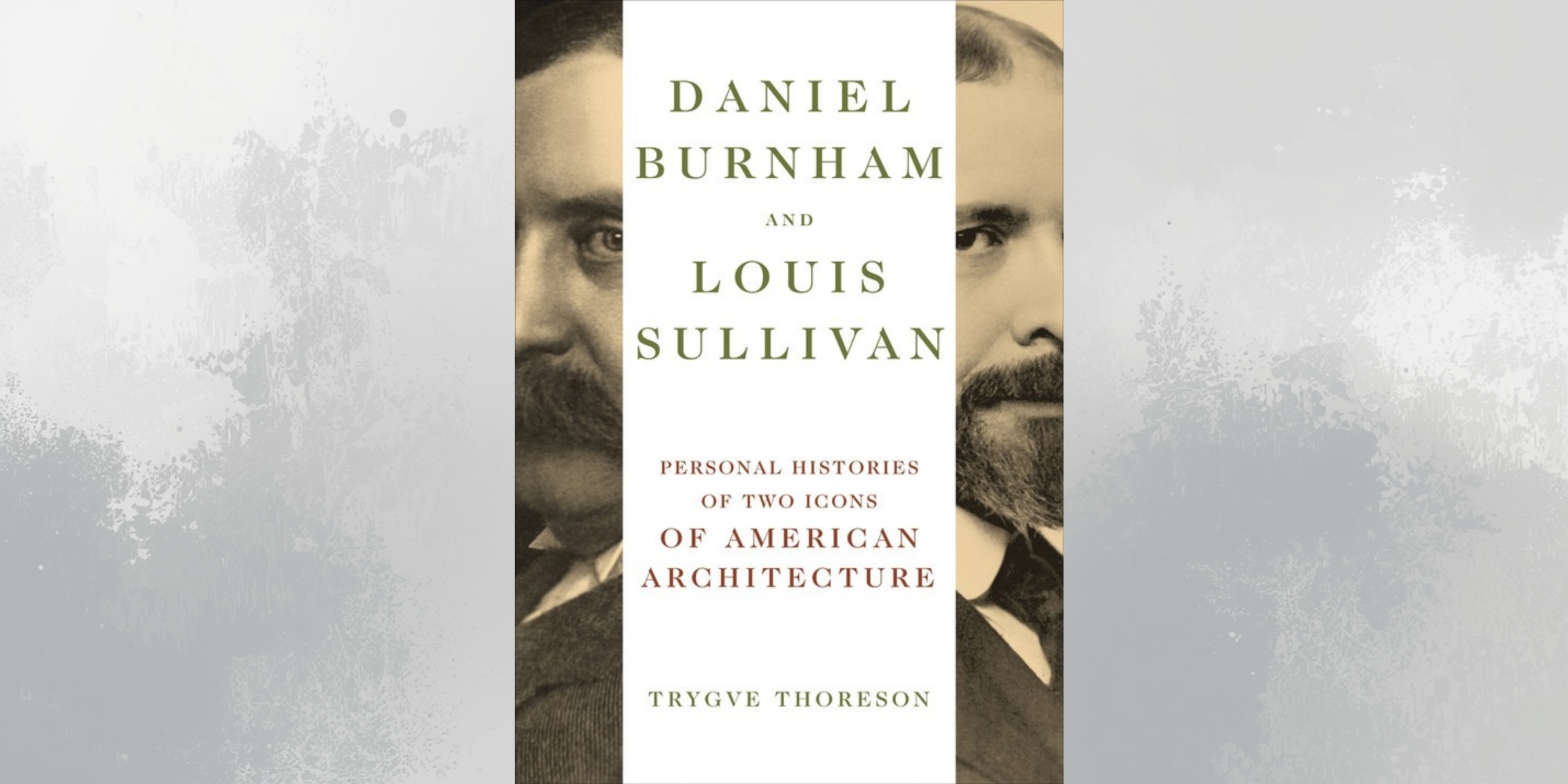

Louis Sullivan and Daniel Burnham lived parallel lives. Both were born in the East and came to Chicago in their youth. Both were poor students and relatively aimless until they decided to pursue architecture as a career. Both prospered and found great success in Chicago, influencing the building styles and methods of the city and the nation for many decades.
Both saw and wrote about the link between the material and the spiritual worlds—for Burnham, an expression of his Swedenborgian brand of Christian faith, and for Sullivan, a Swedenborgian-type vision. Both responded in deep ways to the natural world. And both were major figures among the power brokers of Chicago, often crossing paths and occasionally working on the same projects.
Those parallels are a key element of the story that Trygve Thoreson tells in Daniel Burnham and Louis Sullivan: Personal Histories of Two Icons of American Architecture.
But the deeper story is how different the two men were, and how much their lives diverged.
Burnham, steady, companionable, a team leader who led by suggestion; a man who could not only plan a building but also plan a city, and someone who could compromise.
Sullivan, a skeptic, quick to take offense, a radical, a loner, original, wildly innovative, someone who refused to compromise.
Burnham, for whom success came early and continued to grow stronger until his death in 1912 at 65.
Sullivan whose artistic brilliance brought him great acclaim by his middle 30s, but whose inability to work well with others sent his career into a tailspin until he was living in poverty at the time of his death in 1924 at 67.
Burnham’s Plan and Sullivan’s Transportation Building
Burnham’s outsize impact has continued more than a century after his death because of his authorship (with Edward H. Bennett) of the 1909 Plan of Chicago. Better known as the Burnham Plan, this region-wide vision has influenced the city’s lakefront, its downtown, its parks and forest preserves, and its streets and highways. It remains a touchstone for every new proposal that comes along.
Burnham’s outsize impact has continued more than a century after his death because of his authorship (with Edward H. Bennett) of the 1909 Plan of Chicago.
Over the past century, some of Sullivan’s best buildings have been razed. Perhaps his greatest work was the massive Transportation Building which, like all structures at the 1893 World’s Columbian Exposition, was torn down after the fair. Featuring a huge arched Golden Door, it had a multicolored façade in jarring contrast to all the other structures at the fair, covered in white and of Beaux-Arts design.
His intricate floral designs were idiosyncratic to his style, and his emphasis on ornament was something later architects, following the dictum “less is more,” eschewed.
Yet, Sullivan had his own dictum “form follows function” which is still architectural scripture, and his visionary writings, particularly The Autobiography of an Idea, a mix of memoir, manifesto and eyewitness account of Chicago architecture more than a century ago, are still read as important artifacts.
Indeed, as Thoreson notes, it’s in the Autobiography that Sullivan describes his first meeting with Burnham in a highly detailed account that begins,
“Yes; it seems to me I’ve heard of you. Glad to meet you. My name’s Burnham: Daniel H. Burnham; my partner, John Root, is a wonder, a great man; I want you to meet him some day; you’ll like him…My idea is to work up a big business, to handle big things, deal with big business men, and to build up a big organization, for you can’t handle big things unless you have a big organization.”
“Louis” and “Dan”
Thoreson suggests that Sullivan may have been embellishing this conversation or conflating several into one because the meeting took place in early 1874 and he was recalling it a half century later. Even so, Thoreson notes that “the account seems true to the character and temperament and manner of the man he met that day.” And he adds:
Like Sullivan’s most admired mentors, Burnham openly revealed himself to be “a sentimentalist, a dreamer, a man of fixed determination and strong will…a wholesome effective presence, a shade pompous, a mystic.”
They were now “Louis” and “Dan” to each other, and they enthused together about the “loveliness of nature,” the “hidden beauty in the human soul,” and the uplifting effect of artistic creation.
Late in his career, Sullivan became highly critical of the impact that all those conservatively designed White City buildings had on American architecture, and lashed out at Burnham.
It was a relationship that was far from close, but one in which Burnham, the overseer of the fair, permitted Sullivan to carry out his colorfully and architecturally distinctive Transportation Building design despite the requirement that all other buildings had to be white Beaux-Arts, a requirement that led to its White City nickname.
It was also a relationship in which an older Sullivan, down on his luck, would hit up Burnham for money to keep body and soul together.
Late in his career, after Burnham’s death, Sullivan became highly critical of the impact that all those conservatively designed White City buildings had on American architecture, and lashed out at Burnham in the Autobiography, as Thoreson recounts:
He…noted that it was “one man’s unbalanced mind” and “one man’s unconscious stupor in bigness, and in the droll phantasy of hero-worship” that allowed the World’s Fair to become the “appalling calamity” Sullivan was now certain it had been.
Yet, it’s impossible to read Thoreson’s Daniel Burnham and Louis Sullivan: Personal Histories of Two Icons of American Architecture without feeling that Sullivan could have used a partner like Burnham to deal with clients and weather the financial storms and keep the younger man from flying off the handle. Burnham certainly didn’t need Sullivan.
At the end of his book, Thoreson asks why, despite their high skill, their careers and styles diverged so greatly? And he answers this way:
From early on Daniel Burnham exhibited a respect for the work and values of his contemporaries and artistic forebears…Louis Sullivan, by contrast, carried little respect for convention, authorities, or the authority of history…In matters of style and form Burnham’s conservative temperament gradually asserted itself, while Sullivan readily embraced the role of fearless iconoclast.
One of the many books about Sullivan is subtitled “The Poetry of Architecture.” And maybe, if Sullivan’s genius had been in writing poetry, his abrasive personality wouldn’t have gotten in his way.
But an architect is required to deal with clients and partners and city officials and construction companies, and, in that context, Sullivan couldn’t hold a candle to Burnham.
Daniel Burnham and Louis Sullivan is available at bookstores and through the University of Illinois Press website.
