
Something about Hyde Park is inspirational. It is a vibrant cultural hub with welcoming spaces that foster the growth of artists and their craft. My first dive into the Ear Taxi Festival, presented by New Music Chicago, was at the Reva and David Logan Center for the Arts in Hyde Park. Last week, I spent an afternoon listening to new music from a diverse group of composers. Some of the music was firmly in the far-out category for me, and I have an affinity for art that is ahead of the curve and outside of expectations.
The first performance was from the Chicago Composers' Consortium, featuring baritone Brag Jungwirth: Talking to Heart. Jungwirth was accompanied by the pianist and composer Lawrence Axelrod. It was a lively set of music with vocal and instrumental performances. Featured composers were Elizabeth Start, Laura Schwendinger, Kyong Mee Choi, Kathleen Ginter, Stephen Ferre, and Lawrence Axelrod.
Start's Talking Objects was a three-part composition accompanying the poetry of Conrad Hilberry. "Moustache," "Negative Space," and "Mousetrap" are reminiscent of magical realism and surrealism, with the personification of a mousetrap feeling shunted aside by a box of d-Con. The quirky music was a fitting partner to Hilberry's words.
Axelrod performed his own composition, Bruit d'un coeur, inspired by Migration des Forces by Rainer Maria Rilke. Axelrod translated the words from German to French to better express his interpretation of music. He used the strings inside the piano as well as the keys for the four-part composition. The raw emotion in Rilke's work is expressed beautifully with a spare and haunting soundtrack. Bruit d'un coeur translates to sounds of the heart. There was an English translation written for the audience, but I think that the French interpretation had a better flow for the music.
Schwendinger's Composer's Companions was a fun seven-part piece performed by Amy Wurtz on piano and Amos Gillespie on saxophone. Wurtz is the curatorial director for New Music Chicago, and I reviewed The Amos Gillespie Quartet for the opening of a new chamber music space, the CheckOut. The companions in the composition are cats of various composers, including Mozart, Shostakovich, Brahms, and others. The piano and saxophone sounds let me visualize cats that skittered through the house, war danced, and lazed in the sun shining through a window as the composers they owned (anyone who thinks they own a cat is delusional) wrote the greatest classics of their time.
Violinist Caroline Jesalva presented out of context, beginning with "Trial of the Righteous Mother" by Erez Dessel. For her second piece, "CorrelationAdmirationRamificationOccupation," she introduced the composer Aaron Kaufman-Levine. The composition is usually done in order, but Jesalva asked for a volunteer from the audience to give her the numbers 1-5 in a different order. She improvised her way into each piece rather than the segue on the sheet music. Kaufman-Levine told the audience that he had created his own language through music, and that Jesalva had translated it well through her playing.
Jesalva ended her set with her own composition "Transubstantiation." In Catholic language, transubstantiation is the belief that the communion bread and wine are literally the body and blood of Jesus as told in the Last Supper. In Jesalva's musical language, she was transmuting poverty, grief, and loneliness into joy through music, and that is how I felt listening to her play.
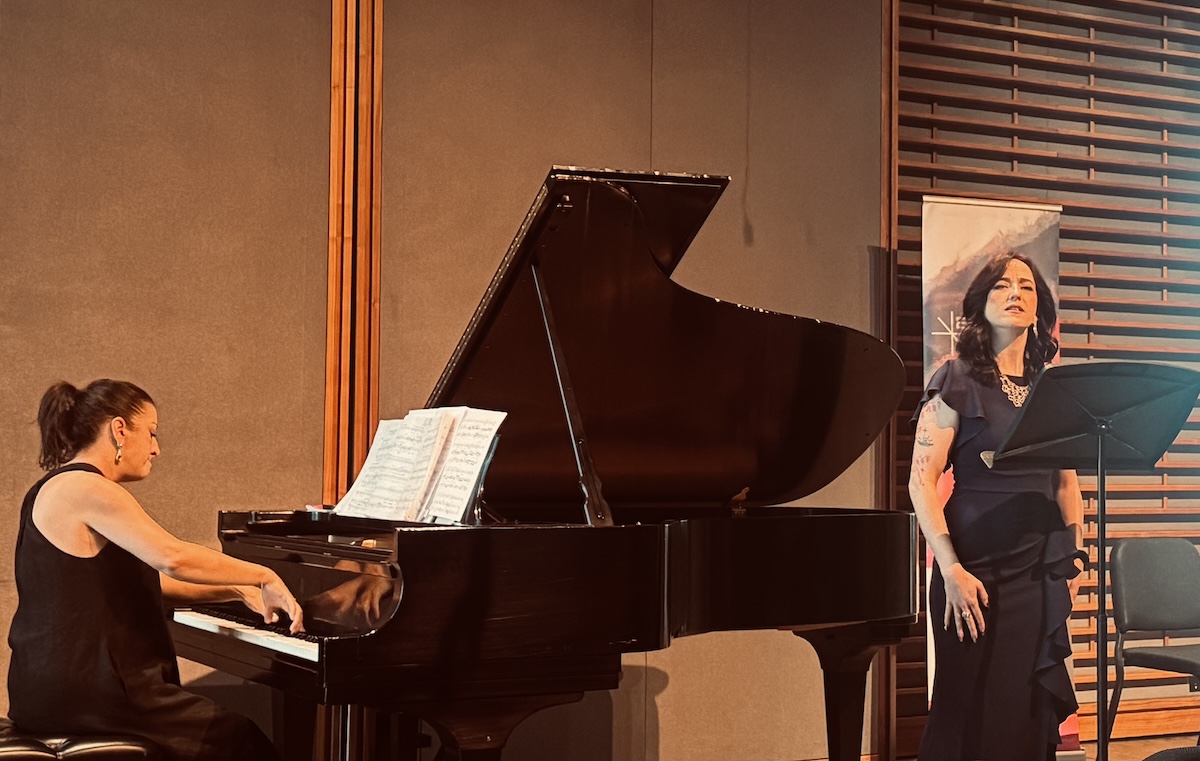
The next performance, titled Anything but a Dream, featured music curated by pianist Shannon McGinnis, accompanied by soprano Corinne Costello. It was a lovely performance of music by composers Behzad Ranjbaran, Gabreille Rosse Owens, and Jodi Goble. The fourth composer was Kyong Mee Choi, who wrote the title piece "Anything but a Dream." McGinnis's curation is based on the book "I Am That" by Sri Nisargadatta Maharaj, a renowned Hindu teacher and spiritual leader. The themes of the songs reflected the philosophy of non-duality and the liminal state between dreams and waking life. The composition by Ranjbaran featured more magical realism from tales told in his childhood in Iran. McGinniss's piano was nicely played, but I wished there had been maybe one other singer in addition to Costello. I could see a contrast in voices, giving more contrast between the compositions.
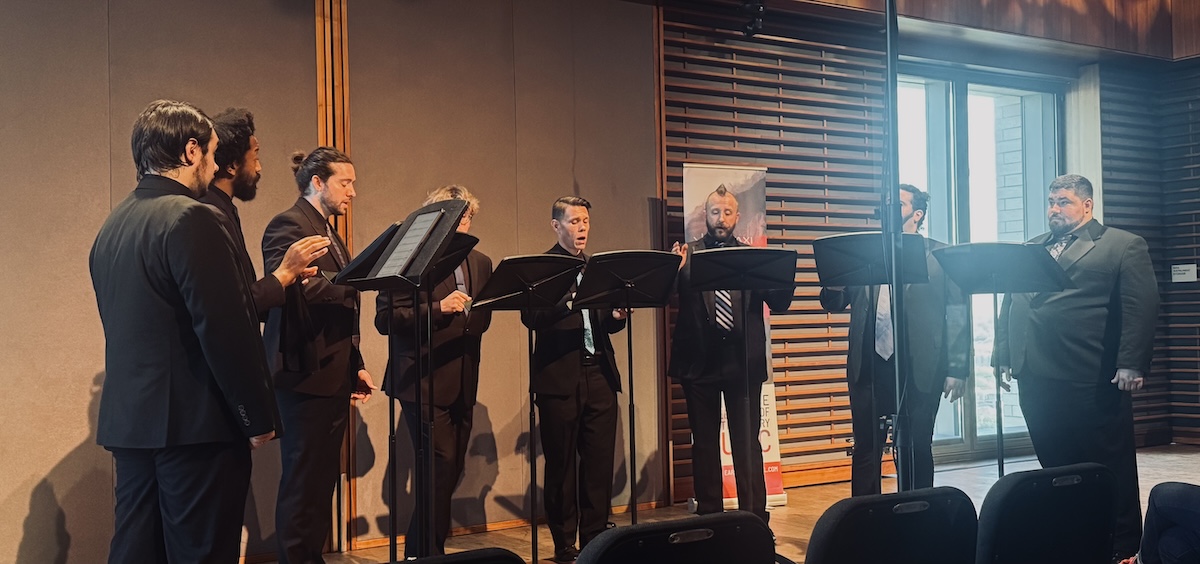
The finale was presented by the Constellation Men's Ensemble (CME) titled Pouring from Empty Cups. The a cappella ensemble consisted of eight men with voices ranging from tenor to bass. Tenor Ryan Townsend Strand led the group in songs with topics ranging from manhood to politics, stereotypes, and the struggle of self-realization. The blend of voices was stunning and easily my favorite performance of the afternoon. Two of the tenors were tenore di grazia, which is the highest range. They added an ethereal layer and resonance to this group of seasoned and powerful voices.
The topics may still be considered radical in some groups, especially in today's political climate. I found CME to be empowering, even though the songs leaned toward breaking free of masculine expectations. Composer Robert Maggio's "Interlude 1 Manhood in the 21st Century" took a torch to the masculine standard being touted by the current political party in power. I loved the stanza, "I can be a high-heeled, tattooed, glitter-bombed, wig-wearing, defiance of Dads gone by." Maggio's composition, "Interlude II Refrains and Misconceptions," listed all the machismo qualities essential to the American image of manhood. "We are the opposite of women...we cannot handle successful women...emotions are scary, weak, and problematic." It sounds remarkably like a recent speech at Quantico, but this was written before that 'performance.'
There is nothing like a great choir or choral ensemble, and the Constellation Men's Ensemble rocks. The singing is emotive without being hammy. They were perfectly in tune, hitting the notes every time. A cappella can be notoriously tricky. If one note is out of place, the whole song can go down the pan and not recover. That did not happen. It was the perfect way to end the afternoon of music on a defiant note, with high expectations of spreading the gospel of breaking stereotypes and rigidity in roles set out for us, rather than by us.
The Ear Taxi Festival continues through November 2 at various locations in Chicago, including the CheckOut, Chicago Music Institute, Experimental Sound Studios, and other awesome performance spaces. For more information on the Ear Taxi Festival, please visit eartaxifestival@newmusicchicago.org.
If you found this post interesting, please consider supporting Third Coast Review’s arts and culture coverage by making a donation. Please select the amount that works best for you, and know that we appreciate your support.
