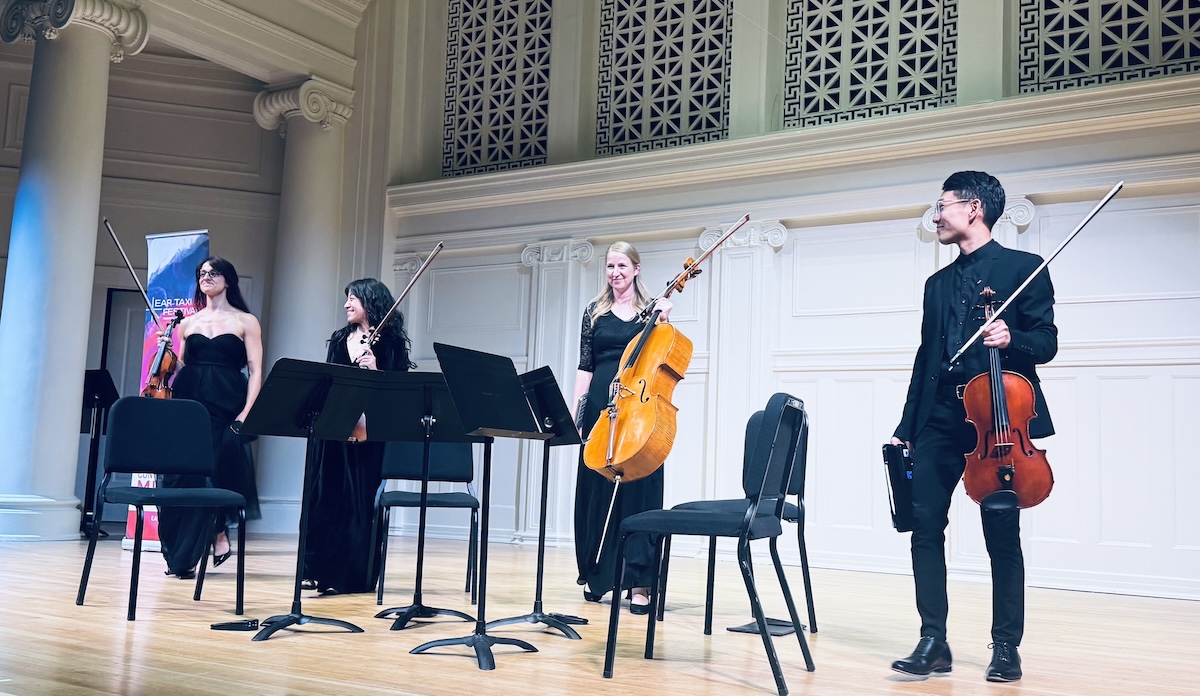

Hosted by the Ear Taxi Festival, the KAIA String Quartet and several vocalists presented six new works by Chicago composers, five of which were world premieres at Music Institute of Chicago's Nichols Concert Hall in Evanston on Friday evening. Although programs can change, the month-long festival is currently expected to offer 71 world premieres, 22 of which the festival itself commissioned. In keeping with the festival's theme of The Composer's Voice, these 22 works are vocal music.
The KAIA String Quartet is Naomi Culp (violin), Hope Shepherd DeCelle (cello), James Kang (viola), and Victoria Moreira (violin). The quartet is known for playing music from Latin America and giving a voice to the unheard composers of the world, making them the perfect vessel for the original and world premiere music at MIC. All of the composers were Illinois-based, which I found to be a point of Midwestern pride. Nichols Concert Hall at MIC provided excellent acoustics and a gorgeous room for a lovely evening of music.
KAIA Quartet backed up sopranos Laura Strickling, Michelle Areyzaga, and Hayley Fox, and mezzo-sopranos Naomi Brigell and Grace Ryan, who perform world premieres by Illinois-based composers Rosśa Crean, Lee Kesselman, Ty Bloomfield, Justin Weiss, and Graham Meyer.
A recent work by Amos Gillespie, Shadow Effect, was also on the program, but it was neither a song nor a world premiere. Gillespie is a saxophone player and has been popping up on Chicago's music scene. The Amos Gillespie Quartet recently opened the new chamber music space, the CheckOut, in Uptown. Gillespie said that he was inspired by the philosopher Juana Inés de la Cruz, who was a Hieronymite nun and philosopher from the 15th century. He claimed that de la Cruz's philosophy was relevant to current times, as she was an advocate for women's rights and sexual diversity.
Shadow Effect was described as a study on how the ego obstructs childhood impulses. It was a beautiful piece of music, with the first part evoking the land and seascape of America to my ears. The world seen through the eyes of a child, unimpeded by concerns. Everything is bright, colorful, and new. The second part of the composition was bluesier and leaned toward the rose-colored glasses of innocence being removed, with the need to find a way into an uncertain future. It was the only composition not to feature a singer or lyrics. The varied textures and layers of Shadow Effect made my imagination fly.
The following selection was to cradle empty air, by composer Rosśa Crean, with lyrics from Chicago poet Christina Rodriguez. Soprano Laura Strickling introduced the song as about the loneliness of a new mother's post-partum stage. The music was beautiful, and Strickland conveyed the pathos of the emotions that cannot be explained; they have to be experienced. The use of pianissimo pizzicato was very effective in punctuating the phrases and pulling the listener into an emotional investment to empathize with the postpartum condition.
Composer Lee Kesselman introduced his piece No Longer Pray with lyrics by Chelan Harkin. Soprano Michelle Areyzaga sang it with an intensity that the composer intended. Kesselman described No Longer Pray as a composition with deep spiritual meaning in everyday things. The lyrics are sung as a chant, as mundane as a cup of hot chocolate, or as spontaneous as howling at the moon. It is about saying yes to desires. Areyzaga was a charismatic performer, connecting with the audience through unleashed emotions. It was powerful music enhanced by the singer and the KAIA Quartet.
Ty Bloomfield wrote the music and lyrics for Cicadian Rhythms, and yes, it is about cicadas—the weird, bug-eyed, decibel-blasting insects. Bloomfield described his composition as being written with a haiku structure in mind. It was the most avant-garde-sounding composition of the evening in a good way. Mezzosoprano Grace Ryan brought the song to life with a lush timbre and velvety delivery. The tempo of the piece was unpredictable, and I could see a bit of the score from my seat. It was akin to sitting in my yard on a humid evening with the continuous hum of life in the air. The snapping cello strings and intermittent sliding drone notes, accompanied by melodic passages, served as a fun onomatopoeic sound.
Soprano Hayley Fox introduced the composition by Justin Weiss with lyrics by Robin Wall Kimmerer. Hold Out Your Hands and Listen to the Rain was about our interconnectedness with nature. Kammerer is a botanist from the Potawatomi Nation. Her book Braiding Sweetgrass inspired Weiss to compose music that I found to be powerfully visual. A microbiology course proved to me that we are all connected through plants and microbes on Earth. Fox has a beautiful soprano that soared in the music hall. This was another composition where I felt a physical connection through the music notes and the experience of watching the KAIA Quartet play. They organically moved with the music, feeling and enjoying each note.
The final selection was by Graham Meyer and featured mezzosoprano Naomi Brigell. Woven took its lyrics from the poet Sappho. Meyer explained that Sappho's poetry is in pieces, literally. No one has or can claim to have a complete work. Some translators fill in what they think would be the logical completion of phrases, and others just put the fragments in an order they deem to be correct. Meyer said that he triangulated different translations; therefore, the title is Woven. The composer specified that the lyrics were fragments, and the musicians filled in the missing pieces, forming a unique musical translation. Woven was sung in eight movements, with some as short as music and two words, translating ancient Greek into contemporary idiomatic language. There were snippets of madrigal sounds, hints of Aaron Copland, and a brief reference to bees.
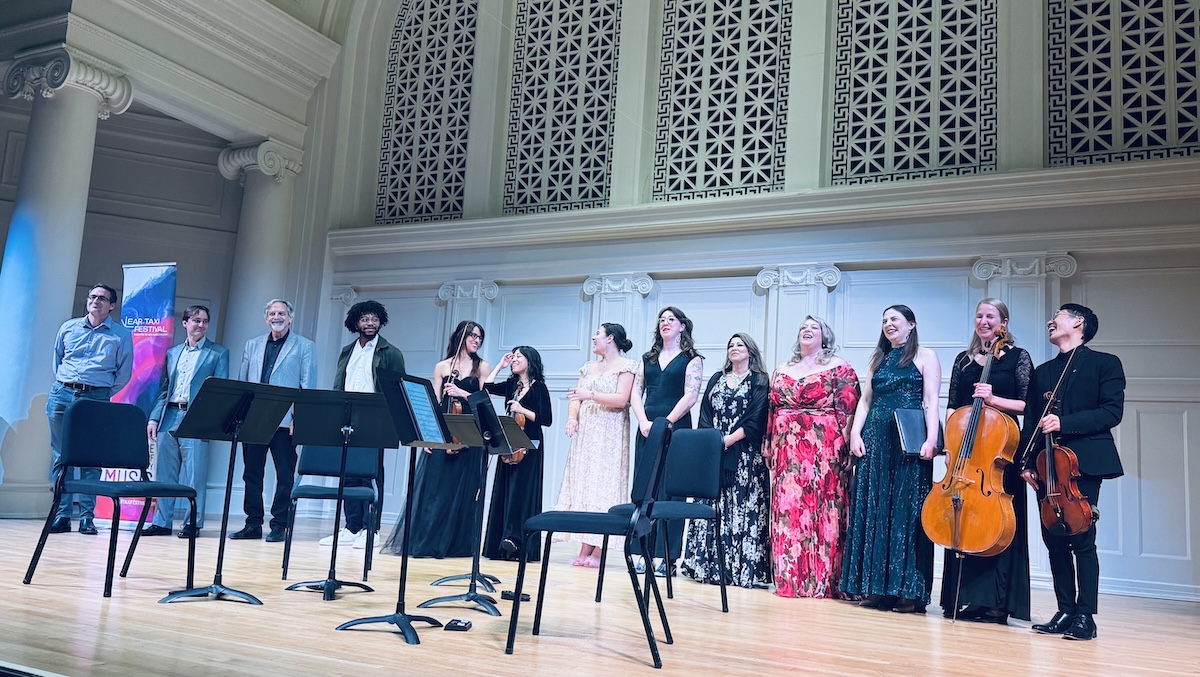
The KAIA String Quartet was delightful and had a group rhythm that flowed beautifully. I love it when the musicians enjoy what they are playing and can groove with a program as varied as this one was. I highly recommend that you try to see them play. Check out the website and videos here.
This afternoon at an Ear Taxi Concert, Fonema Consort, Arcomusical & Krissy Bergmark, and Stare at the Sun, will be performed at Roosevelt University's Ganz Hall at 2pm. This evening Ganz Hall will host a Composer Showcase with musicians from the Ravinia Steans Institute performing world premieres by Blair Boyd, Andrei Skorobogatykh, Liza Sobel Crane, Eric Malmquist, and Bradley Robin. 430 S. Michigan Ave., 7:30 pm. For more information, click here.
Tomorrow night CheckOut will host The Pleiades Improv Jam, hosted by LaRob K. Rafael. Pleiades is a performance series dedicated to celebrating femme, trans, and nonbinary artists. The CheckOut is at 4116 N Clark St. at the tip of the Southport Corridor. Monday, October 13, 7pm.
While you are surfing for great music, I highly recommend that you go to https://www.eartaxifestival.com and catch at least two or three of the performances. This is music from Chicago and Illinois-based composers, much of which is a world premiere. You get to hear it first! Ear Taxi Festival continues through November 2.
BTW, Chicago has been named the number one big city in the USA in a reader's poll from Conde Nast Traveler. I have been saying that for most of my life. We have fantastic cultural events, activities, and friendly and down-to-earth people. Combine that with an incomparable skyline on beautiful Lake Michigan. Add music festivals like Ear Taxi, and it's clear that Chicago is easy to love.
If you found this post interesting, please consider supporting Third Coast Review’s arts and culture coverage by making a donation. Please select the amount that works best for you, and know that we appreciate your support.
