
Last week, the Russian government erected a new statue of Joseph Stalin in Moscow. Apparently Vladimir Putin is resurrecting the image of the brutal dictator. And this week, a Chicago theater opened a production of Six Men Dressed Like Joseph Stalin. In an intimate staging by A Red Orchid Theatre, this play is even more relevant—even prescient—than it seemed a few months ago.
Directed by Dado, the play is a two-hander between a veteran Russian actor (John Judd) and his trainee, a candidate for Stalin’s body double (Esteban Andres Cruz). The setting is 1942-43, somewhere in the NKVD headquarters in the Kremlin. Six Men Dressed Like Joseph Stalin is funny, tragic, and a love letter to theater, as well as a political history lesson. Playwright Dianne Nora has done a masterful job of creating the script and Dado’s two actors give extraordinary performances. Judd, in particular, is masterful in his movement and his character’s theatrical and political musings, while Cruz is manic and soulful.
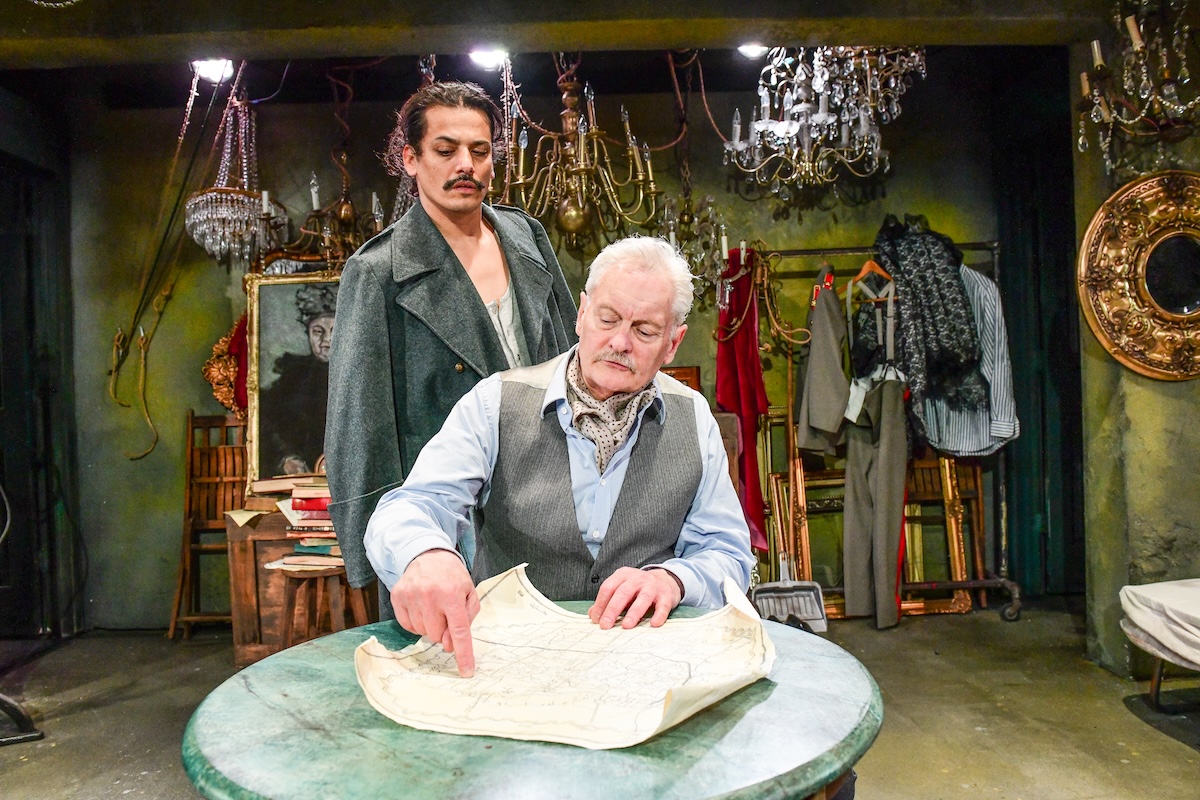
The two characters, as we learn early in the play, represent real people with code names. Koba is Alexei Dikiy, a Stanislavski-trained actor who played Joseph Stalin in propaganda films. Soso is Felix Dadaev, a young soldier who was left for dead on the battlefield; he was a dancer and juggler who performed in small towns and became one of a half dozen Stalin body doubles. But for the next 100 minutes, we know them as Koba and Soso.
Koba starts by giving Soso a pile of books for his education. The first play he reads is Chekhov’s The Seagull, which Soso at first finds puzzling. He says “I was hoping it would be a positive story. You know, a ‘happily ever after’ sort of thing.” Koba responds, “Don’t be bourgeois.”
The Seagull and its characters are threaded throughout the play as are a smattering of Shakespeare’s Macbeth and a line or two from Hamlet. Koba’s training for Soso involves scene readings, political education, and frequent cautions about careful conversations because, of course, the NKVD may be listening. Soso is stressed because he can’t communicate with his family in Dagestan; they probably think he is dead and he fears his father will die before he can return home and see him. But home is not on your itinerary when you’re training to be Stalin’s body double.
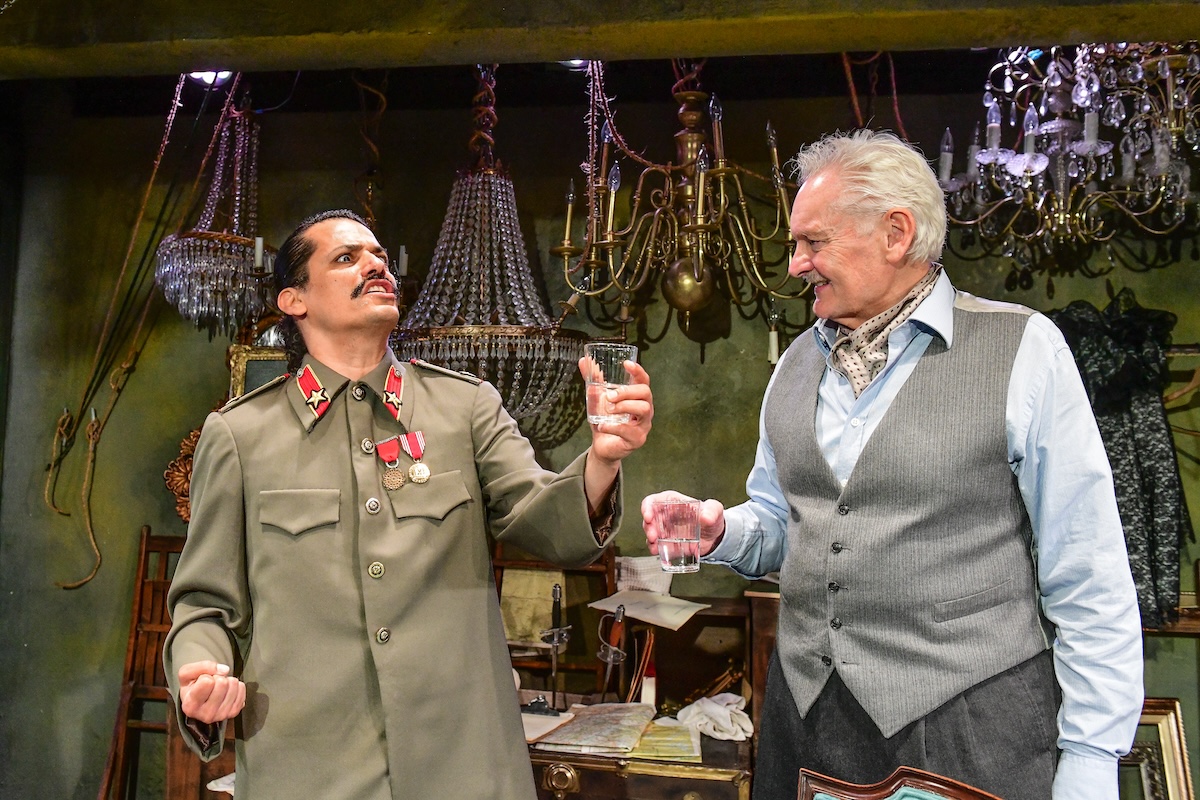
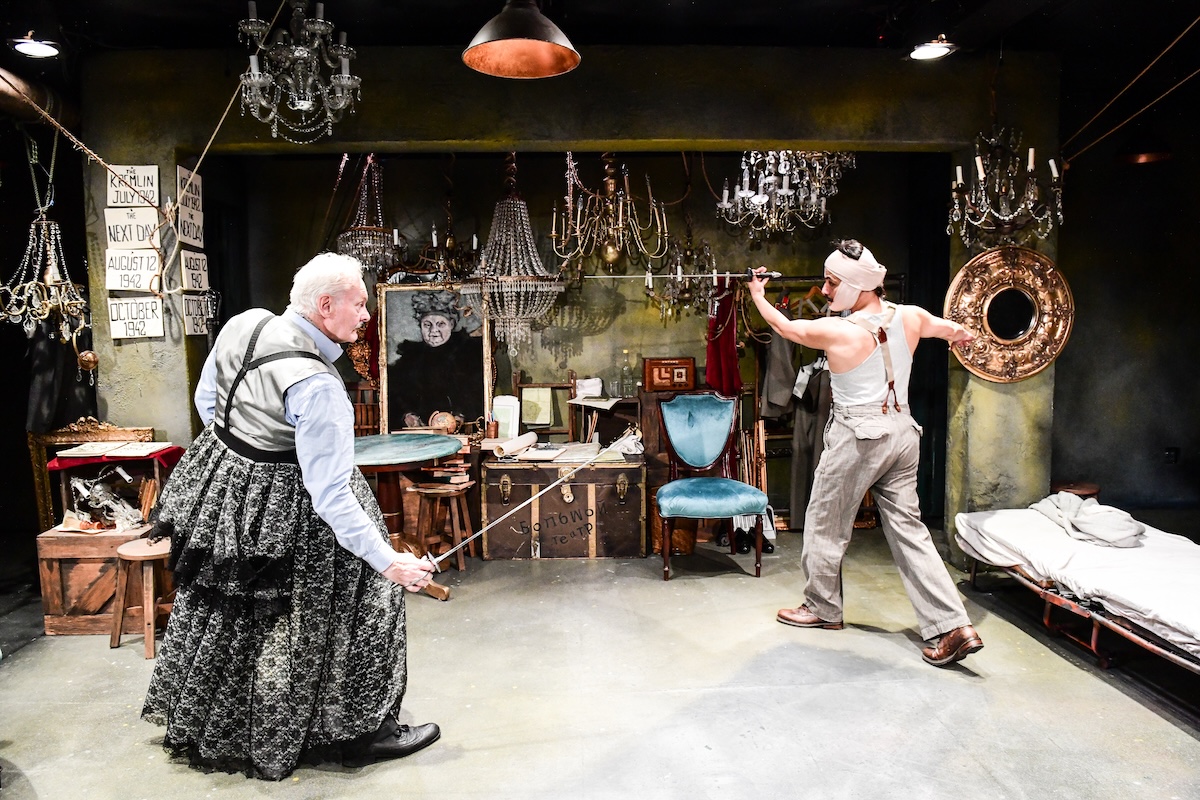
The language of Nora’s script is one of the delights of the play. Soso and Koba have casual conversations between lessons and Soso has a chance to ask his elder about his theater background, his experiences performing before Stalin, his time in Siberia, and how he lost his fingernails. They get drunk on vodka, sword fight while acting (a scene from The Seagull), and even dance. Over the many months of Soso’s training program, the two men develop a friendship, first as mentor/student and then as two men surviving in a high-risk era.
Soso grows more confident in his preparation for appearing as Stalin. His first big assignment will be the conference at Tehran with the other two Great Ones: Churchill and Roosevelt. Soso has to be educated to talk policy with these heads of state (or their body doubles) and that element of the play seems unrealistic. Everything you read about political body doubles suggests they only appeared in parades and on reviewing stands; they didn’t conduct global policy discussions with their counterparts.
The room where Koba and Soso work is crowded with books and costumes and lighted by eight glass chandeliers. Sign boards announce date changes. Scenic design is by Grant Sabin with lighting by Levi J. Wilkins and sound design by Angela Joy Baldasare. Costumes are by Myron Elliott. Lauren Lassus is stage manager.
Six Men Dressed Like Joseph Stalin has been extended to June 28 at A Red Orchid Theatre, 1531 N. Wells St. Running time is 100 minutes with no intermission. Tickets are $35-$50 with discounts available; performances are Thursday-Sunday.
For information on Putin’s effort to resuscitate Stalin’s image and restore the USSR, see this BBC video.
For more information on this and other productions, see theatreinchicago.com.
Support arts and culture journalism today. This work doesn't happen without your support. Contribute today and ensure we can continue to share the latest reviews, essays, and previews of the most anticipated arts and culture events across the city.
