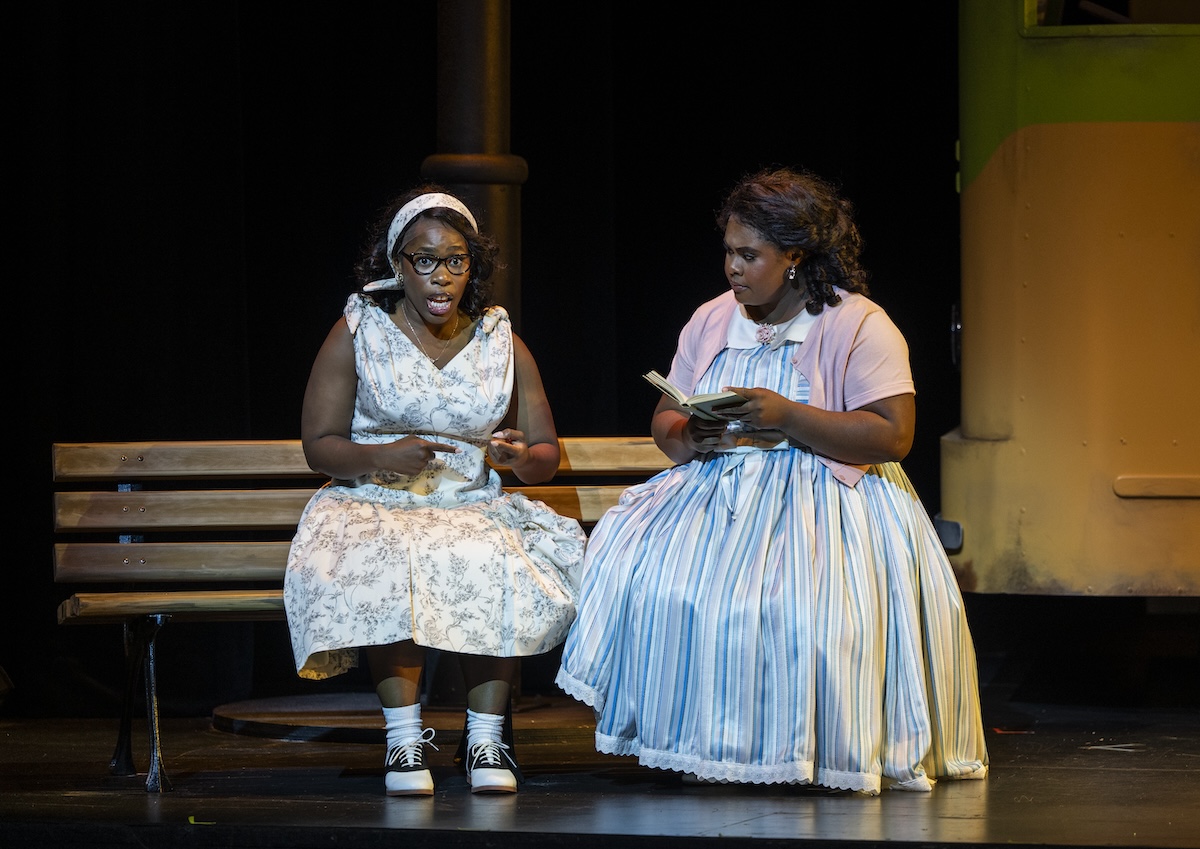

I asked one of my Gen Z friends if they knew about the Montgomery Bus Boycott. Their quizzical expression hit me like a lead weight. The history of the Civil Rights Movement has been reduced to a footnote and made palatable for mass consumption. Just in time, composer Jasmine Arielle Barnes and librettist Deborah D.E.E.P. Mouton have created a headline for those who may have to take up the torch again. Chicago Opera Theater presented the world premiere of She Who Dared on June 3 at the Studebaker Theater. The opera was commissioned by the American Lyric Theater, which also presented The Life and Death of Alan Turing.
Many of us grew up being taught that the Civil Rights Movement was started on the day that Rosa Parks refused to give up her seat to a white person on a Montgomery, Alabama, bus. Barnes and D.E.E.P. have uncovered the story behind the women who lit the Civil Rights torch. There is so much more to the story that until recently has been glossed over, giving glory to the men and a footnote to the women who were the organizers. She Who Dared is the story of 15-year-old Claudette Colvin (Jasmine Habersham), who was first arrested in 1955 (before Rosa Parks' action) for refusing to give up her seat to a white person. It also fleshes out the details of how Rosa Parks (Jacqueline Echols McCarley) was the right image and the right shade of Black to be chosen as the poster child for dignified defiance.
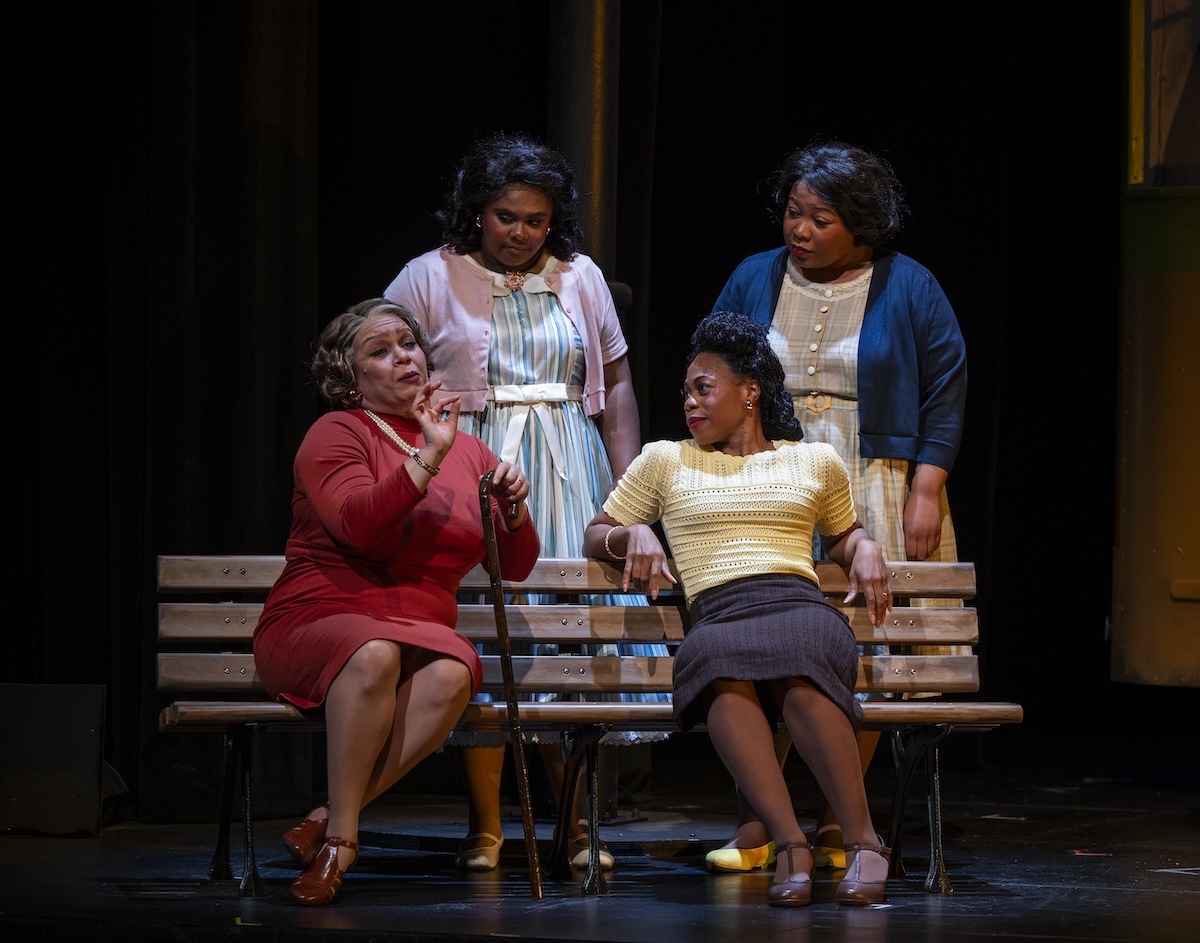
She Who Dared is directed by Timothy Douglas, who brings vast experience in opera and musical theater to this production. It is seamless and well-paced, which is essential for a cast where everyone could be considered a central character. Mezzosoprano Deborah Nansteel plays community organizer Jo Ann Robinson, who was also nudged aside to allow Parks to be the symbol of the movement. Nansteel brings fire and good acting to a pivotal character and a dual role as Alabama lawyer Fred Gray.
Lindsey Reynolds is a soprano to watch. Her performance as Claudette's best friend, Mary Louise Smith, sneaks up on you. Her voice has a creamy texture and tone. Her timbre and flawless enunciation added extra sheen to a wonderful acting role. She and Habersham have great chemistry, effortlessly portraying friends and classmates. Habersham's tear-the-roof-off soprano is in perfect balance with Reynolds's. Their characters have the youthful enthusiasm and fire that come with a sharp edge, which needs time to be refined. Colvin wanted to 'burn it all down,' but was dark-skinned and then got pregnant. That was certainly not the image to be put forth in Eisenhower's America.

Mezzo-soprano Chrystal E. Williams is fire personified as Aurelia Browder, the lead plaintiff in the landmark case of Browder v. Gayle, which effectively struck down the Jim Crow segregated transportation laws and the mayor of Montgomery, W.A. "Tacky" Gayle. Leah Dexter plays Susie McDonald with sass and flair. McDonald could pass for white, which gave her an advantage, but she publicly identified as Black. Dexter is a fine mezzo-soprano who can rock out some gospel. Her character reminded me of women I knew from the South; she has a way with words and a 'don't mess with me' attitude.
Soprano Jacqueline Echols McCarley is great as Rosa Parks. I loved that Barnes and D.E.E.P. gave her character a soupçon of parody. McCarley leans into the comic vein and goes full Technicolor musical when she is chosen to be the face of the "spark." Mezzo-soprano Cierra Byrd gives justice and individuality to multiple characters. Byrd plays the bus driver, the police officer, the judge, a classmate of Claudette, and most touchingly, Jeanetta Reese, who didn't want to be publicly defiant. The fear of reprisal from the racist vigilantes put her on a tightrope. I found that role to be quite powerful. Some people were so fearful that they considered the status quo preferable. Her character is a moment of quiet genius that brings reality back to the surface. The trauma of racism kept some people back in an existence of fear.
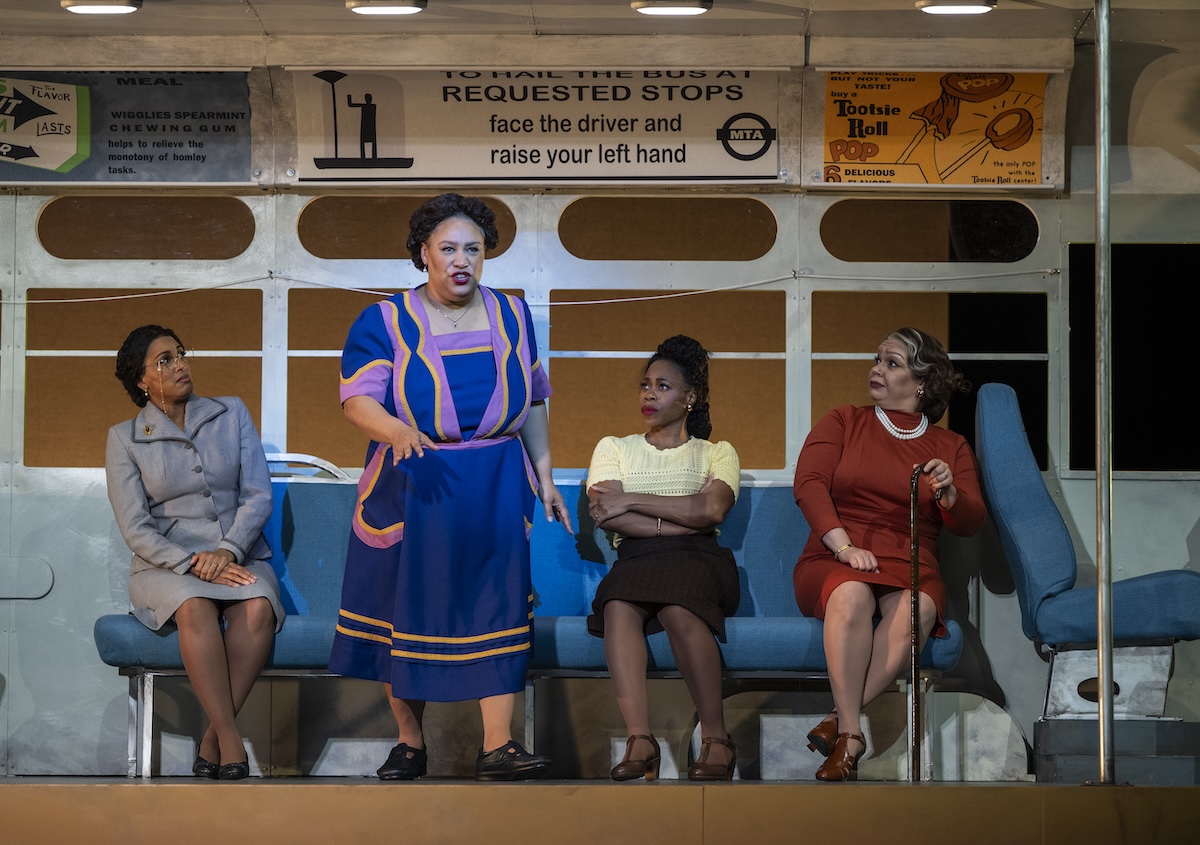
The music is a rousing blend of gospel and classical. The overture and opening number had that vast Americana feel. I could see Pearl Bailey or Ethel Waters suddenly appearing. There are melodic arias with Habersham's soprano ascending and sustaining high notes that turn to a gentle whisper or a call to burn it all down. D.E.E.P.'s libretto is politically on point, with the metaphor of quilting broken pieces of dissent. My favorite quote is "Sometimes things have to be broken to fix them."
The staging of She Wo Dared is deceptively simple. Scenic designer Junghyun Georgia Lee creates a capsule of Montgomery, Alabama, with a cool vintage bus and a bench. It reminded me of the Green Hornet buses that ran the length of Chicago when I was a kid. Hair and makeup designer Rueben D. Echols remains a force in Chicago and national theater. Costume designer Yvonne L. Miranda hit it out of the park with everything, but especially the Rosa Parks look. That hat and peplum suit is iconic from the fingerprinting photo and mugshot.
Conductor Michael Ellis Ingram led an orchestra comprising members of D-Composed, a Black chamber music ensemble that plays and promotes the works of Black composers and musicians. I first experienced them in ROBESOИ: An Electro-Gospel Acid Trip, and the virtuosity was apparent. Barnes' score has flourishes that are not often heard, if ever, in "traditional" operas. The sound of a rattle enhances a scene in She Who Dared. I imagined it as a metaphor for Jim Crow, akin to a deadly rattlesnake. The music is percussion-forward, featuring piano and subtle sounds of triangle, xylophone, or marimba, as well as organ.
Can you imagine getting up three hours early to either walk or wait for a carpool to get to work for pennies on the dollar? The women who organized and lit the torch of the Montgomery Bus Boycott worked as housekeepers, maids, and farmers. They were often verbally abused and forced to subjugate themselves. The men were given the glory and canonization for the movement, while the women did the footwork. Those women are getting much-deserved recognition, and then I recall reading that the lioness undertakes the hunting to provide nourishment for the pride. They were inside the homes of the white people who upheld laws that considered Black people 3/5th human. Black women claimed the other percentage to make the race whole. She Who Dared makes history whole.
She Who Dared by Chicago Opera Theater in partnership with American Lyric Theater runs Friday, June 6, and Sunday, June 8, at the Studebaker Theater in the Fine Arts Building, 410 S. Michigan Ave. The opera is 2 hours and 15 minutes, including intermission. Get tickets and take some young people, if you can, to give them a great history lesson. I highly recommend She Who Dared. For more information, please visit https://www.chicagooperatheater.org. Also, check out the websites for composer Jasmine Arielle Barnes and librettist Deborah D.E.E.P. Mouton.
Support arts and culture journalism today. This work doesn't happen without your support. Contribute today and ensure we can continue to share the latest reviews, essays, and previews of the most anticipated arts and culture events across the city.
